
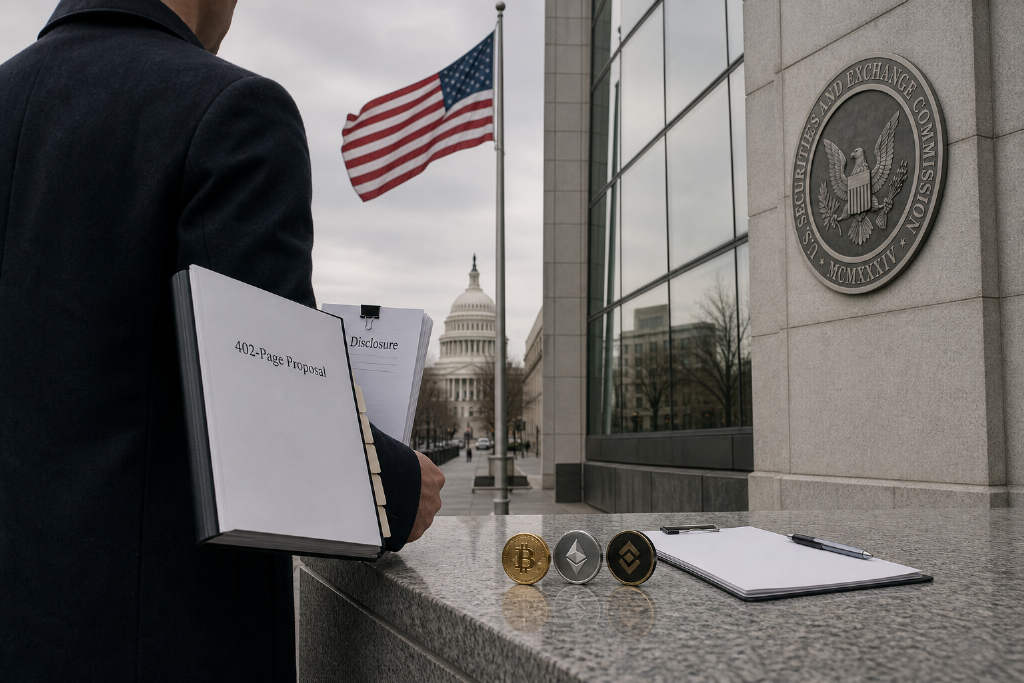
The U.S. Securities and Exchange Commission has released a 402-page proposal on crypto asset regulation built around a simple idea: make issuers lay out the facts and the risks, then let investors make their own call. In the proposal summary, the SEC says the planned issuance framework is meant to support capital formation, adapt to innovation in crypto asset markets, and make sure investors receive the information they need to make informed decisions.
The part likely to draw the most attention is the creation of two exemptions that would allow new crypto projects to issue tokens to users and investors without running afoul of securities laws. As framed in the article, that gives crypto founders a clearer legal route to raise money through token sales in the United States.
Anti-fraud rules would still apply
The proposal does not relax anti-fraud obligations. The SEC says those rules would remain in force whether or not an issuer relies on an exemption, and "bad actors" would be barred from taking part. The point is straightforward: an exemption from securities registration is not an exemption from other legal liabilities. Fraud would still be fraud.
For investors, the key requirement is disclosure. The SEC proposes that any issuer using either exemption must make public, principle-based narrative disclosures. The agency’s role, under that approach, is not to decide whether a token is a good investment. It is to make sure investors have the material information needed to judge that question for themselves.
A return to the SEC’s original philosophy
The article places the proposal in a longer history of U.S. securities regulation. In a 1933 message to Congress, Franklin D. Roosevelt said the federal government could not and should not do anything that might be read as approving or guaranteeing the soundness of newly issued securities, or assuring that their value would hold or that the assets behind them would be profitable.
At the same time, Roosevelt argued that every new security sold in interstate commerce should come with full publicity, and that no important element related to the issuance should be withheld from the buying public. The article describes that framework as adding seller responsibility to the old rule of caveat emptor: buyers bear risk, but sellers must also bear the burden of telling the whole truth. In that telling, securities regulation should protect the public while interfering as little as possible with honest business activity.
That is the essence of disclosure regulation. Investors get the facts needed for an informed decision, and the regulator stops short of making the decision for them.
Different from state-level merit review
The article contrasts that model with the merit review approach that many U.S. states once used. Under that system, regulators judged the perceived fairness or quality of securities as investments.
It cites Texas and Wisconsin as examples where regulators could, and often did, block proposed offerings because they believed the securities were overpriced or otherwise unfair to investors. The SEC, by contrast, judged proposed offerings on the quality and completeness of the disclosure.
Brandeis and Joseph Kennedy on what disclosure is for
The article traces that lighter-touch model to legal scholar Louis Brandeis. Writing in 1914, he argued that securities should be regulated the way food was regulated. The Federal Pure Food law did not guarantee quality or price; it required disclosure of ingredients so consumers could decide for themselves. Brandeis believed the same logic could work for securities if information was made easily available.
He wrote that facts must actually be conveyed to investors, and that the best way to do that was to require clear and prominent statements in every notice, circular, letter and advertisement inviting people to buy. Compliance, in his view, had to be mandatory and not waivable by the investor. He then added the line that became famous: "Sunlight is said to be the best of disinfectants; electric light the most efficient policeman."
When the SEC was created two decades later, its first chair, Joseph Kennedy, described the same basic mission. The securities law, he said, did not make the government an appraiser of values. It did not give advice and did not signify approval. What it did was create an office where company executives had to file information in response to required questions, so that before anyone asked the public to invest, there would already be a record in Washington of the material facts needed for judgment.
Peirce said the SEC drifted away from that mandate
The article also argues that the SEC did not always stay close to that founding principle. It cites a 2024 speech by SEC Commissioner Hester Peirce, who said the agency had drifted away from its original disclosure-based mandate.
According to the piece, Peirce said that as the rulebook expanded at record speed in this century, the Commission’s regulatory style became more prescriptive. Some directives came from statute, but many were products of SEC discretion. Public companies were left with ever longer disclosure checklists, and some mandatory requirements seemed aimed more at changing how companies operate than drawing out material disclosure.
She added that Congress did not design the SEC to be a merit regulator and urged the agency to return to its original disclosure-centered role. In the article’s framing, the new crypto asset proposal does exactly that by relying on disclosure to let investors assess risk on their own.
How disclosure standards might take shape
The proposal would require crypto projects selling tokens under an exemption to make disclosures, but it does not prescribe exactly how those disclosures must be made. It remains unclear whether the final rules will include a more detailed disclosure format. The article says the SEC could choose to recognize an industry standard, much as it has done in accounting and compliance.
One existing model is already in view: Blockworks’ Token Transparency Framework, or TTF, which the article describes as the first open-source disclosure standard for digital assets.
TTF filings are already part of due diligence for some firms
Since its launch in June 2025, 75 protocols have voluntarily submitted standardized disclosure documents to TTF, according to the article. The framework includes a one-time "B-1" filing submitted around the time a token first begins trading, compared in the piece to an S-1 filed before an IPO.
It also includes a "B-2" filing used to keep information current, described as similar to a 10-K. Beyond the issuers themselves, 69 industry participants, including exchanges, custodians and asset managers, have joined the Transparency Alliance, which is working with Blockworks on common disclosure standards for digital assets.
The article says those participants represent more than $400 billion in combined market capitalization and have made TTF filings a core input in their due diligence process. For asset managers, those documents are not the end of the investment process. They are the starting point. As Blockworks put it, "Each filing assesses completeness, not quality."
That line captures the larger point running through the SEC proposal: the regulator sets the expectation for disclosure, but it does not substitute its judgment for the investor’s.