
The U.S. Securities and Exchange Commission’s Division of Corporation Finance has released a new FAQ on how federal securities laws apply to certain types of crypto assets and related transactions. The document is not a formal SEC rule or commission statement and does not have legal force, but it gives a more detailed view of how the agency is drawing the line between a non-security crypto asset and an investment contract.
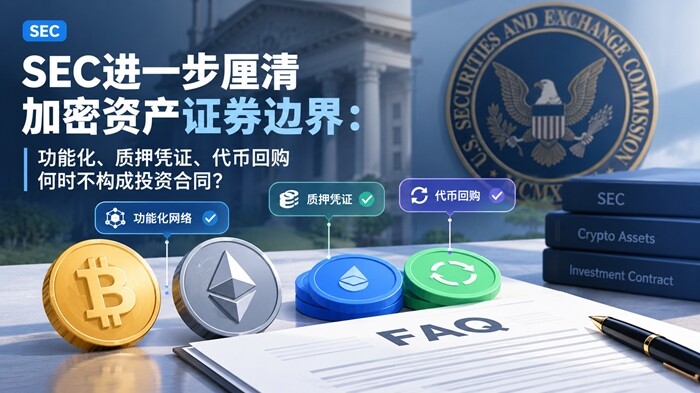
The FAQ takes up a set of questions that have remained unsettled in earlier SEC interpretive materials. It covers functional networks, decentralization, staking receipt tokens, redeemable wrapped tokens, token buybacks, marketing statements, and whether a secondary trading platform can be treated as a promoter. Running through the document is a basic question: once a crypto system is functional and centralized control has been reduced or no longer exists, when do maintenance, upgrades, and network-effect efforts stop counting as the kind of “essential managerial efforts” that matter under the Howey test?
How the SEC staff frames “functional” and “decentralized”
In Question 1, the staff addresses the relationship between the definitions of “functional” and “decentralized” used in earlier interpretive guidance and the way an issuer may define or describe those terms in its own promotional materials when offering an investment contract.
The answer is that the SEC staff’s definitions are not what determines whether an issuer has fulfilled its own statements or commitments. For that purpose, each issuer sets the standards it says must be met to reach functionality and or decentralization. In other words, the agency’s interpretive definitions do not replace the benchmarks an issuer may have established for itself in its own representations to buyers.
Staking receipt tokens and what counts as a “receipt”
Question 2 turns to staking receipt tokens. The staff says that if a staking receipt token is issued as a receipt for a digital commodity that is not subject to an investment contract, the token itself is a digital instrument because it serves the practical function of evidencing the holder’s ownership of the underlying digital commodity.
The FAQ also says that a staking receipt token issued by a protocol-based liquid staking provider may be classified as a digital commodity. In that setting, the token is tied internally to the programmatic operation of a crypto system that has already become functional, and its value comes from that operating mechanism together with supply and demand.
Question 3 expands on the use of the term “receipt” for staking receipt tokens and redeemable wrapped tokens. The staff describes a receipt as an instrument showing that a specified amount of assets has been deposited with the depository institution or custodian that issued the receipt, while also showing that the depositor retains ownership of those assets.
According to the FAQ, a receipt does not alter any of the rights, obligations, or interests attached to the deposited asset. It also does not give the holder any extra financial incentive or benefit.
The staff draws a sharper distinction from other financial instruments as well. A receipt does not transfer ownership or control of the deposited asset to the issuer of the receipt. Because of that, the issuer may not transfer, lend, pledge, rehypothecate, or otherwise use the deposited asset for any reason, and may not expose it to claims by third parties.
When marketing statements may count as managerial promises
Question 4 deals with promotional and marketing materials. Earlier interpretive guidance had said that statements or commitments are more likely to create a reasonable expectation of profits when they clearly and unambiguously describe the issuer’s essential managerial efforts, include enough detail to show the issuer can carry out the proposed project, and explain how those efforts would generate the profits buyers reasonably expect.
In the new FAQ, the staff says whether marketing statements amount to promises of essential managerial efforts depends on the specific facts and circumstances.
Still, the document gives two important clarifications. First, simply promoting the current utility and functionality of a crypto system may not amount to a statement or commitment to undertake essential managerial efforts, absent other factors. Second, if promotional activity does not tout potential profits and instead uses uncertain, aspirational language about utility, functionality, and capabilities the system may have in the future, that too may not amount to such a statement or commitment, again absent other factors.
A third party taking over obligations does not break the investment contract link
Question 5 addresses a continuation scenario. A non-security crypto asset may initially have been offered and sold as part of an investment contract. If buyers no longer reasonably expect the issuer to fulfill or continue the essential managerial efforts described in its statements or commitments, the asset may no longer remain subject to that investment contract framework.
The FAQ says that does not happen merely because another party takes over those statements or commitments. If a third party assumes the issuer’s obligations to carry out essential managerial efforts, whether voluntarily or by operation of law, the non-security crypto asset does not separate from the related investment contract on that basis.
What activity after functionality does not satisfy Howey
Question 6 focuses on the reality that software and networks are often in continuous development. Maintenance and upgrades continue, and a functional crypto system may still need to grow through network effects.
The SEC staff says it has recently stated that once a crypto system is functional, activities that provide security, maintenance, improvement, or enhancement for the system or its functions, or that promote network effects, do not involve essential managerial efforts. That remains true whether those activities are carried out by initiating or funding development projects or through similar means.
As a result, once the system is functional, any statements or commitments by the issuer to provide, continue providing, or arrange for others to provide those services would not satisfy the Howey test. The FAQ cites Regulation Crypto Assets, Release No. 33-11434, dated Aug. 18, 2026, and 91 FR 54510, 54525, dated Aug. 21, 2026.
Why a new investment contract is less likely without a controlling actor
Question 7 asks whether an issuer’s statements could create a new investment contract that would subject a native crypto asset to that contract if the crypto system is already functional and no person or entity can centrally control, manage, or materially influence the system’s operation or success.
The staff’s answer is that this is generally unlikely. If no issuer or other person can control the functional crypto system, then no one is in a position to take actions that would affect the system’s success or failure in the way contemplated by the investment contract analysis.
Token buybacks are not automatically promises of profit
Question 8 addresses buyback programs for non-security crypto assets. The FAQ notes that issuers may pursue buybacks for several reasons, including treasury management, reducing supply, burns supported by protocol funds, and rebalancing.
The staff says that if the crypto system is already functional, an issuer’s announcement of a buyback program for a non-security crypto asset does not amount to a promise to investors that the issuer will generate returns for the project or token through its own managerial or entrepreneurial efforts.
But the answer changes if the system is not yet functional. In that case, if the issuer describes the buyback as something that can create gains or returns for token holders, the announcement may amount to that kind of promise.
When a secondary trading platform may be a promoter
Question 9 turns to secondary market platforms. Earlier interpretive guidance said that an “issuer” includes affiliates and agents of the issuer or promoter.
In the FAQ, the SEC staff says a platform that provides a secondary market for a crypto asset will be treated as a promoter only if it meets the definition of “promoter” in Securities Act Rule 405.
The document is not framed as a simple list of which tokens are or are not securities. Its focus is narrower and more technical: how crypto assets relate to investment contracts in specific settings, and what kinds of conduct may not keep those assets within the investment contract framework. For crypto issuers and market participants, the answers touch token issuance, marketing, network operations, and buyback design, and offer a new reference point for reading the boundaries of U.S. crypto securities regulation.