
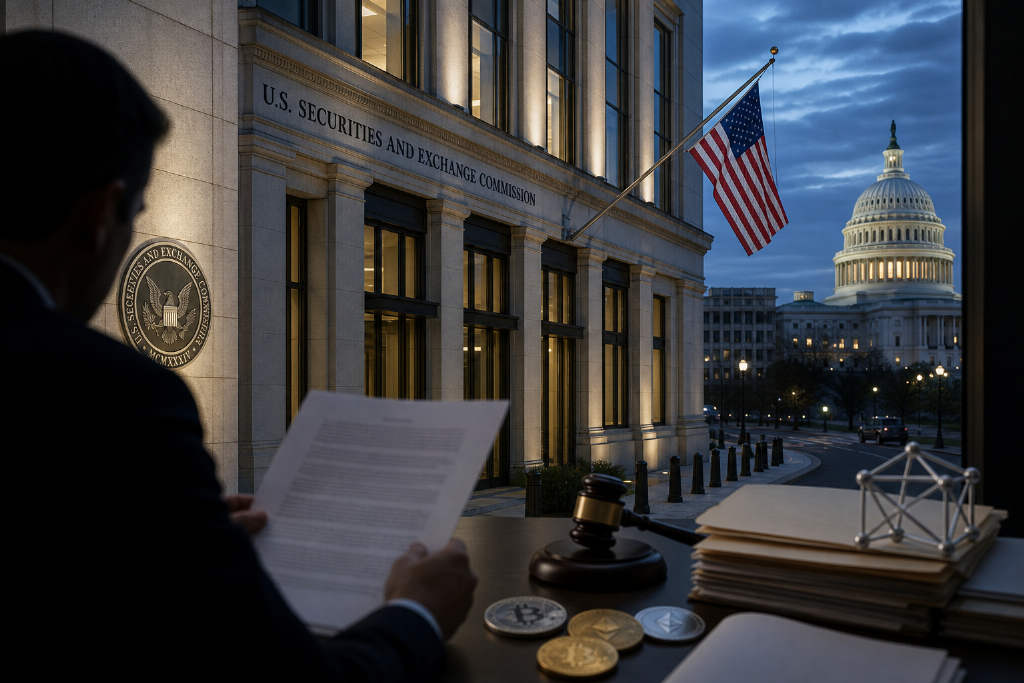
The U.S. Securities and Exchange Commission on Tuesday released a proposal for “Regulation of Crypto Assets,” its first rule written specifically for crypto asset fundraising and the treatment of “investment contracts.” Under the draft, some issuers would be able to raise money if they meet stated conditions without running afoul of the Securities Act.
The proposal marks the SEC’s first attempt to write a dedicated rule for digital assets. It also arrives while Congress has yet to complete legislation on the Digital Asset Market Clarity Act, or the CLARITY Act, making the agency’s move an effort to put a regulatory structure in place before that process is finished. The release drew added attention because the SEC had previously canceled a meeting scheduled for Aug. 14 to discuss the proposal, citing a scheduling conflict, before issuing it without prior notice.
SEC Chair Paul Atkins said: 「Today, we are opening a new chapter through a series of exemptions. This will promote capital formation and allow crypto asset innovation to thrive in the United States over the next several years.」
Two exempt fundraising tracks
According to the proposal, the SEC has outlined two exempt fundraising mechanisms for crypto token issuance, each tied to a different scale of capital raising and a different level of regulatory obligations.
The first track is aimed at startups. Eligible issuers would be allowed to raise up to $5 million over a four-year period. Companies using that route would need to file public documents at the beginning and end of the offering and disclose required information to investors.
The second track raises the limit sharply, allowing offerings of up to $75 million a year. That route comes with stricter disclosure and ongoing reporting requirements. In addition to filing public offering information, issuers using the second exemption would have to disclose their financial condition and comply with continuing reporting obligations, placing the framework closer to the SEC standards applied to some investment contracts.
The SEC said issuers using either exemption must provide investors with principles-based narrative disclosures. Issuers relying on the second track would also need to provide financial statements, meet ongoing reporting duties, and comply with securities law provisions covering fraud and market manipulation.
Safe harbor seeks to define when an asset stops being an investment contract
A separate part of the proposal is likely to draw equal attention. The SEC is trying to clarify when a crypto asset should be treated as an “investment contract,” and under what conditions it can move outside that securities law framework.
Under U.S. securities law, an investment contract falls within the definition of a security. That question has been at the center of many disputes between the crypto industry and the SEC in recent years: if a token was initially issued through a fundraising process, does that mean it must remain subject to securities law on a continuing basis?
To address that issue, the SEC has proposed a safe harbor. Paul Atkins said that, consistent with the SEC’s earlier interpretive guidance, a token could qualify for the safe harbor if the issuer has completed, or permanently stopped, the “essential managerial efforts” promised in the investment contract.
In practical terms, the proposal says that once a project team has formally stepped away from those managerial functions and specific conditions are met, the related investment contract would no longer be viewed by the SEC as a potential security.
60-day comment period now open
The SEC has opened a 60-day public comment period on the proposal and is inviting feedback from industry participants and the public. According to the report, the agency typically spends several months reviewing and organizing those submissions before deciding on a final version of the rule.