
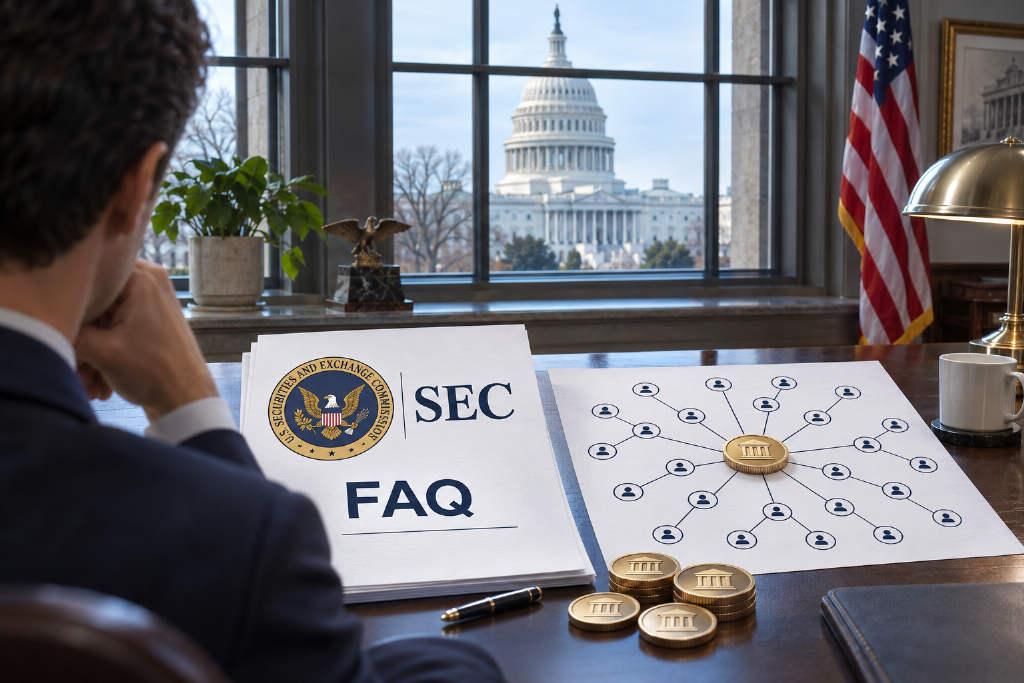
The U.S. Securities and Exchange Commission updated its frequently asked questions on Nov. 2, 2026 on how federal securities laws may apply to governance tokens, adding three responses focused on governance participation, network control, and decentralization standards.
The move addresses a question that has followed crypto projects for years: if voting rights are spread across a large base of token holders, can regulators still view those holders as a control group, and could that shape whether a token is analyzed as a security or a digital commodity?
The new FAQ builds on the SEC’s March statement
The update rests on an interpretive statement the SEC released on March 17, 2026. That statement set out a framework for classifying crypto assets by drawing a line between centralized and decentralized systems and introducing the idea of a "central party."
Under that framework, a central party is an individual, entity, or group with operational, economic, or voting control over a crypto system. For projects governed through decentralized autonomous organizations, or DAOs, that definition has carried obvious weight because token holders often vote on protocol parameters, treasury use, and upgrade proposals.
If thousands of holders were treated as one coordinated bloc, a system would have a harder time meeting a decentralization standard, and its governance token could face a greater chance of falling within securities law.
Staff says unilateral control remains the key test
The Nov. 2 FAQ draws a clearer line on that point. SEC staff said token holders who participate in governance generally would not be treated as a "group" within the definition of a central party if they are not affiliated and do not have a separate agreement, arrangement, or understanding to act together. The guidance says that can include coordination through delegation.
The FAQ adds that even if token holders are viewed as a group in some factual settings, they still must possess actual operational, economic, or voting control to satisfy the central-party standard.
It then gives a more concrete description of what that control looks like. A central party, the FAQ says, would have unilateral power at the protocol layer, validator layer, or user layer, including the ability to control access, change voting procedures, determine validators, modify code, reverse transactions, or restrict access.
That means broad voting participation alone is not enough to establish centralized control. The deciding issue is whether any person, entity, or group can exercise one-sided control over the system.
The authors of the FAQ also made a point of limiting its reach. They said the answers reflect staff views only, not a Commission rule or position, and they carry no legal force or new obligations.
Broad governance does not automatically create a control group
Uniswap has become a common reference point in this discussion. UNI holders can vote onchain on matters such as protocol fee parameters and treasury allocations.
The SEC said broad governance, even when it operates through a foundation or association, does not necessarily mean participants form a control group. That gives projects using similar legal structures some room in how they explain their governance setup.
Still, the FAQ does not name any specific project, and it does not say UNI or any other token is automatically a digital commodity. Projects still need to show that voting power is widely distributed and that no small faction can unilaterally rewrite rules, restrict access, or overturn decisions.
Guidance arrives after the CLARITY Act failed in the Senate
The update comes after a setback in Congress. The CLARITY Act, a bill intended to clarify the division of regulatory authority over crypto assets, failed in the Senate in September 2026 by a 49-50 vote.
In the weeks that followed, the SEC continued to issue classification guidance through staff FAQs and other documents. The next step in Congress will depend on the makeup of the new legislature after the midterm elections.
That has left staff guidance filling part of the gap. It has also fueled debate over how far an administrative agency should go in shaping the practical boundaries of regulation while legislation remains stalled.
DAO teams get a more detailed compliance reference point
For Web3 and DAO organizations, the clarification reduces one specific area of regulatory uncertainty. Where voting rights are genuinely dispersed and there is no hidden coordination agreement, collective voting itself is less likely to be used directly as evidence against decentralization.
Exchanges, market makers, and institutional investors may also get a more usable framework when assessing these tokens, which could reduce some of the caution tied to regulatory ambiguity.
For DAO design, the update points to several areas that may draw closer attention:
- whether voting power is broadly distributed,
- whether proposal and execution processes are transparent,
- whether any single entity or affiliated group holds unilateral veto or amendment power.
The article also notes that projects using legal structures such as DUNA may now have clearer language to reference in future compliance discussions.
Reaction on X was split
Comment on X was divided. Miles Jennings of a16z described the update as a helpful clarification, saying it adds detail to the token classification framework and shows that a system can use legal entities such as DUNA while keeping decentralized governance.
Some users saw the move as a positive signal for decentralized finance, or DeFi, and DAOs, arguing that it speaks to the uncertainty long faced by projects such as Uniswap and could offer a more predictable regulatory reference for open governance.
Others focused on the limits. They noted that the document is staff guidance only, has no legal force, and does not classify any specific token. Some commentators also pointed out that with the CLARITY Act stalled, the SEC staff has kept advancing interpretation through FAQs. That may provide short-term clarity, but it also highlights the administrative lead created by the absence of legislation.
Another point raised in the discussion was that judgments around "acting together" and "broad distribution" still depend heavily on the facts of each case, leaving substantial room for interpretation in practice.
Delegation and staking relationships remain a gray area
The article gives a simple example: delegating tokens to one’s own staking operator remains a complicated relationship under the current interpretation. At least for now, there is no clear case law or statutory text that settles whether that arrangement is decentralized enough.
Overall, the FAQ gives the market a more detailed reference point for analyzing governance tokens, especially when separating independent voting from collective control. It eases part of the regulatory concern around DAO governance structures and gives projects language they can cite in structural design and compliance discussions.
But the update does not remove all uncertainty. Its non-binding nature remains, and many judgments still turn on case-specific facts. For Web3 projects, the real distribution of voting power, the possibility of unilateral control, and the direction of future legislation and enforcement still matter.



