SEC
Nov 3, 2026

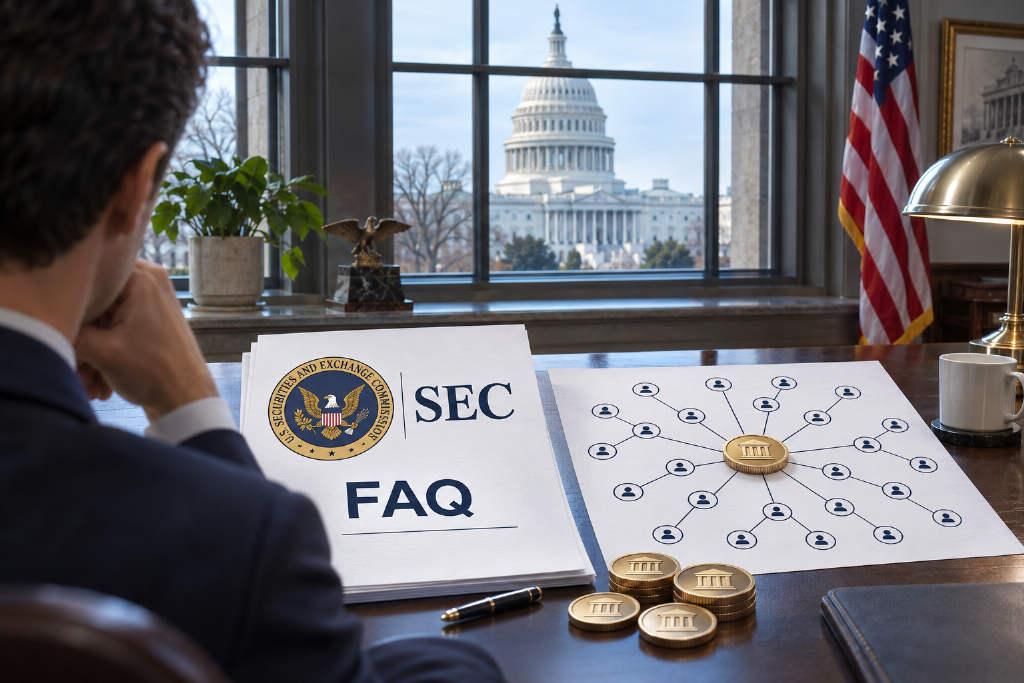
SEC FAQ says dispersed token voting does not by itself amount to collective control

The U.S. Securities and Exchange Commission updated its FAQ on Nov. 2, 2026 covering how federal securities laws may apply to governance tokens, adding three new responses on governance participation, network control, and decentralization standards. The update addresses a long-running question in crypto: whether giving voting rights to a large number of token holders could cause regulators to treat them as a coordinated control group, affecting whether a token is viewed as a security or a digital commodity. According to the SEC staff guidance, token holders who take part in governance generally would not be treated as a "group" under the agency’s concept of a central party if they are not affiliated and have no separate agreement, arrangement, or understanding to act together, including through delegation. Even if they were viewed as a group in some fact patterns, they would still need to hold actual operational, economic, or voting control to meet that standard. The FAQ also says a central party implies unilateral power at the protocol, validator, or user level, such as the ability to control access, change voting procedures, choose validators, modify code, reverse transactions, or restrict access. The SEC staff added that the FAQ reflects staff views only, not a Commission rule or formal position, and it does not create legal obligations or classify any specific token.

740
SEC FAQ says dispersed token voting does not by itself amount to collective control
a16z
Aug 1, 2026

a16z Says DUNA Could Give DAOs a Native Legal Form as a New Organizational Model

a16z crypto argues that DUNA, short for decentralized unincorporated nonprofit association, could become a viable legal structure for internet-native organizations that do not fit neatly into traditional corporate forms. In a long essay tracing the history of business organization from medieval merchant networks and commenda arrangements to corporations, cooperatives, and LLCs, the firm says the core challenge has remained the same for centuries: how to let people with different incentives, limited information, and no preexisting trust coordinate around a shared goal. The article says corporations solved many of the coordination and capital formation problems of earlier eras, but they also rely on centralized management and create classic principal-agent conflicts. DAOs offered a different path by using software rules and collective governance, yet they have struggled with low participation, power concentration, uncertain legal status, and securities law risk in the United States. a16z says the lack of legal recognition also leaves DAO participants exposed to potentially unlimited personal liability. Against that backdrop, the firm presents DUNA as a legal wrapper designed for decentralized governance. It says Alabama, West Virginia, and Wyoming have authorized the structure, with Wyoming passing its law in March 2024. According to the essay, DUNA provides legal personhood, limited liability, perpetual existence, and state recognition, and has already been adopted by groups including Uniswap Governance and Nouns DAO.

2520
a16z Says DUNA Could Give DAOs a Native Legal Form as a New Organizational Model
ChainFeeds
Jul 31, 2026

ChainFeeds roundup tracks China venture capital, Coinbase reshuffle, token value capture, Robinhood earnings, and DUNA

ChainFeeds’ July 31 research roundup brought together five pieces that cut across venture capital, exchange strategy, protocol economics, earnings, and legal structure in Web3. One report examined China’s tech investment system outside Silicon Valley, arguing that sectors such as open-source AI, biotech, and robotics are gaining ground while founders operate under tighter financing and exit pressure. Another focused on Coinbase, where a month of executive changes pointed to a shift from fighting regulators toward helping shape rules, while the company pushes its “Everything Exchange” plan and leans harder into AI internally and in product design. A third piece from Castle Capital argued that strong protocol revenue does not automatically translate into token performance, especially when inflation, unlocks, and incentive emissions dilute value capture. The roundup also highlighted Robinhood’s second-quarter earnings call, where the company posted record revenue, profit, and funded customer growth while discussing tokenized stocks, Robinhood Chain, and stablecoin lending. The final essay, from a16z, argued that DUNA could become a new legal form for internet-native organizations by giving decentralized groups recognized legal status and limited liability in parts of the United States.

2610
ChainFeeds roundup tracks China venture capital, Coinbase reshuffle, token value capture, Robinhood earnings, and DUNA