
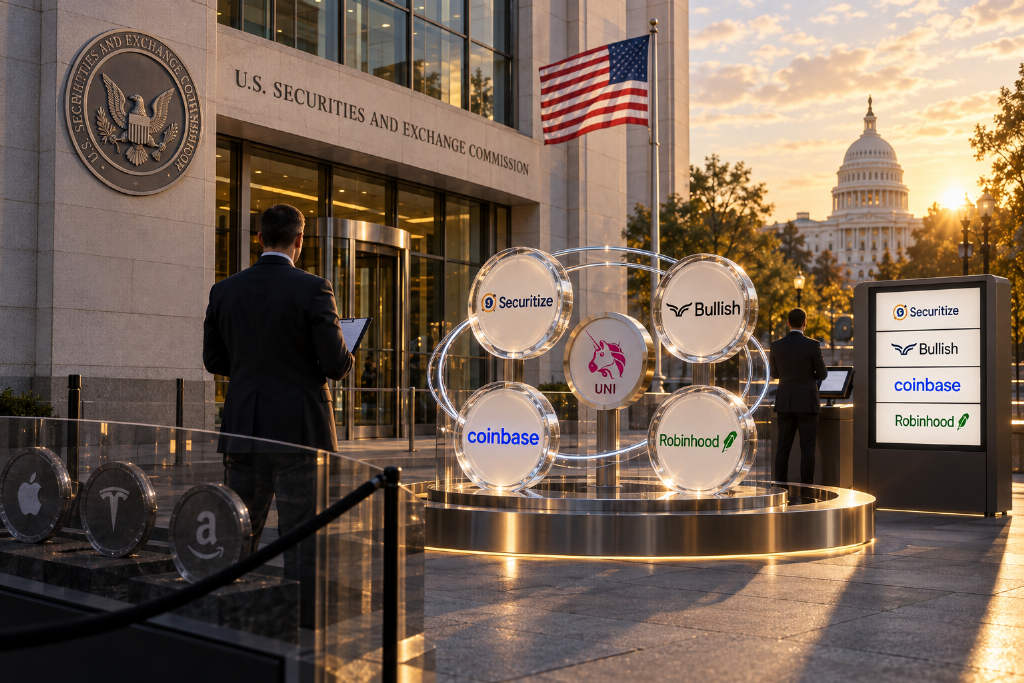
The U.S. Securities and Exchange Commission has issued an "Innovation Exemption" order that opens a five-year compliance route for on-chain trading of tokenized U.S. equities. SEC Chair Paul Atkins said in a statement, "Today, the U.S. Securities and Exchange Commission is taking an important step to bring America's capital markets into the digital age."
Under the order, compliant Tokenized Securities Venues, or TSVs, will be allowed to facilitate on-chain trading of tokenized National Market System stocks through permissioned automated market maker, or AMM, liquidity pools. The venues themselves, along with market makers supplying liquidity to those pools, receive temporary relief from being classified as "exchanges" and "dealers" under the Securities Exchange Act of 1934.
The response was immediate across the real-world asset and tokenization sector. Securitize rose nearly 15% in a single day, Bullish gained more than 6%, and Coinbase and Robinhood also moved higher. Uniswap's governance token UNI at one point climbed close to 18% over 24 hours. The market broadly read the move as a major easing in the U.S. approach to on-chain securities trading.
The order also lands after the CLARITY Act stalled in the Senate, leaving broader crypto legislation in procedural deadlock. In that setting, the SEC's exemption authority has become a way for Chair Atkins, Commissioner Mark Uyeda, and Commissioner Hester Peirce, who leads the agency's Crypto Task Force, to move a digital-market agenda forward without waiting for Congress.
A five-year test for Tokenized Securities Venues
At the center of the order is a conditional exemption for a specific category of on-chain platform: Tokenized Securities Venues. A TSV that uses a permissioned AMM and liquidity pools to trade tokenized NMS stocks can avoid being treated as an exchange under the 1934 Act. A liquidity provider that uses its own capital to supply tokenized NMS stock into those pools can also avoid dealer treatment.
The relief lasts five years from publication. The Commission framed the program as a controlled experiment. It wants to observe how these venues operate, collect data that could support future rulemaking or legislation, and preserve the ability to tighten the framework if necessary.
Uyeda said the SEC's use of exemptive authority to support innovation follows an established path. In his words, it is "a tried and true path," and he pointed to money market funds, index funds, and ETFs as products that grew after early Commission use of exemptive authority.
The operating conditions attached to the exemption
The order does not grant open-ended relief. TSVs must satisfy a detailed set of conditions.
- Listed symbols and trading volume are subject to limits tied to limit-up, limit-down bands.
- Each tokenized stock must provide holders with the same economic and governance rights as a traditional NMS stock, including dividends and voting rights.
- Smart contracts used by the venue must be auditable, public, and deployed on a public, permissionless distributed ledger.
- If the underlying stock is halted on the primary market, on-chain trading must halt as well.
- The venue must publicly disclose operational and trading activity information and regularly report U.S. dollar-denominated transaction prices, size, time, pool addresses, and end-of-day pool balances to reduce information asymmetry and support regulatory monitoring.
That structure makes clear the SEC is not giving tokenized stock trading a blank check. Access rules, disclosure, smart-contract transparency, and market synchronization all remain central to the framework.
Two hard lines: issuer veto power and the exclusion of synthetic products
The most consequential boundaries in the order are two explicit red lines.
First, issuers get veto power. If a TSV wants to list a third-party tokenized stock that it does not control, it must notify the issuer in writing and wait 30 days. If the issuer objects, the token cannot rely on the exemption.
Second, synthetic instruments are outside the framework. Products that only track stock prices but do not carry actual shareholder rights are not covered.
Those limits reflect a dispute that surfaced this summer. AMC Entertainment CEO Adam Aron publicly criticized Robinhood for launching AMC-related stock tokens without the company's participation. Robinhood CEO Vlad Tenev argued that public companies do not control third-party products that reference their stock. The issuer veto now written into the SEC order shifts a key part of tokenization control back to listed companies.
Why the SEC moved now
The order follows a sequence of tokenization-related developments. In March, the SEC approved Nasdaq's tokenized stock rule. In April, a similar rule for the New York Stock Exchange was approved. Depository Trust & Clearing Corporation, or DTCC, also started a tokenized asset pilot and plans limited production trading in July, followed by a broader launch in October.
This week, the CLARITY Act, designed to provide a broader legal framework for the crypto market, stalled in a procedural Senate vote after falling short of the 60-vote threshold. With the legislative route narrowing, administrative exemptions have become a practical tool for Atkins. Earlier, in August, the SEC had already proposed allowing some crypto firms to receive relief from securities offering rules, a move seen as part of the same strategy.
The market-structure shift behind the exemption
In practical terms, the order points to a change in market structure. Tokenized equities can trade 24/7, settle almost instantly, support fractional ownership, and allow users to self-custody. That weakens the trading-hour and clearing barriers that traditional brokerages have long relied on.
Atkins described the move as a first step toward bringing U.S. capital markets into the digital age. The article cited CoinMarketCap data showing that the tokenized stock market has expanded from only a few million dollars at the end of 2024 to more than $6.4 billion now, with almost all of that growth coming from retail participants.
Industry reaction split along obvious economic lines
Once the framework was released, reactions quickly split according to who stands to gain a compliant path into on-chain securities.
Supporters include firms building "real stock" tokenization products. Carlos Domingo, CEO of digital asset and RWA tokenization platform Securitize, called it "an extremely positive step because it provides a path to trade real tokenized stocks." He said the framework "reinforces the issuer-led logic of tokenization and will accelerate adoption of native tokenized securities."
Dinari CEO Gabo Otte focused on the meaning of tokenized equity itself. He said the SEC is drawing an important line around what tokenized equity should represent: "Putting stocks on-chain should not mean stripping away the rights that make them stocks."
Joris Delanoue, co-founder of compliance-focused on-chain transfer agent Fairmint, said issuer veto power is a key protection. Ladan Stewart, global head of fintech at White & Case, described the exemption as a "major victory" for the crypto industry because it gives crypto firms a path to combine trade execution and clearing without taking on the full rule set applied to registered intermediaries.
Grayscale's Zach Pandl said he expects the exemption to create "more utility for tokenized assets." Superstate founder Robert Leshner said issuers are likely to redesign products over the coming months to fit the rules.
DeFi gets a boost, but not a blanket pass
The order also created an opening for a narrow slice of DeFi infrastructure. Uniswap founder Hayden Adams amplified and backed comments from Commissioner Peirce, saying truly autonomous software-driven decentralized systems do not need an exemption, and that this corresponds to standard permissionless Uniswap.
In practice, though, the exemption applies to permissioned pools on Uniswap v4. That creates a compliant route for certain assets and users to trade in the United States through permissioned liquidity structures. Uniswap said it plans to submit a comment letter with suggested improvements.
Peirce drew the line clearly through the Crypto Task Force: "This is not about DeFi." She said TSVs represent only one model for on-chain securities trading and that the Commission remains open to others. That leaves genuinely decentralized systems outside the direct scope of the exemption rather than newly authorized by it.
Wall Street and rule-focused critics are pushing back
The strongest opposition has come from traditional market participants and those wary of changing core market structure through one-off relief. Citadel Securities and the Securities Industry and Financial Markets Association, or SIFMA, publicly opposed using special exemptive treatment to push through this kind of structural change. They argued that such changes should go through formal rulemaking. Citadel had also warned earlier that tokenization could siphon liquidity away from public markets.
Even inside crypto, the language has been cautious. Thomas Cowan, global head of Bullish's tokenization business, referred to the framework as not fully open. Peirce's own description of TSV as only one model points in the same direction. Whether the five-year program becomes permanent or gets rolled back will depend on the data produced by the experiment, not on industry enthusiasm alone.
Who stands to gain the most
First tier: direct beneficiaries with a U.S. compliance route
The clearest winners are AMM protocols that support permissioned pools, especially Uniswap v4. The exemption explicitly recognizes permissioned AMM liquidity pools as lawful trading infrastructure for this use case. Because Uniswap v4 is modular and can support whitelisted pools, institutions can build isolated and controlled pools that meet TSV requirements on access, auditability, and reporting.
That benefit has limits. The tailwind applies to institutional permissioned pools, not to ordinary permissionless decentralized exchange pools. Native public pools remain outside the exemption. Other DEXs such as Aerodrome and Raydium would need to build permissioned and segregated pool modules if they want to enter the TSV business, because current versions do not automatically qualify.
The second set of direct beneficiaries includes tokenized securities service providers such as Securitize and Bullish. Securitize, already a major player in digital securities, jumped first in the market. Firms in this category already have experience in token issuance, custody, and compliance filings, which positions them to operate TSVs: working with issuers on tokenized stock issuance, building the venue, connecting to market makers, and handling KYC access controls, reporting, and issuer communication.
Bullish, which previously acquired securities transfer services firm Equiniti, has already added parts of the traditional securities registration and clearing stack. That gives it the building blocks needed to shift toward a TSV model as well.
A third group of direct beneficiaries includes institutional custody, audit, and on-chain data providers. Because the TSV framework requires auditable smart contracts, public trade data, and verified participants, smart-contract security auditors, compliant custodians, and blockchain trade-data analytics providers are likely to see new business demand from institutions.
Second tier: indirect beneficiaries that still need product changes
Crypto exchanges including Coinbase, Robinhood, Kraken, and Gemini have already offered tokenized stocks offshore, but not to U.S. users. Hyperliquid, a leading on-chain perpetuals venue, has also been discussing a domestic route with regulators. The exemption gives those firms a reason to believe tokenized equity products could return to the U.S. market, and Coinbase and Robinhood both traded higher on the day.
Still, most existing offshore stock-token products are synthetic in nature and fail the framework's requirement for real underlying rights. To benefit from the new route in the United States, those products would need significant restructuring.
Public blockchains such as Ethereum, Solana, and BNB Chain could benefit indirectly as settlement networks because the SEC framework explicitly refers to public, permissionless distributed ledgers. That positioning could let them capture spillover from compliant tokenized stock activity.
Third tier: pressure on synthetic products and traditional brokerages
There are losers as well, and the dividing line is the one between real stock and synthetic exposure. Purely synthetic tokenized stock products that offer price exposure without shareholder rights are excluded outright. The article pointed to Ondo as an example of a platform whose offshore stock product does not fit within the framework. Without adding rights and a compliant structure, those products are not merely delayed entrants; they are outside the table.
That sharply contrasts with the second-tier exchanges, which at least have user reach and some room to redesign products. Pure synthetic platforms have less existing distribution and less compliance infrastructure, which leaves them more exposed.
Traditional brokerages are also under pressure. Charles Schwab and Morgan Stanley's E*Trade both faced the prospect of more direct competition from crypto-native platforms, and their shares fell about 1.4% and 0.5%, respectively, on the day.
From long-running narrative to real U.S. pilot
For years, the crypto industry has pushed a broad narrative that blockchain-based tokenization could reshape capital markets by moving stocks and bonds on-chain for 24/7 global trading and near-instant clearing and settlement. The SEC's Innovation Exemption is the first move that takes that idea out of theory and into a real pilot stage inside the United States.
But it is still a controlled experiment, not broad deregulation. The SEC used a hard line between "real stock" and "synthetic token" to block products that offer price exposure without shareholder rights. It also gave listed companies a formal veto over certain third-party tokenized listings.
On-chain equities have taken a step out of the gray zone and onto a regulated testing ground. Which firms remain standing at the end of the five-year window will depend on a narrower question: whether they can put real stocks on-chain without giving up compliance.