
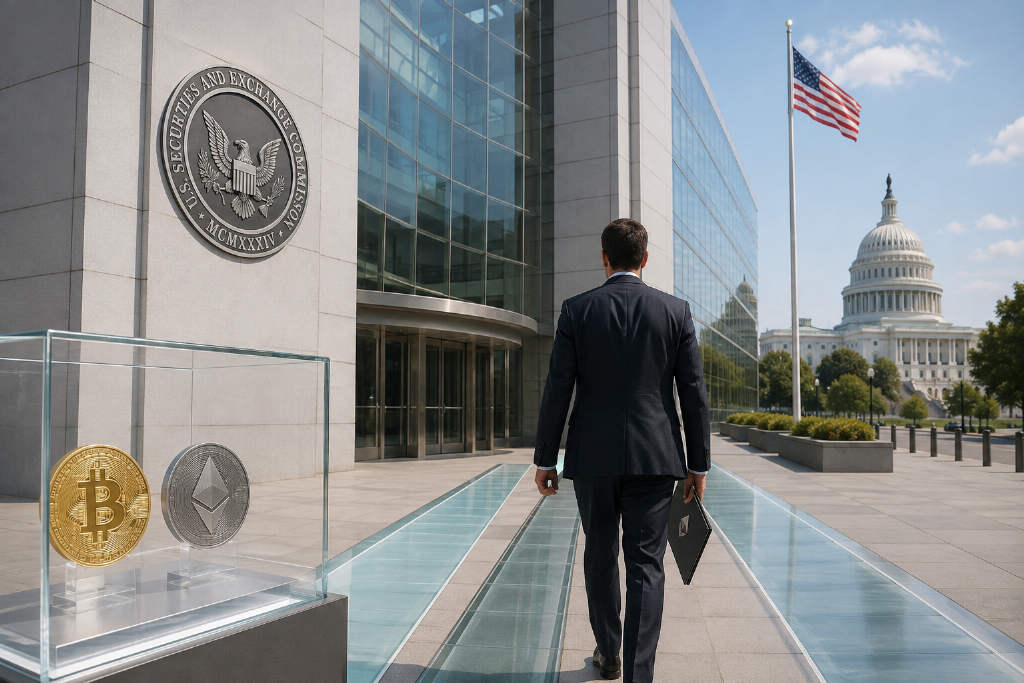
U.S. Securities and Exchange Commission Chair Paul Atkins said the SEC’s latest proposed framework for crypto assets is an important step toward building rules tailored to digital assets in the United States and attracting companies and investment activity back onshore. He also called on Congress to move forward with the CLARITY Act to put a more durable market oversight structure into law.
In an interview with Fox Business on Sept. 3, Atkins said the SEC proposal, titled Regulation Crypto Assets, is one of the agency’s most significant efforts so far to modernize crypto rules. He said the goal is to give companies a clearer route to issue crypto assets and raise capital in the U.S.
Atkins criticized the country’s past reliance on enforcement actions to handle crypto-related questions. That approach, he said, left firms unable to judge in advance whether a token would be treated as a security, which registration regime they should use, or how they could raise funds without breaching securities laws. In his view, that regulatory uncertainty pushed some developers and issuers to move business operations and financing activity overseas. The new proposal is meant to reverse that trend.
Two exemptions in the draft, with a ceiling of $75 million a year
The SEC formally proposed Regulation Crypto Assets on Aug. 18. The draft is aimed at situations in which the crypto asset itself is not a security, but the initial issuance or sale arrangement may amount to an investment contract. For those cases, the SEC set out two dedicated exemptions from securities registration.
The first, a startup exemption, would allow eligible projects to raise up to $5 million in a one-time offering over four years. The second, a fundraising exemption, would allow an issuer to raise as much as $75 million in any 12-month period.
Companies using the second exemption would have to file financial statements and meet ongoing reporting obligations. Both categories of offerings would also need to provide investors with principles-based disclosure.
The SEC said the draft does not give crypto firms a blanket carveout from securities law compliance. Federal securities law provisions on fraud and manipulation would still apply. The exemptions would cover only specific investment contracts that meet the rule’s definitions and conditions, rather than all token issuances.
The framework also includes an investment contract safe harbor
The proposal includes what the SEC calls an investment contract safe harbor. If an issuer has completed, or permanently stopped, the key managerial work it previously promised to investors, and also meets other specified conditions, the related crypto asset may no longer be treated as bound by the original investment contract.
Through that mechanism, the SEC is trying to address a long-running dispute: whether a token first sold through an investment contract can later fall outside securities law once a network matures or the issuer’s role changes.
For now, the framework remains only a proposed rule. It was published in the Federal Register on Aug. 21, and the public comment period runs through Oct. 20. After that, the SEC still has to review comments, decide whether to revise the proposal, and hold another vote before any rule can take effect.
The CLARITY Act is separate from the SEC proposal
Atkins also voiced support for passage of the CLARITY Act in Congress. The bill is intended to establish a federal framework for U.S. digital asset markets, divide oversight responsibilities between the SEC and the Commodity Futures Trading Commission for digital assets, securities, and digital commodity markets, and create registration and compliance rules for trading platforms and other centralized intermediaries.
The House passed the H.R.3633 version on July 17, 2025, by a vote of 294 to 134. The Senate Banking Committee later approved a revised text on May 14, 2026, by a 15-9 vote and sent the bill to the full Senate.
According to Senate information, cloture on the motion to proceed to consideration of the CLARITY Act is scheduled to reach a vote-eligible stage at 2:15 p.m. Eastern Time on Sept. 15, which is 2:15 a.m. Taipei time on Sept. 16. Under Senate rules, cloture on legislation usually requires 60 votes out of 100 seats.
Even if the measure secures 60 votes, that would only allow the bill to move into formal debate and amendment. It would not mean the legislation has cleared final passage.
Rules may come first, but legislation would provide longer-term certainty
For crypto companies, the immediate effect of the SEC draft would be to reduce the burden of using traditional securities registration systems for some domestic token fundraising activity, while preserving disclosure, financial reporting, and anti-fraud requirements.
Industry groups including the Blockchain Association and the Digital Chamber have already welcomed the proposal, saying tailored rules could help companies operate and expand in the United States.
Still, whether the proposal can actually bring innovation back will depend on the final text, the real compliance costs companies face, potential court challenges, and whether Congress can provide a more lasting legal foundation. Atkins himself acknowledged that agency rulemaking alone may not stop a future SEC leadership team from changing policy again, which is why congressional action remains central to long-term market certainty.
U.S. regulatory policy is clearly shifting away from a framework dominated by enforcement and toward rules written specifically for crypto issuance and market activity. But it is still too early to say crypto innovation has already returned to the United States at scale. The next points of focus are the SEC comment deadline on Oct. 20 and whether the CLARITY Act can clear the Senate’s 60-vote procedural threshold on Sept. 15.