
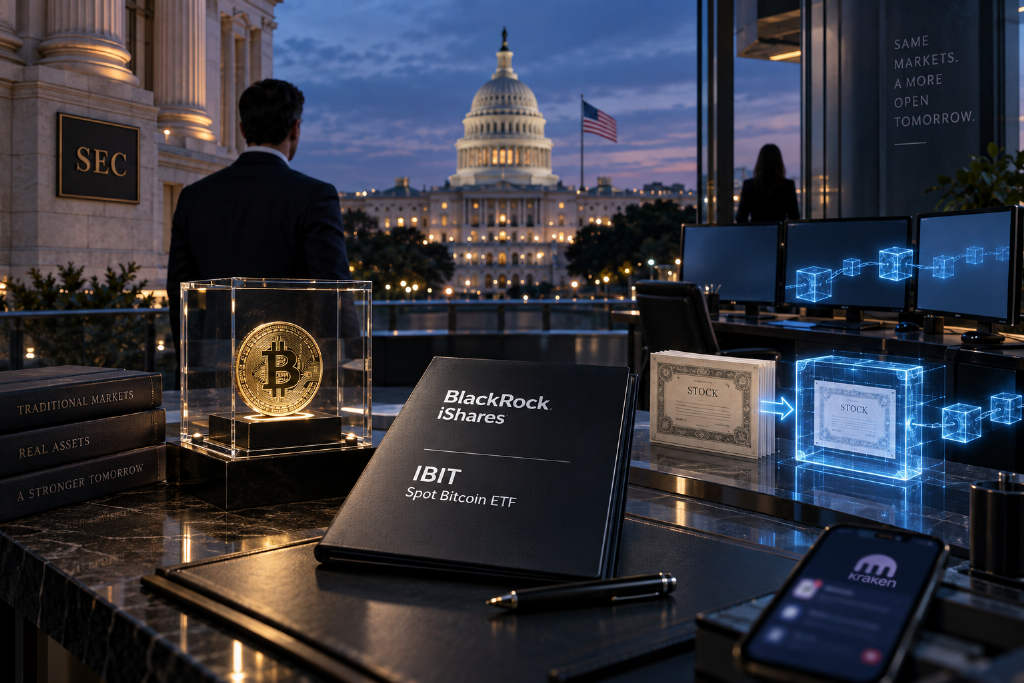
The U.S. Securities and Exchange Commission approved an "innovation exemption" that temporarily allows qualified Tokenized Securities Venues, or TSVs, to offer trading in certain tokenized NMS stocks. On the same day, spot Bitcoin ETFs in the U.S. recorded $159 million in net inflows for Sept. 17, with BlackRock's IBIT the only fund to post net inflows.
SEC sets conditions for tokenized stock trading
According to a statement from SEC Chair Paul S. Atkins, the exemption was granted under the Securities Exchange Act of 1934. It creates a temporary regulatory channel for on-chain trading in some tokenized NMS stocks and also provides a "dealer" definition exemption for certain liquidity providers.
Atkins said the framework is designed as a temporary path for tokenized stock trading on-chain. The tokens must preserve the same rights as traditional securities, including dividend and voting rights, and issuers must be able to object to the trading of their shares on a TSV.
The SEC said four key conditions must be met:
- The TSV must be a U.S. entity and comply with OFAC sanctions rules.
- The venue must use permissioned access.
- Synthetic tokenized stocks are prohibited. Eligible tokens must be issued either by the underlying stock issuer or by an unaffiliated third party, and holders must receive rights equivalent to those of traditional shareholders, including dividends and voting rights.
- Issuers must have the right to object to and block trading of their securities on a TSV, while anti-fraud and anti-manipulation provisions remain fully in force.
In a separate SEC filing, the agency said a tokenized securities venue must notify an issuer at least 30 days before trading in a stock begins. If the issuer objects, the stock cannot be traded on that venue. If the issuer does not respond, that will be treated as consent. Atkins said issuers "must have the opportunity to object to and prevent their securities from trading on a TSV."
The SEC also said exempted tokenized NMS stocks must provide holders with the same rights available in traditional securities, including access to dividends and voting rights.
U.S. equities move closer to 23×5 trading
Jamie Selway, director of the SEC's Division of Trading and Markets, said the U.S. equity market data infrastructure is scheduled to expand to 23×5 operations on Dec. 6. At that point, multiple approved exchanges will be able to offer trading during those hours.
There are already four ATSs offering overnight trading, and DTCC began 23×5 stock clearing in June. Selway said a further move to 24×7 trading remains possible.
SEC Commissioner Hester M. Peirce raised six questions about the shift toward 23-hour, five-day trading. She said overnight trading still accounts for less than 1% of total NMS stock volume and is concentrated in a small number of names. Her questions covered lessons from FX, crypto and futures markets; how brokers can meet best execution duties and protect retail investors when overnight liquidity is fragmented; whether asset managers that avoid overnight trading are still making reasonable fiduciary decisions; whether longer trading hours could change issuer disclosure practices; whether the SEC should adjust EDGAR to support timely overnight disclosure of material information; and whether listed companies should receive guidance or exemptions.
Bank of Japan raises rates by 25 basis points
The Bank of Japan raised its target rate by 25 basis points, from 1.00% to 1.25%, the highest level in 31 years. The move matched market expectations and passed by a 7-2 vote.
BOJ Governor Kazuo Ueda said the central bank will continue raising rates based on economic, price and financial conditions while the overall financial environment remains accommodative. He said the timing and pace of policy adjustment will be considered carefully.
Ueda said it is important for core inflation to stay close to 2% and for underlying inflation to remain stable at around 2%. He also pointed to more aggressive corporate behavior, rising medium- to long-term inflation expectations, and the risk that underlying inflation could exceed the 2% target. He added that the BOJ will closely watch developments in the Middle East, yen volatility, and AI-related demand and their effects on Japan's economy and prices.
Federal Register site briefly used Qwen-powered AI search
Reuters reported that the Federal Register website, operated by the U.S. National Archives, had launched an AI search function powered by Alibaba's Qwen model to search proposed federal rules and public comments.
The report noted that the FBI had previously accused Alibaba of "maliciously" copying technology from Anthropic in the development of Qwen. After the feature surfaced on social media, the Qwen-based search tool was taken offline.
Reuters said several experts did not see an immediate direct national security risk, but the episode stood in tension with Washington's broader caution toward Chinese AI models. Some members of Congress publicly opposed the federal government's use of Chinese AI systems.
Exchange and protocol updates
Hyperliquid launches manual borrowing
Hyperliquid said its manual borrowing feature is now live, allowing users to post HYPE or BTC as collateral and borrow USDC or USDT.
The loan-to-value ratio is 65% for HYPE and 50% for BTC. Liquidation thresholds are 82.5% for HYPE and 75% for BTC. Posted HYPE and BTC do not earn interest. Deposited USDC and USDT do earn interest, but they do not count toward borrowing capacity. Rates change with utilization and accrue hourly, and the system includes both account-level and global caps.
The feature is available for manual and unified accounts, while portfolio margin accounts use auto-borrow. Hyperliquid said both systems share the HyperCore backend and that total borrowed assets reached $269 million on the day.
Kraken to force-liquidate seven assets for UAE users
Kraken said it will force-liquidate balances of XMR, ZEC, DASH, USDD, DAI, USDS and USDE held by users in the UAE starting Sept. 15, with the process running through Sept. 25.
Withdrawals for those assets stopped at 14:00 UTC on Sept. 14. Trading and deposits had already been closed on June 16. Kraken said the delisting followed a "routine asset review" and did not cite any regulatory requirement. It also said it could not confirm the denomination currency of liquidation proceeds before execution.
Upbit to delist ICX trading pairs on Oct. 19
South Korean exchange Upbit said it will end support for ICX/KRW trading at 15:00 KST on Oct. 19, 2026. Open orders will be canceled, and withdrawals will remain available until Nov. 18.
Upbit said it had designated ICX as an investment warning item on Aug. 28 and later concluded that the reasons for the designation had not been resolved. The exchange cited an Aug. 27 replay attack on the ICON network in which two signed withdrawal messages were reused 1,492 times, releasing 119.9 million ICX and 531,600 bnUSD. The network was down for about 25 hours. After the notice, Upbit said it would no longer support ICX airdrops, wallet upgrades, migrations or hard forks.
Binance Futures adds several U.S. stock-linked perpetuals
Binance Futures said it will roll out multiple USDⓈ-margined perpetual contracts on Sept. 18, including PATHUSDT, AMCUSDT, CYPHUSDT, ANETUSDT, HUTUSDT, APLDUSDT and AGPUUSDT. The contracts track UiPath, AMC, Cypherpunk Technologies, Arista Networks, Hut 8, Applied Digital and Axe Compute. All are settled in USDT and support leverage of up to 20x.
Binance to distribute cash dividends for bStocks
Binance said it will distribute cash dividends for bStocks tied to Broadcom (AVGO), Invesco QQQ Trust (QQQ), Meta (META) and Seagate (STX). Net dividends, after withholding tax and fees, will be automatically reinvested into the corresponding bStocks, including fractional shares where applicable.
Holders of AVGOB, QQQB and METAB must hold tokens by the snapshot time of 2026-09-21 08:00 (UTC+8). The record time for STXB is 2026-09-24 08:00 (UTC+8). Token trading will not be affected during the process, but deposits, withdrawals and 1:1 spot-to-stock conversion will be paused and then resumed after distribution.
Across Protocol shifts to AcrossCo, ACX to lose all functions in 2027
Across Protocol said its token exchange portal is now live and that the protocol has moved to a new company, Across, Inc., referred to as AcrossCo. ACX will be phased out, and after Jan. 8, 2027, it will lose all governance, utility and economic functions.
Token holders can choose between two options before the deadline. One is a 1:1 exchange of ACX for AcrossCo equity at an implied valuation of $0.04375 per token, with a minimum of 250,000 ACX, first-come-first-served allocation, KYC requirements, and accredited investor status for U.S. applicants. The other is a USDC redemption at a fixed price of $0.04375 per ACX.
Across said exchange ratios after the deadline cannot be guaranteed, and Risk Labs and AcrossCo will no longer have obligations tied to ACX at that point.
Nostra pauses lending after oracle manipulation
PeckShieldAlert said Nostra's lending market on Starknet was exploited after manipulation of the NSTR oracle price. A single account used NSTR as collateral to borrow about $3.5 million worth of ETH, STRK, USDC, USDT, WBTC and DAI.
The attacker later bridged about $1.92 million to Ethereum, including 234.57 ETH and 1.3 million DAI. Nostra's money market has since paused lending and related functions.
Solana cuts target block time to 250 milliseconds
CoinDesk reported that Solana reduced its target block time from 300 milliseconds to 250 milliseconds on Sept. 18, a speed increase of about 17%, under SIMD-0525.
Because the allowed compute and data per slot were reduced proportionally, the network's processing ceiling per unit of time is largely unchanged. The number of consecutive leader slots per validator was also cut to four, and the target epoch length was shortened from about 36 hours to about 30 hours. A further reduction to 200 milliseconds remains possible, but no mainnet schedule has been set.
AI product launches and platform changes
OpenAI unveils Astra for Law
OpenAI introduced Astra for Law for law firms and legal tech companies. Built on GPT-6 Astra, the product includes legal analysis and drafting instructions, work modes and context settings, along with a search index covering more than 230 million links to U.S. case law, statutes, regulations and administrative decisions.
Law firms including Sullivan & Cromwell, Ropes & Gray and Cooley have already built tools on top of it for contract review, M&A due diligence and IPO preparation. Astra for Law will first be offered to selected firms through Trusted Access in ChatGPT and Codex, with API access to follow.
Anthropic merges Claude chat and Cowork
Anthropic said it has combined Claude chat and Cowork into a single interface, with Claude automatically routing different types of requests.
The company also launched Claude Docs and Claude Slides, which support collaborative document and presentation creation, mobile task tracking, and export to PowerPoint or PDF. The experience will roll out first to Pro and Max users, then expand to free users and Team plans.
Anthropic is also testing a new Projects experience in Claude Code. After a user sets a goal and connects a code repository, a coordinator can break down tasks, schedule multiple cloud threads in parallel, review outputs and assemble the final delivery. The test is currently available to some Pro and Max users.
OpenAI tests Sponsored Agents ad format
OpenAI said it has launched Sponsored Agents, an advertising product that lets users click an ad inside ChatGPT and then speak directly with a brand's AI assistant before deciding whether to visit the merchant's website.
OpenAI said those conversations are separate from ChatGPT's own answers and separate from the user's existing chat history. The feature is currently being tested with selected advertisers in the U.S. HubSpot and Shopify are the first CRM and e-commerce partners, and Shopify's international version is scheduled to go live on Sept. 23.
Zhipu releases GLM-5.3-FlashX
Zhipu released GLM-5.3-FlashX, with access now open through its API and experience center. The company said inference speed can reach 200 tokens per second, supported by inference capacity from 100,000 domestic chips and additional spending on infrastructure and inference optimization.
Its base model, GLM-5.3-Flash, was open-sourced on Aug. 26 with 320 billion total parameters, 18 billion activated parameters, and a 1 million-token context window. It had previously been tested anonymously under the name "Ox Alpha."
Funding and governance
CoreWeave plans up to $3.5 billion in convertible notes
Business Wire reported that CoreWeave plans to privately place $3 billion of convertible senior notes due 2033 and grant initial purchasers an option to buy up to an additional $500 million.
The notes will be senior unsecured obligations guaranteed by the company and its wholly owned subsidiaries. They mature on April 1, 2033 and may be converted, under certain conditions, into CoreWeave Class A common stock, cash, or a combination of both. The interest rate and initial conversion price will be set at pricing. CoreWeave said part of the proceeds will be used to pay for capped call transactions related to the offering, with the rest for general corporate purposes.
Zcash opens Q3 retroactive grant voting
Zcash said voting has opened for its Q3 Retroactive Grant program for Shielded ZEC holders and will run until 20:00 UTC on Sept. 29.
The vote covers 37 proposals, each requiring a separate yes-or-no vote. The quorum threshold is about 420,000 ZEC. Participants need to update to Zodl 3.14.0 or later, the latest Vizor Wallet, or the latest Zkool before voting.
Market data and commentary
Spot Bitcoin ETFs add $159 million
SoSoValue data showed that U.S. spot Bitcoin ETFs recorded total net inflows of $159 million on Sept. 17, Eastern Time.
BlackRock's IBIT posted the largest daily net inflow at $184 million, bringing its historical cumulative net inflow to $64.016 billion. Fidelity's FBTC had the largest daily net outflow at $16.6386 million, while its historical cumulative net inflow reached $10.051 billion.
As of publication, total net assets across spot Bitcoin ETFs stood at $96.247 billion. The ETF net asset ratio was 6.26%, and cumulative historical net inflows reached $54.728 billion.
Bitcoin whale sends 1,651.82 BTC to Kraken
Arkham data showed that a Bitcoin whale transferred 1,651.82 BTC to Kraken yesterday, worth about $126.69 million.
The coins had been withdrawn from Kraken in April, then moved through two new wallets before returning to the exchange. The related wallets are now empty. Arkham said the whale made about $15.21 million on the position.
Robinhood Chain stablecoin market cap tops $1 billion
The Block reported that the total market capitalization of dollar-pegged stablecoins on Robinhood Chain recently surpassed $1 billion. USDG accounts for about 67% of the total, making it the largest stablecoin on the chain, while Ethena's USDe represents nearly 30%.
Uniswap handles about 80% of Robinhood stock token volume
Uniswap said about 80% of trading volume in Robinhood stock tokens has been executed through the decentralized exchange protocol, with cumulative volume reaching about $10 billion.
Analysts and industry figures weigh in
Starknet co-founder Eli Ben-Sasson said part of ZEC's recent rise reflects market concern that Bitcoin may be "too rigid" at the protocol level. He said he "deeply loves Bitcoin" but still sees those concerns as real, adding that some Bitcoin holders have told him they shifted part of their positions into ZEC.
Bitcoin analyst Willy Woo said his Fisher Transform indicator, first introduced in 2002, has successfully identified bottoms in three Bitcoin cycles without false signals, and a fourth signal has now appeared on the chart. He added that a Fisher "turning point" does not necessarily mean a trend reversal, since price can consolidate and then continue in the same direction.
Bloomberg senior ETF analyst Eric Balchunas reiterated his view that Bitcoin ETFs could eventually reach three times the asset size of gold ETFs. He said Bitcoin investors skew younger and that broader institutional adoption could follow as Bitcoin matures and its volatility and correlation with other assets stabilize. He also said Bitcoin ETFs benefit from stronger market enthusiasm as well as stronger sales and investor education efforts.
Binance co-founder He Yi said projects seeking a Binance listing must use Binance's official channels. She said there are no so-called intermediaries or listing fees at Binance, though in some cases the exchange reserves airdrop allocations for users. She also urged the community to warn projects and users about scams that misuse Binance's name.
Other data points and price moves
WikiLeaks founder Julian Assange posted "I'm back" on X and quoted a WikiLeaks account post saying "He's back" alongside a recent photo. The post has drawn more than 31 million views, about 366,000 likes and 62,000 reposts.
The Wall Street Journal reported that an independent security research team used Anthropic's Claude software to compromise a ChatGPT account belonging to an OpenAI employee, gaining access to and modifying the employee's connected internal OpenAI code system. The researchers first used Claude to analyze a Discourse vulnerability in OpenAI's developer community and generate working exploit code, then obtained authentication tokens and used a permissions configuration issue to enter the employee's ChatGPT account. They also gained limited read access to some private GitHub repositories and the ability to submit code modification suggestions.
OKX market data showed ARB rose 32.74% over the past 24 hours to about $0.22. NEAR and UNI were both up about 26%. APT rose 22.8% to $0.688, and OP gained about 18.5% to $0.114.
Binance market data showed Intel (INTC) shares were up 10.02% intraday at $111.34.
OKX also showed UNI up more than 15% over 24 hours at $7.8, while NEAR was up more than 20% at $3.2.