
The U.S. Securities and Exchange Commission has opened a formal, if narrow, path for tokenized stock trading. Under a temporary and conditional “Innovation Exemption,” the agency will allow limited trading of tokenized equities on certain on-chain venues known as Tokenized Securities Venues, or TSVs.
The move came one day after SEC Chair Paul Atkins said the agency would act decisively to provide a clear regulatory framework for U.S. investors and entrepreneurs regardless of whether the CALRITY Act advanced in the Senate. Atkins had said, “stay tuned.” The exemption followed shortly after.
SEC sets out a venue model for tokenized equities
Tokenized stock trading had been held back by two issues: SEC approval and the question of where these products should trade. The first issue covered applications already raised by Nasdaq and the New York Stock Exchange, along with some technical implementation problems. The second was more basic for both traditional finance and crypto markets: what kind of venue should handle tokenized stocks.
The SEC’s answer is the TSV model. It sits between a traditional securities exchange and a crypto trading platform, creating a separate structure for tokenized securities trading.
Four hard conditions for the exemption
In the agency’s explanation, Atkins laid out four clear conditions for TSVs:
- A TSV must be a U.S. entity and comply with economic and trade sanctions administered by the Office of Foreign Assets Control, or OFAC.
- It must use a permissioned access model and allow trading in tokenized National Market System, or NMS, stocks only for eligible participants.
- Synthetic tokenized stocks are not allowed. Tokenized equities must be created either by the issuer of the underlying stock or by an unaffiliated third party, and holders must receive the same rights as holders of traditional securities, including dividends and voting rights.
- Issuers have the right to object to and block trading of their securities on a TSV, and federal securities law provisions on fraud and manipulation remain fully applicable.
That framework narrows the gray area that had surrounded tokenized equities and excludes synthetic stock products from this U.S. structure.
Five-year trial period and permissioned AMM pools
The exemption takes effect on publication and will remain in force for five years, to around September 2031. After that, it may be revised or converted into a more permanent rule. The SEC said it is also seeking public comment for later adjustments.
On market access, TSVs are designed around one or more permissioned automated market maker liquidity pools provided by liquidity providers that meet disclosure, recordkeeping, and related requirements. Eligible participants interact through those pools and agree on trade terms under defined access standards.
Same rights, synchronized halts, and volume caps
On product rights, a stock token must represent ownership of the actual underlying security. It must be tokenized by the issuer, by a party acting for the issuer, or by an unaffiliated third party. Holders must receive the same rights as traditional shareholders, including dividends and voting rights. Synthetic tokens that only provide price exposure without actual ownership are explicitly excluded.
Trading halts must also be synchronized. If the underlying stock is halted on a primary listed exchange, the corresponding tokenized stock on a TSV must stop trading as well.
The SEC also imposed volume limits by tier:
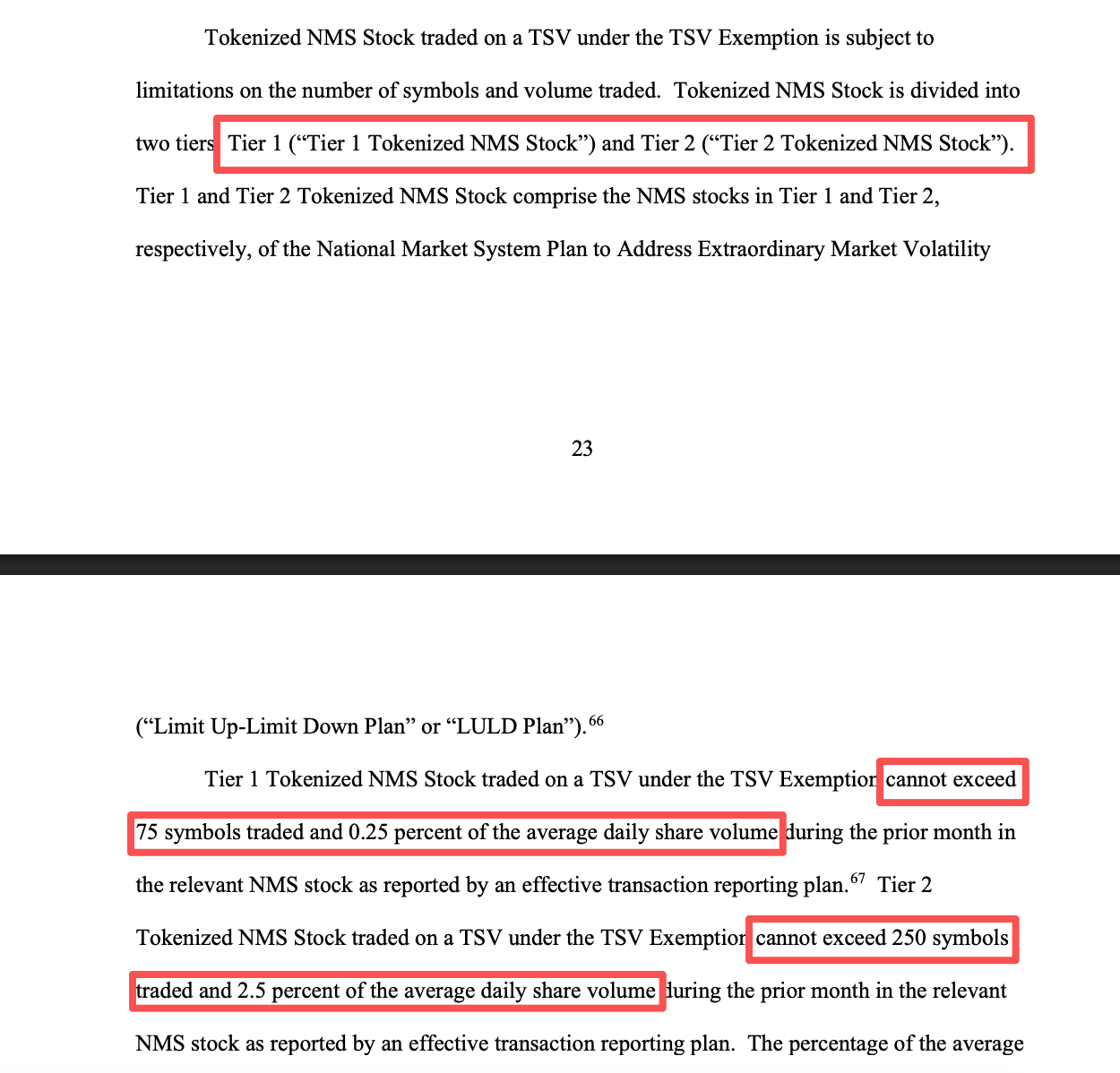
- For Tier1 stocks, which mainly include S&P 500 constituents, Russell 1000 constituents, and qualified ETPs with high liquidity, each TSV may trade no more than 75 names. Trading volume in any one stock may not exceed 0.25% of that stock’s average daily volume in the prior month, based on effective transaction reporting plan data.
- For Tier2 stocks, meaning other U.S. equities, each TSV may trade no more than 250 names. Trading volume in any one stock may not exceed 2.5% of that stock’s average daily volume in the prior month.
The agency said smart contracts for stock tokens must be auditable, public, and deployed on a public, permissionless blockchain network. They must also meet requirements tied to public disclosure, trading transparency, coordinated circuit breakers, record retention, and technical safeguards. Before an unaffiliated third party tokenizes a stock, the TSV must give written notice to the issuer and provide an opportunity to object, usually for at least 30 days. If the issuer objects, the token cannot trade.
Peirce flags six unresolved questions
SEC Commissioner Hester M. Peirce later published a separate note on key issues in the exemption and raised six questions at the SEC’s overnight trading roundtable:
- How should the U.S. stock market draw from the long-running experience of foreign exchange, crypto, and futures markets?
- When overnight liquidity is fragmented and spreads widen, how should brokers meet best execution duties and strengthen retail investor protection?
- If overnight liquidity is thin and execution costs are high, is it still a reasonable fiduciary decision for asset managers not to trade overnight?
- Would longer trading hours change how listed companies release earnings and other material information?
- Because EDGAR filings submitted after 5:30 p.m. Eastern Time are usually not processed until the next business day, should the SEC adjust EDGAR so material information can be disclosed in time for overnight trading?
- Should the SEC provide guidance or regulatory relief for listed companies, especially smaller issuers?
Peirce said U.S. equities are gradually moving toward a “23×5” trading model, but overnight trading still accounts for less than 1% of total NMS stock volume and remains concentrated in a small number of names.
Robinhood and AMC executives respond
After the announcement, Robinhood CEO Vlad Tenev said the United States is entering a tokenization era. He said the SEC’s move would let Americans start to benefit from tokenization, including instant settlement, 24/7 trading, and native support for fractional trading. He called it an important moment for U.S. innovation.
AMC CEO Adam Aron also praised the framework and highlighted three principles: investor protection cannot be missing, synthetic assets must not be used, and stock issuers must have the right to object to trading of their securities on tokenized securities venues. Aron said that under the SEC’s framework, qualifying stock tokens should carry full voting and dividend rights, and listed companies should be able to stop their securities from being traded in tokenized form. He also called on Robinhood co-founder Vlad Tenev to apply the same standards in Robinhood’s overseas tokenized stock business, especially on investor protection, synthetic assets, and issuer objection rights.
Crypto market reaction
The article said several meme tokens tied to Robinhood’s on-chain ecosystem and stock-token pairings rose more than 20% after the SEC approved limited tokenized stock trading on on-chain platforms. The tokens named were MEME, BONER, microduck, Artificial Inu, CATGPT, and MOO.
The broader crypto market also moved higher, with DeFi names standing out. Genius (GENIUS) rose 20.66%, while Uniswap (UNI) and Hyperliquid (HYPE) gained 14.81% and 10.01%, respectively. UNI reached as high as $7.93 and was up more than 14% over 24 hours. ONDO touched $0.3792 and was up more than 7% over 24 hours. BP reached $0.55 and rose nearly 14% over the same period.
The exemption does not remove every restriction, but it marks a concrete step for tokenized U.S. stock trading. It also gives the market a formal SEC framework for venue design, investor protection, issuer rights, and the boundary between real ownership tokens and synthetic products.