
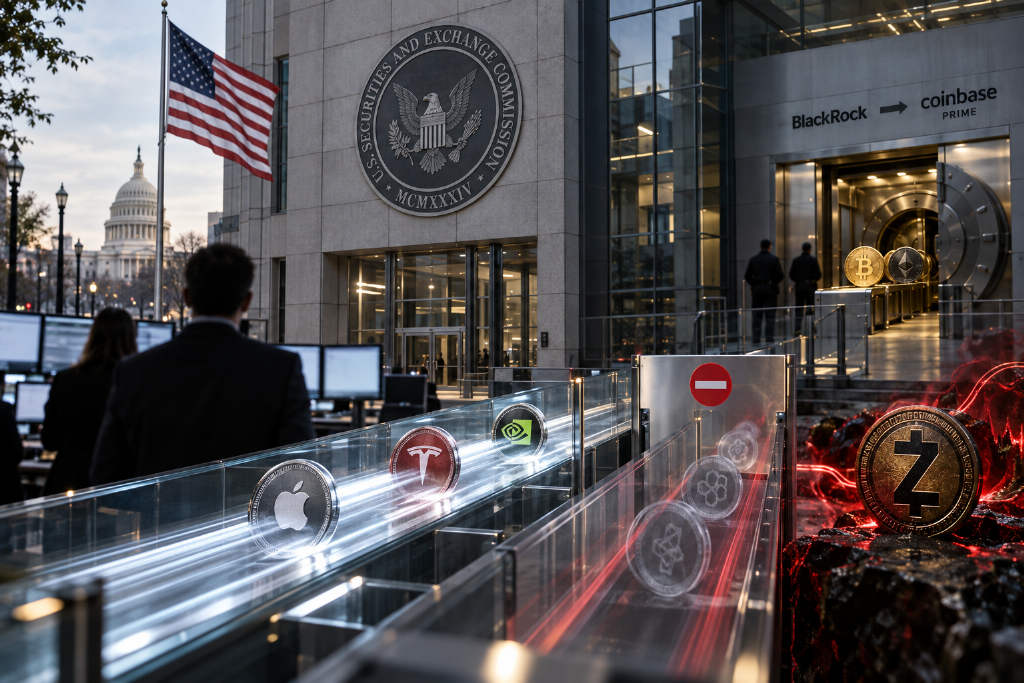
Crypto markets moved through a heavy stream of headlines from Sept. 17 to Sept. 18, with U.S. tokenized securities policy, ZEC trading activity and large institutional transfers drawing the most attention.
Central banks and macro headlines
European Central Bank Governing Council member Olli Rehn said the Federal Reserve’s decision was unanimous, calling that point very important. Earlier reporting said the Fed raised rates by 25 basis points for the first time in three years, with the Federal Open Market Committee approving the move by a 12-0 vote.
The Bank of England kept its policy rate unchanged at 3.75%, in line with market expectations.
Brent crude fell 3% intraday to $99.03 a barrel. South Korea’s KOSPI opened up 2.54%, while Japan’s Nikkei 225 opened 0.62% higher.
Zilliqa sets Sept. 22 for second exchange migration hard fork
Zilliqa said its second exchange migration hard fork is expected to be triggered at 07:21 UTC on Sept. 22 at block height 36,383,378. Participating exchanges will move ZIL from legacy wallets to verified Zilliqa EVM addresses.
The migration list includes CoinEx, HTX, Bitkub, GOPAX, Coinone, OKX, LBank, Crypto.com, Gate, Paribu, CEX.IO, Bitget and Bybit. Bithumb is expected to complete its migration during the third hard fork.
After the migration, exchanges will gradually resume ZIL deposits and withdrawals on Zilliqa EVM, with timing subject to each platform’s own announcement. Zilliqa also said the ZKP migration tool audit has been completed and the tool is scheduled to go live when the relevant custody contracts are activated in this hard fork.
Kimi rolls out an AI solution for finance
Kimi, developed by Moonshot AI, formally launched an AI solution for the financial industry. The first batch has already been deployed at dozens of institutions, including Industrial and Commercial Bank of China, CSC Financial, China International Capital Corporation and E Fund.
The product includes more than 10 data sources, among them Wind, Eastmoney, S&P Global, Caixin Data and Cailianshe. It packages nine professional functions, including financial modeling, research report drafting, earnings commentary, portfolio review and Hong Kong IPO analysis.
In some use cases, Kimi said it cut financial modeling cycles from 5-15 person-days to 2-4 person-days, and reduced the time needed for in-depth industry reports from 10-20 days to 2-4 days. It also said it built a risk assessment gateway with CSC Financial, promised zero retention of enterprise data and supports auditable institutional deployment through hosted agent services.
SEC approves a temporary framework for some tokenized NMS stock trading
The U.S. Securities and Exchange Commission said tokenization could lower costs across issuance, trading, transfer, settlement and ownership recordkeeping while improving transparency and liquidity. The agency approved a temporary, conditional Innovation Exemption that allows limited trading of tokenized National Market System stocks on certain on-chain venues known as Tokenized Securities Venues, or TSVs.
Eligible TSVs may use automated market makers and liquidity pools for approved trading activity, but they must meet requirements covering public disclosure, trading transparency, circuit-breaker coordination, record retention and technical safeguards. They also face limits on the number of stock symbols and trading volume. The SEC said the goal is to observe how on-chain venues and market participants operate and gather data for future long-term rulemaking.
SEC Chair Paul S. Atkins said the exemption was granted under the Securities Exchange Act of 1934. It temporarily allows qualifying TSVs to facilitate some tokenized NMS stock trading and gives certain liquidity providers relief from the definition of “dealer.” He said the tokens must preserve the same rights as traditional securities, including dividends and voting rights, and issuers may object to having their shares traded on a TSV.
According to Atkins, eligible tokenized NMS stocks must be tokenized either by the issuer, on the issuer’s behalf, or by an unaffiliated third party. Synthetic securities are excluded. The Block reported that an SEC spokesperson said synthetic products “can continue to stay in the wild” and added that there is little interest in a derivatives-based route in the U.S. market. The exemption took effect on Sept. 17 and runs for five years, expiring on Sept. 17, 2031. The report said the tokenized stock market is currently worth nearly $3 billion, with most of that market made up of synthetic products that do not qualify.
SEC documents also say a TSV must notify an issuer at least 30 days before a stock begins trading on the venue. If the issuer objects, the stock cannot be traded there. No response is treated as consent. Atkins said, “Issuers must have an opportunity to object to and prevent their securities from trading on TSVs.”
He also laid out four core conditions. First, a TSV must be a U.S. entity and comply with sanctions rules administered by the Office of Foreign Assets Control. Second, access must be permissioned, with trading limited to eligible participants. Third, synthetic tokenized stocks are barred, and qualifying tokens must be created either by the underlying issuer or by an unaffiliated third party, while preserving the same rights as traditional securities. Fourth, issuers retain the right to object and block trading of their securities on a TSV, and federal anti-fraud and anti-manipulation rules continue to apply in full.
SEC Commissioner Hester Peirce said the Innovation Exemption “has nothing to do with decentralized finance.” She said truly decentralized systems run by automated software do not create the core concerns that underlie securities regulation, and investors using permissionless smart contracts for peer-to-peer trading do not need an exemption. She also said the Commission is not presuming that anyone relying on the exemption is an exchange or a dealer before seeing who uses it and how.
Robinhood CEO Vlad Tenev said the U.S. is entering an “era of asset tokenization” after the SEC approved the temporary, conditional relief. Hayden Adams said Uniswap v4 received SEC relief that opens a path for compliant AMM trading in the U.S.
Debate grows over longer U.S. stock trading hours
Jamie Selway, director of the SEC’s Division of Trading and Markets, said U.S. equity market data infrastructure is scheduled to expand to 23x5 operation on Dec. 6, allowing multiple approved exchanges to offer trading during those hours. He said four ATSs already offer overnight trading, and DTCC began 23x5 equity clearing in June. He added that a move to 24x7 trading remains possible in the future.
Commissioner Hester M. Peirce separately raised six questions about the shift toward 23-hour, five-day trading. They include what U.S. equities can learn from foreign exchange, crypto and futures markets; how brokers should meet best-execution duties when overnight liquidity is fragmented and spreads widen; whether asset managers are still acting reasonably as fiduciaries if they avoid overnight trading when liquidity is thin and execution costs are high; whether longer hours will change how listed companies release earnings and material information; whether the SEC should adjust EDGAR because filings submitted after 5:30 p.m. Eastern are usually not processed until the next business day; and whether listed companies, especially smaller ones, need guidance or regulatory relief.
Crypto.com registration and CFTC software relief
Crypto.com said its U.S.-regulated derivatives exchange, North American Derivatives Exchange, or Nadex, has completed SEC registration and can offer securities futures products through OG.com. The registration became effective on Sept. 14. CEO Kris Marszalek said the step supports plans to launch single-stock futures in the U.S. and that the company is working with the SEC and the Commodity Futures Trading Commission to seek approval for single-stock perpetual futures.
The CFTC’s Division of Market Participants also issued a no-action position for providers of “passive software.” If certain conditions are met, and the software only helps users trade with regulated futures commission merchants, introducing brokers or designated contract markets, staff will not recommend enforcement action solely because the provider is not registered as an introducing broker or associated person. Covered platforms cannot custody user assets or make trading decisions on behalf of users.
The measure expands a March arrangement involving crypto wallet Phantom to other qualifying software providers. Phantom has already partnered with Kalshi to give its more than 20 million wallet users access to prediction market trading.
Genius.fun outlines a BNB Chain RWA launchpad
According to the Genius.fun website, the project has introduced a BNB Chain-based RWA Launchpad that is intended to let projects convert stock exposure represented by bStocks into real shares held by a Cayman foundation, which would exercise the related shareholder governance rights. The site says the feature is still listed as “coming soon.” Token holders would not directly own the shares held by the foundation and would not have redemption rights.
Genius.fun says users can create and trade tokens based on tokenized shares and can split those tokens for campaigns aimed at acquiring real listed companies and contesting board seats. Creators can choose trading pairs including USDT/USDC, BNB, Ondo, bstocksfinance and fourdotmeme, and may receive up to 1.25% of trading fees generated by the tokens they issue. All tokens will migrate to PancakeSwap once they reach a size of 15 BNB.
GENIUS briefly rose more than 40% as the market reacted to the RWA plan.
S&P Global signs a deal to acquire OpenZeppelin
S&P Global said it has signed an agreement to acquire blockchain security company OpenZeppelin to strengthen its risk assessment and digital asset strategy. After the transaction closes, OpenZeppelin will continue to operate as an independent business unit. CEO Demian Brener will report to Yann Le Pallec, president of S&P Global Ratings. Financial terms were not disclosed, and S&P Global said the deal is not expected to have a material impact on its overall financials.
Founded in 2015, OpenZeppelin maintains the widely used OpenZeppelin Contracts open-source smart contract library. The company says it has supported more than $37 trillion in value transfer, completed more than 900 security audits and identified more than 10,000 potential vulnerabilities. Its clients include major stablecoins, tokenized funds and DeFi protocols.
S&P Global said it plans to combine its ratings and risk assessment capabilities with OpenZeppelin’s smart contract security technology to build compliance-grade security and risk frameworks for stablecoins, tokenized money market funds and institutional on-chain finance.
BlackRock moves about $285.5 million in BTC and ETH to Coinbase Prime
Asset manager BlackRock transferred 54,096 ETH worth about $131.7 million and 2,015 BTC worth about $153.8 million to Coinbase Prime, for a combined value of roughly $285.5 million.
Morgan Stanley, meanwhile, added 123.211 BTC through its spot Bitcoin exchange-traded fund MSBT, worth about $9.33 million. Its total Bitcoin holdings have now risen above 8,000 BTC for the first time, reaching 8,026 BTC worth about $614 million.
Bloomberg ETF analyst Eric Balchunas said Bitcoin ETFs have advantages over gold ETFs because Bitcoin investors are younger, and because broader adoption by large pools of capital could follow as the market matures and volatility and cross-asset correlations stabilize. He also said Bitcoin ETFs benefit from stronger market attention and distribution resources.
Another market note compared the current Bitcoin setup with 2022. After the Fed’s Sept. 16 rate increase of 25 basis points, the market expects another 75 basis points of tightening over the next six months. Bitcoin is now down about 40% from an October high near $126,000, similar to the roughly 40% drawdown seen by March 2022 from the November 2021 high near $69,000. In 2022, Bitcoin rebounded about 18% within 12 days after the first hike and then fell another roughly 50%. The report said a similar “rebound first, decline later” pattern is possible, while also noting that a single historical cycle offers limited guidance.
ZEC swings sharply as whale positions and withdrawals pile up
One address opened a long position of about 3,380 ZEC on Hyperliquid, with a liquidation price near $1,275. ZEC liquidations topped $65 million over the past 24 hours, and price volatility exceeded 20%. OKX market data showed ZEC briefly moved above $1,500 early in the day and later traded around $1,470, still up more than 10%.
One whale closed a ZEC long in the early hours after holding it for nearly a month. The address had opened a long of 10,160 ZEC on OKX from Aug. 20 at around $630, a position worth about $6.4 million at entry. It fully closed the trade at around $1,458, locking in an estimated profit of about $8.29 million.
Zcash has posted repeated daily gains of more than $100, with the price at one point reaching about $1,500. The main short-side trader described as the “Garrett Jin whale entity” is currently holding a short position of about 37,760 ZEC and is sitting on roughly $30 million in unrealized losses. A related address had earlier withdrawn 35,000 ETH, worth about $85.11 million, from Binance, and that capital has not made any further move so far. A separate item said Garrett Jin withdrew 35,000 ETH from Binance and moved it to Hyperliquid.
As Zcash rallied, several newly created addresses withdrew large amounts of ZEC from exchanges over the past two days. Address “t1UcyM” withdrew 15,860 ZEC from Binance in a single day, worth about $22.69 million. “t1fXjw” withdrew a combined 7,081 ZEC from multiple exchanges over two days, worth about $10.29 million. “t1YLeD” withdrew 5,818 ZEC in one day, worth about $8.45 million. “t1gxP4” withdrew 3,534 ZEC from Binance in one day, worth about $4.72 million. All of the funds were sent to newly created wallet addresses.
A separate report said a short SP500 position worth about $7.19 million was fully liquidated as U.S. stocks rebounded.
Mining, security incidents and protocol updates
CleanSpark plans to issue senior secured notes due 2031 to raise $2.227 billion.
PeckShieldAlert said Nostra’s lending market on Starknet was exploited after manipulation of the NSTR oracle price. A single account used NSTR as collateral to borrow about $3.5 million worth of ETH, STRK, USDC, USDT, WBTC and DAI. The attacker later bridged about $1.92 million to Ethereum, including 234.57 ETH and 1.3 million DAI. Nostra has suspended lending and related functions in its money market.
Liquid Network said in a security update that block production and on-chain transfers, including LBTC transfers, have been operating normally since service resumed on Sept. 10. Peg-out redemptions remain paused while the network works with federation members and partners on a recovery plan. Of roughly 4,000 BTC taken in the incident, about 3,400 BTC has returned to federation reserves, leaving about 600 BTC unrecovered. Liquid said peg-outs will resume only after LBTC is confirmed to be fully restored to a 100% 1:1 BTC backing and after software updates, testing and an independent security review are complete.
Chainalysis reported that open-source AI models have helped drive a 440% increase in cases where malware instructions are embedded in on-chain transactions and smart contracts.
World, Arc and other infrastructure developments
Bubblemaps said Circle minted 10 billion ARC tokens on the Arc blockchain and distributed them from the zero address to 11 addresses. Arc described the event as a technical milestone in its roadmap to move from proof-of-authority to proof-of-stake.
World, formerly Worldcoin, launched its self-custodial financial app World Money in more than 150 countries. The app includes stablecoin payments, trading, yield and virtual account functions. Users can hold eight currencies and make cross-border transfers inside the app. Stripe provides a new U.S. on-ramp that lets users convert Apple Pay funds into stablecoins within minutes. World said users who complete World ID verification can receive higher rewards in eligible Earn programs, with features and assets varying by jurisdiction. The project is developed by Tools for Humanity, whose co-founders include Alex Blania and OpenAI CEO Sam Altman.
China’s cross-border digital yuan infrastructure also appeared at the China-ASEAN Expo.
AI and technology company developments
AI infrastructure company Crusoe is discussing an IPO and has completed a $3.9 billion Series F round at a $30.9 billion valuation.
Nvidia CEO Jensen Huang said the company’s chip sales next year will reach twice this year’s level. He also said AI safety is critical and unsafe products must be stopped. Binance market data showed Nvidia shares up 2.2% in premarket trading.
The CEO of Databricks said the risk AI poses to humanity is close to zero and that cybersecurity is the biggest risk facing AI.
Elon Musk, Mark Zuckerberg and Jensen Huang all opposed the creation of a FINRA-style self-regulatory organization for the AI industry, and Donald Trump ultimately decided not to establish one. The proposal had been put forward in July by Google DeepMind CEO Demis Hassabis. It would have created an independent body to test frontier models for cybersecurity, biological and deception risks up to 30 days before public release, starting on a voluntary basis and potentially becoming mandatory later under government oversight.
Foreign media reported that OpenAI is close to solving another Millennium Prize problem. A person familiar with the work said employees expect the next problem, the Hodge conjecture, to be solved soon, though the company may take longer to publish the result while it works with the mathematics community to avoid another public relations dispute. The report added that some researchers believe the automation wave seen in software engineering over the past year could spread to mathematics within the next six to nine months.
OpenAI also launched Astra for Law, a legal version of GPT-6 aimed at law firms and legal tech companies. It includes a search index covering more than 230 million links to U.S. case law, statutes, regulations and administrative decisions. Firms including Sullivan & Cromwell, Ropes & Gray and Cooley have already built tools on top of it for contract review, M&A due diligence and IPO preparation. Astra for Law will first be available to selected firms through Trusted Access in ChatGPT and Codex, with API access and broader privacy, governance and plugin controls to follow.
OpenAI hired Brian McCarthy from SpaceX as vice president of global sales. The Information reported that OpenAI also recruited two senior sales staff from Snowflake. The report said OpenAI now has more than 2 million enterprise customers, double the level a year earlier, and is aiming for enterprise customers to contribute half of revenue by the end of 2026.
Anthropic said it is merging Claude chat and Cowork into a single interface, with Claude automatically routing different kinds of requests. The company also introduced Claude Docs and Claude Slides, which support collaborative document and presentation creation, mobile task tracking and export to PowerPoint or PDF. The experience will roll out to Pro and Max users over the coming weeks before expanding to free users and Team plans.
Anthropic is also testing a new version of Projects in Claude Code. After users set a goal and connect a code repository or other context, a coordinator can break down tasks, run multiple cloud threads in parallel, review the results and deliver a combined output. The threads share project memory and a common materials library. The feature is being tested with some Pro and Max users who use Claude Code cloud sessions.
Figure introduced Helix 2.5, a new neural network for its humanoid robots. The company placed robots in 30 previously unseen homes in the San Francisco Bay Area and had them complete long-horizon whole-body tasks such as tidying living rooms, folding towels and making beds without collecting local data, fine-tuning or adapting to the environment. Figure said zero-shot full-task success in blind tests rose from 9% for a model trained from scratch to 56%, while requiring only half as much task-specific data as representative Helix 02 tasks. It added that its Index dataset is now growing by about 35 minutes of human behavior data every second and that it has committed $3.5 billion in compute to Helix training.
SpaceX is internally discussing whether to buy customer and operational data from struggling or failed startups to improve SpaceXAI model performance. The report said the talks remain informal and may not lead to any transaction.
Palantir CEO Alex Karp told CNBC that companies that develop and deploy AI systems should bear legal responsibility for the consequences of their technology rather than relying only on government regulation. Responding to proposals for third-party safety evaluators inside AI companies, Karp said such oversight is complicated and requires people who genuinely understand the technology.
Additional protocol, corporate and market items
Ethereum’s Glamsterdam upgrade completed testing on Devnet-11 this week and successfully confirmed blocks under new block-building rules. The proposal would raise the block gas limit from 60 million to 200 million and introduce block-level access lists so nodes can fetch data and validate unrelated transactions in parallel. It would also extend block data propagation time from about 2 seconds to 9 seconds to accommodate larger blocks. During testing, the Nethermind execution client passed all 2,302 performance tests and processed 570.7 billion gas in 3 minutes and 15 seconds. Developers are targeting a Sept. 6 deployment on the Sepolia testnet, pending confirmation. The 200 million gas limit remains experimental and has not yet gone through adversarial stress testing.
JPYC said it has temporarily halted reservation-based issuance of JPYC on Ethereum while it investigates the cause. Users on social media said they were affected because they could not complete issuance and KYC procedures. Earlier, some users posted screenshots claiming that 1 million JPYC had spiked to about $21,300 on the secondary market, creating a potential arbitrage opportunity of about 3.31 million yen per redemption. JPYC said it will announce resumption plans after clarifying the details.
Ondo Finance founder Nathan Allman died intestate in May, and a dispute has emerged over the estate, which includes controlling equity in the company and a large amount of ONDO tokens inherited by his parents. His mother, Kathleen Allman, sued acting CEO Ian De Bode, alleging that he pushed through compensation and token incentive packages worth about $11 million within a week of the founder’s death in an attempt to seize control. At the same time, Nathan’s half-sister Lani Clinton and Ondo investor David Chen asked a Hawaii court to establish a limited conservatorship over 77-year-old Kathleen. She denies the allegations.
Markets built on Hyperliquid’s HIP-3 accounted for nearly 50% of the platform’s perpetual futures volume by the summer of 2026, up from about 2% at the start of the year. TradeXYZ’s stock markets, including Nasdaq 100 index and single-stock contracts, were the main driver. Over the same period, monthly RWA perpetual volume rose from about $85 billion in January to about $470 billion in June, with Binance, Hyperliquid and OKX together accounting for more than 80% of the category.
On Sept. 16, the U.S. House of Representatives passed the Ratepayer Protection Act by a vote of 417 to 3. The bill would require state regulators to consider a federal standard under which utilities recover the full incremental cost of generation, transmission and distribution upgrades from large-load users such as data centers with peak demand of 100 megawatts or more at a single site or campus. It would also require financial assurances or direct contributions from those users. The bill still needs Senate approval.
The U.S. Treasury sanctioned Iranian crypto exchange BitBank, saying it is controlled by already sanctioned Iranian financier Babak Zanjani and was used to pay for safe passage of ships through the Strait of Hormuz and to move hundreds of millions of dollars to the Islamic Revolutionary Guard Corps. The action also targeted software developer Pishtaz Simorgh Electronic Trade Company, three Zanjani associates, and a wider network that includes previously sanctioned entities Zedcex and Zedxion as well as affiliated companies in Iran, Turkey and the United Arab Emirates.
U.S. Defense Secretary Pete Hegseth said the Pentagon is advancing multiple classified projects related to Bitcoin and crypto after agreeing that the U.S. should seek a “strategic advantage” in BTC.
Apollo Global Management is in talks with SoftBank Group to increase a loan tied to SoftBank from $5.4 billion to $9 billion to help finance SoftBank’s investment in OpenAI. SoftBank had previously committed $64.6 billion to OpenAI.
In market moves, UNI rose more than 15% over 24 hours to $7.8, while NEAR gained more than 20% to $3.2. Intel shares climbed 10.02% intraday to $111.34.