
Crypto headlines on Sept. 18 centered on a new U.S. regulatory exemption, a large ZEC short under pressure, and a funding round that could reprice AI startup Manus. The U.S. Securities and Exchange Commission issued what it called an “innovation exemption” for tokenized securities venues, while on-chain data tracked by Lookonchain showed Garrett Jin’s ZEC short position carrying more than $26 million in unrealized losses. Bloomberg, meanwhile, reported that Manus is nearing a $500 million raise.
Arthur Hayes says FLOP testnet tokens will support real-money trading
Arthur Hayes said FLOP testnet tokens will support real-money transactions through hashed timelock contracts, or HTLCs, and will be exchangeable for FLOP mainnet tokens at a ratio that has yet to be determined. Users can take part in the FLOP Labs testnet as miners, validators, or agents.
Matt Huang says Zcash developer funding matters for the long run
Paradigm co-founder Matt Huang said blockchain ecosystems broadly face a long-term funding problem, especially when it comes to public goods. He said inflation-backed developer funds can be an effective mechanism. While the way funds are allocated can still be improved, he argued that the fund is particularly important for Zcash as AI-driven network attack capabilities strengthen and quantum technology advances quickly.
Huang also said that as Zcash gains wider acceptance and adoption as a privacy complement to Bitcoin, relying only on token voting could introduce unpredictability and weaken its long-term credibility as a monetary asset. In his view, token voting should be combined with other forms of governance. He disclosed that Paradigm is an investor in ZEC and ZODL.
Standard Chartered changes its Fed call
Standard Chartered now expects the Federal Reserve to raise rates by 25 basis points in December 2026. Its previous forecast had been for policy rates to remain unchanged this year.
U.S. initial jobless claims for the week ended Sept. 12 came in at 196,000, versus an expectation of 208,000 and a prior reading of 206,000.
ZEC short whale adds collateral after losses deepen
According to on-chain analytics platform Lookonchain (@lookonchain), Garrett Jin (@GarrettBullish), described as the largest on-chain ZEC short, currently holds a short position of 37,760 ZEC worth about $51.5 million. The liquidation price is $2,631.53, and unrealized losses have exceeded $26 million.
To maintain the position, he recently withdrew 35,001 ETH worth about $85 million from Binance and deposited the funds into Hyperliquid.
SEC issues five-year “innovation exemption” for tokenized stock trading
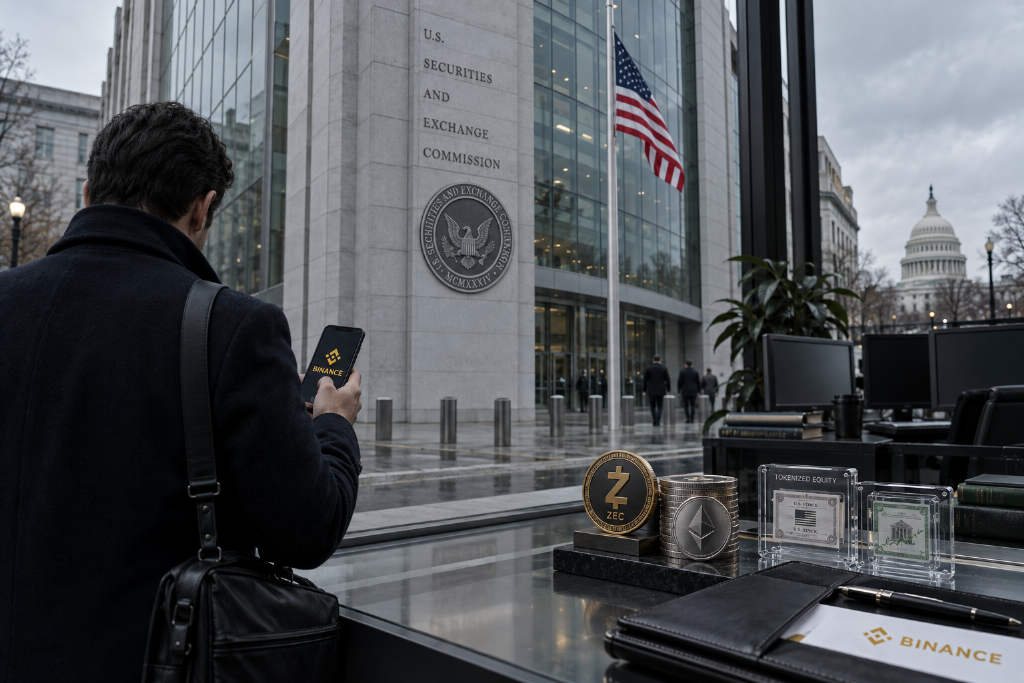
According to the SEC’s official website, the agency on Sept. 17, 2026 issued an “innovation exemption” order granting temporary, conditional relief to tokenized securities venues, or TSVs. The order allows those venues to use permissioned automated market maker liquidity pools to trade tokenized National Market System stocks. The exemption runs for five years.
SEC Chair Paul S. Atkins said the move is intended to bring U.S. capital markets into the digital era.
The main conditions include:
- caps on trading symbols and trading volume;
- tokenized stocks must give holders rights equivalent to those attached to traditional shares;
- smart contracts must be deployed on a public, permissionless distributed ledger and remain auditable;
- trading halts must be synchronized with halts in the underlying NMS stocks.
The SEC is also seeking public comment on the details of the exemption.
Bloomberg: Manus is working on a $500 million raise
Bloomberg reported that Manus, a China-founded artificial intelligence startup, is advancing a financing round of about $500 million and that the deal is close to completion. If completed, the company’s valuation is expected to double to $4 billion.
The report said this would be Manus’s first funding round since its separation from Meta. Existing investors include Tencent Holdings, HongShan, identified in the source as HSG, and ZhenFund. The talks are still ongoing, and final terms could change.
LSK transfers point to possible GSR Markets market-making activity
According to monitoring by Ai Yi, a multisig address, 0xCAa…B0C02, transferred 9.2 million LSK worth about $6.52 million to address 0x9c7…0C04D six hours earlier. Of that amount, 2 million LSK were later sent to a Binance deposit address associated with GSR Markets. Similar activity was seen nine months ago.
LSK briefly rose to $2.37 over the weekend, then fell back to $0.5084, down about 78.5% from the high.
Hayes says rate hikes can still expand money supply in a high-debt setting
Arthur Hayes said that with government debt at elevated levels, a Fed rate hike can have a stimulative effect. Higher interest on bank reserves and higher U.S. Treasury bill yields would increase income for banks and asset holders, which in turn could support consumption and allocations to financial assets.
He added that although the Fed stopped related asset purchases in mid-August, the expansion of bank balance sheets is still increasing the combined assets of the Fed and the banking system, which raises the money supply. In Hayes’s view, the quantity of money is still growing even as the price of money rises, and financial assets may continue to trend higher.
