
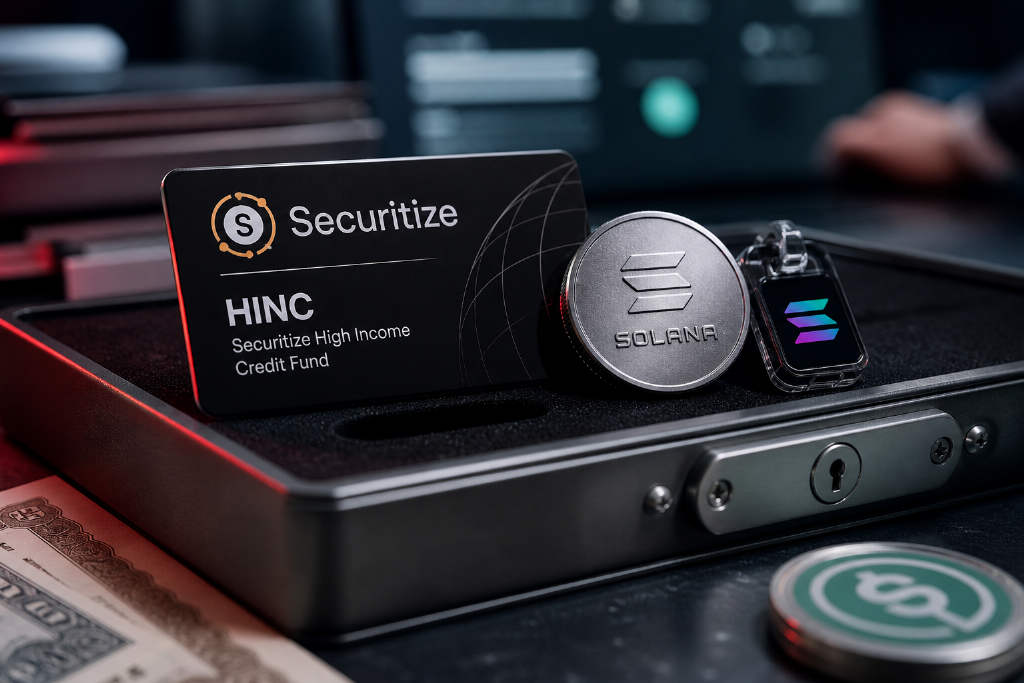
Securitize’s tokenized high-yield credit fund HINC is now live as collateral on Solana lending protocol Loopscale, giving eligible investors a way to borrow the USDG stablecoin against their shares without redeeming the position.
The listing brings sub-investment-grade corporate credit into an onchain lending market where collateral has been dominated by Treasuries, government money-market funds, and investment-grade paper. HINC’s net asset value can move with credit spreads and rating migrations, so Loopscale is taking collateral whose marked value can decline, and one that only allowlisted wallets are allowed to hold.
HINC structure, launch, and investor access
The Neuberger Securitize High Income Tokenized Fund, or HINC, launched on Aug. 18 across Avalanche, Ethereum, Solana, and Sui. The portfolio is made up mostly of high-yield corporate bonds, with the rest allocated to CLO tranches, bank loans, and other high-yielding fixed-income assets. Its CLO allocation can range from 0% to 30% of the portfolio.
Neuberger Berman Investment Advisers serves as sub-adviser. The firm managed $613 billion as of June 30. HINC has a $100,000 minimum subscription and a total expense ratio of 0.60% per year. Shares are available only to accredited investors and qualified purchasers that complete Securitize’s onboarding process.
“Treasuries were a natural starting point for bringing traditional assets into DeFi, but they shouldn’t be the endpoint,” said Carlos Domingo, co-founder and CEO of Securitize. “HINC expands the opportunity into institutional credit.”
The third Securitize product on Loopscale
HINC is the third Securitize product to reach Loopscale. Apollo’s tokenized credit fund ACRED has been usable as collateral there since late 2025, with USDG subscriptions added in January. Securitize’s own NYSE-listed stock, SECZ, went live as collateral on Aug. 20.
Loopscale has $91.3 million in total value locked and $55.9 million in active loans, up 7.1% over the past 30 days, and ranks 27th among lending protocols by DefiLlama. On Solana, it trails Kamino Lend, which stands at $1.25 billion, and Jupiter Lend at $1.07 billion by roughly an order of magnitude.
The protocol was exploited for $5.8 million in April 2025, two weeks after its own launch, and later recovered the funds after agreeing to a bounty with the attacker.
Its markets operate with fixed rates and fixed terms. Borrowers set the collateral, rate, loan-to-value ratio, and duration. Liquidations are partial, meaning the protocol sells only enough of a position to restore the loan to health and leaves the remainder in place.
“HINC adds a fundamentally different type of collateral to Solana credit markets,” said Mary Gooneratne, co-founder of Loopscale. “Supporting an actively managed high-yield strategy demonstrates how onchain lending can extend beyond crypto-native assets and short-duration instruments.”
Daily NAV pricing through RedStone
RedStone prices HINC on Solana, Ethereum, and Avalanche through its Trusted Single Source Oracle standard. Under that setup, the administrator’s daily NAV is published onchain in signed, timestamped, chained form, allowing a protocol to verify that the value came from the administrator and was not altered in transit.
Loopscale uses that feed to value HINC collateral and trigger clearing events.
“Bringing more complex financial assets into onchain lending markets requires dependable valuation infrastructure,” said Marcin Kaźmierczak, co-founder and COO of RedStone.
The design problem posed by a NAV-priced credit fund differs sharply from crypto collateral. There is no intraday gap risk because NAV is struck once each business day. What matters instead is whether a position can be unwound within a bounded number of business days at or near the published mark.
USDG is the borrowable asset
On the borrowing side, users receive USDG. The stablecoin is issued by Paxos Digital Singapore under regulation from the Monetary Authority of Singapore and distributed through the Global Dollar Network. Total supply stands at $3.26 billion, with $610.7 million on Solana, down 6.1% over the past month.
Securitize, a member of the network, has enabled on- and off-ramping between HINC and USDG.
“Stablecoins provide an important liquidity layer for tokenized real world assets,” said Peter Jonas, chief revenue officer at Paxos.
Most tokenized assets still sit idle in DeFi
Securitize’s argument that tokenized assets remain lightly used as DeFi collateral broadly holds up, with an important distinction. Tokenized real-world assets excluding stablecoins account for about $34.1 billion in onchain market value across 217 issuers, according to DefiLlama. Of that, $3.8 billion is active in DeFi, or about 11%.
Most of the idle share sits in Treasury products. BlackRock’s BUIDL, the largest tokenized money-market fund at $2.79 billion, has just $17.7 million deployed in DeFi, a utilization rate of 0.63%. Franklin Templeton’s BENJI and iBENJI both show zero.
Collateral demand is much stronger in credit products. Centrifuge’s Janus Henderson Anemoy AAA CLO Fund, the tokenized CLO strategy that Resolv looped on Aave Horizon in February, runs at 97.8% utilization. Maple’s syrupUSDT is at 88.3%, while Hastra’s PRIME stands at 62.7%.
Risk figures disclosed in Securitize’s Aave filing
Securitize published HINC’s risk figures in a governance filing submitted to Aave on Aug. 18. The filing used an illustrative index blend made up of 70% ICE BofA US High Yield Constrained and 30% J.P. Morgan CLOIE Post-BB, covering the period from July 2016 through July 2026.
On that basis, the strategy produced a 7.21% annualized return. Its worst month was March 2020, when it lost 18.25%. In calendar 2022, it fell 8.97%, with a 13.20% drawdown inside that year. A sudden 200 basis-point widening in spreads would cut NAV by about 7% to 9%, while a 400 basis-point widening would reduce NAV by about 14% to 18%.
The strategy is short interest-rate duration but carries spread duration of three-and-a-half to four-and-a-half years. “This is not a low-volatility asset,” Securitize wrote, adding that the March 2020 result “should be treated as the governing stress case.”
The fund has no operating history. Investors face a 24-hour lock-up and can submit daily redemption requests against a portfolio that may take days to sell. Securitize said explicitly that “the 24-hour lock-up does not reflect practical liquidity.” Its CLO sleeve also carries structural leverage of roughly six to eight times at the BB level.
Aave approval is still pending
The same filing asked Aave Horizon to accept HINC on Ethereum as supply-only collateral, with USDC, GHO, and RLUSD available to borrow against it. Two weeks later, the proposal had not yet reached a Snapshot vote and had not received a published risk assessment.
It still requires a technical assessment, a LlamaRisk review, proof that liquidators have been onboarded, a vote, and a final Aave Improvement Proposal.
A forum comment posted on Aug. 30 questioned whether the proposed liquidation backstop of 3% to 5% of borrowed TVL is enough to cover a four-business-day stress window. It also flagged inconsistent naming of the oracle provider and asked who would compensate stablecoin suppliers if a legally frozen position cannot be liquidated but continues to accrue debt.
On the oracle issue, Securitize’s Aave filing identifies a Chainlink NAV feed wrapped with LlamaGuard dynamic bounds as the primary source for Ethereum, while also listing RedStone among external dependencies. Loopscale configures markets on a collateral-by-collateral basis without a token-holder vote, which is why the Solana venue went live first.
The larger market case and the immediate test
Securitize’s announcement cites a Standard Chartered projection that assets deployed in DeFi will reach $2.7 trillion by 2030. The company then argues that if tokenized assets make up 10% of that market, roughly $270 billion would be put to work onchain.
That math is Securitize’s own. In its Aave filing, the company disclosed that it is HINC’s tokenization platform, transfer agent, and investment adviser, giving it “a direct commercial interest” in the listing.
The immediate test for the Loopscale launch is narrower and more concrete: whether a lending market can hold collateral that only allowlisted wallets can touch, liquidate it inside a T+1 redemption window, and price an asset whose mark moves with credit spreads that borrowers cannot directly see coming.