
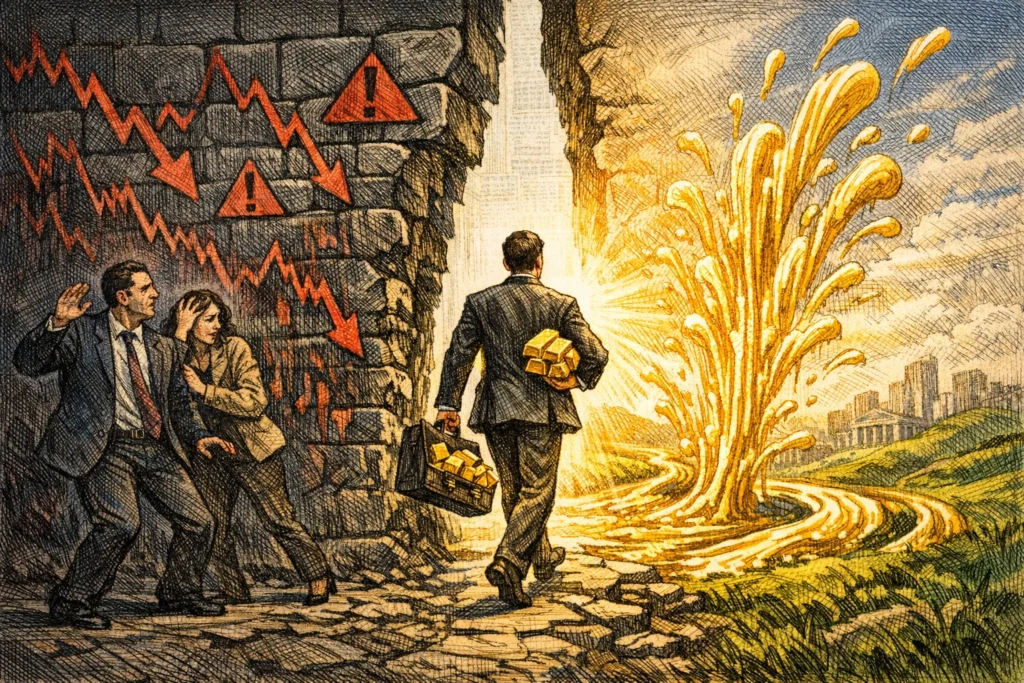
Wall Street’s list of worries has grown longer, but fund flows are telling a different story. Bloomberg reported that chip-stock losses, elevated bond yields and ongoing geopolitical tensions did not stop investors from adding to risk assets last week. The S&P 500 hit a record high, the Nasdaq 100 posted its biggest weekly gain in two months, high-yield bond funds brought in $4 billion, and spot Bitcoin ETFs logged $500 million in net inflows over the five trading days through last Thursday.
Bank of America’s bull-and-bear indicator rose to its highest level since 2021, the report said. That shift in sentiment came after the liquidation turmoil tied to AI hedge fund Situational Awareness, an episode that briefly pushed the Philadelphia Semiconductor Index down 29% from its June high. Investors did not pull back. They treated the move as a buying opportunity.
More than $11 billion rushed into semiconductor ETFs in two days
Situational Awareness was founded by Leopold Aschenbrenner. Bloomberg described the fund’s liquidation turmoil as one of the market’s most dramatic recent events, with the pressure spilling into technology shares. Even so, investors poured more than $11 billion into semiconductor ETFs in just two trading days after the selloff, and those funds then rebounded sharply.
Bloomberg data cited in the report showed that the Direxion Daily Semiconductor Bull 3X ETF, a triple-leveraged product, attracted more than $2 billion over two trading days. It then gained more than 50% across the next seven trading days. Over the same period, the two largest unleveraged semiconductor funds took in more than $7 billion combined, and each rose about 16%.
Flows also reached junk bonds and Bitcoin ETFs
The buying was not limited to chip funds. Citing Bank of America data, Bloomberg said high-yield bond funds recorded $4 billion in net inflows last week, the largest weekly total in two years. Bitcoin ETFs posted $500 million in net inflows over the five trading days through last Thursday, even though Bitcoin has traded sideways in a narrow range for months.
Michael O’Rourke, chief market strategist at JonesTrading, called the move a “tsunami” of momentum buying. “The Situational Awareness event created a near-term low in the AI trade, which unleashed a large wave of momentum chasing,” he said. He added that many investors still prefer to cluster in mega-cap names and that the “Magnificent Seven” remain the main driver of index gains.
A Bank of America team led by Michael Hartnett said the equity rally has spread beyond the technology core. Strong inflows into high-yield debt and tighter credit spreads have also supported the upbeat tone.
High yields remain a live market risk
The report also stressed that risk assets are not rallying in a carefree setting. The 30-year US Treasury yield fell on four of the past five trading days, but it still hovered near its highest level in almost 20 years.
Views differ on what has kept yields elevated. Some market participants blamed the late-July jump on Federal Reserve Chair Kevin Warsh’s reluctance to give clear rate guidance, saying that left investors unsure about the central bank’s anti-inflation stance. Others argued that bond-market action reflected confidence in continued economic expansion.
On Friday, US Labor Department data showed employers unexpectedly cut jobs in July, while the previous two months were revised lower. Bloomberg said the weaker employment report actually lifted stocks and pushed yields down, as traders came to expect that the Federal Reserve would not be forced to raise rates in the near term.
Strategists still favor risk assets, though cautiously
Garrett Melson, portfolio strategist at Natixis Investment Managers Solutions, said market fears have been overstated and that the fundamentals for risk assets remain intact. He kept an overweight stance on US equities, focused on large-cap technology, while staying underweight fixed income, with some exposure to longer duration and selective credit risk.
“At the end of the day, growth is holding up well,” Melson said. “Sentiment and positioning can get stretched, but the overheating is more localized, and sector rotation has helped work off excess froth while keeping support under the indexes.”
Lindsay Rosner of Goldman Sachs Asset Management said the broader economic picture and the return on capital spending are becoming clearer as more data comes in and oil prices stabilize. “What we’re seeing points to an economy that remains strong, while markets are adjusting to current AI supply and continuing the price-discovery process for what comes next,” she said.
Ayako Yoshioka, senior investment strategist at Wealth Enhancement, said semiconductors remain central to AI infrastructure buildout, but the bottleneck may shift toward power shortages as projects advance. She said higher yields still pose a risk, especially as AI infrastructure spending keeps pressing on the bond market.
The buy-the-dip mindset is still in place
Bloomberg said today’s tone is also being held up by a habit investors have learned over and over again: pullbacks have often been brief, and bouts of fear have often turned into buying opportunities.
Nathan Thooft, senior portfolio manager at Manulife Investment Management, said repeated short-lived corrections have reinforced investor confidence. Those who stepped out when uncertainty was highest often missed the largest gains, which tend to arrive during the market’s most volatile stretches.
“There still isn’t a compelling alternative,” Thooft said. “Cash may feel safe, but over the long run it struggles to beat inflation and equity-like earnings growth. As for bonds, we think term premium is still underpriced. Over the past decade, many investors waiting for a better entry point have simply been left behind.”