
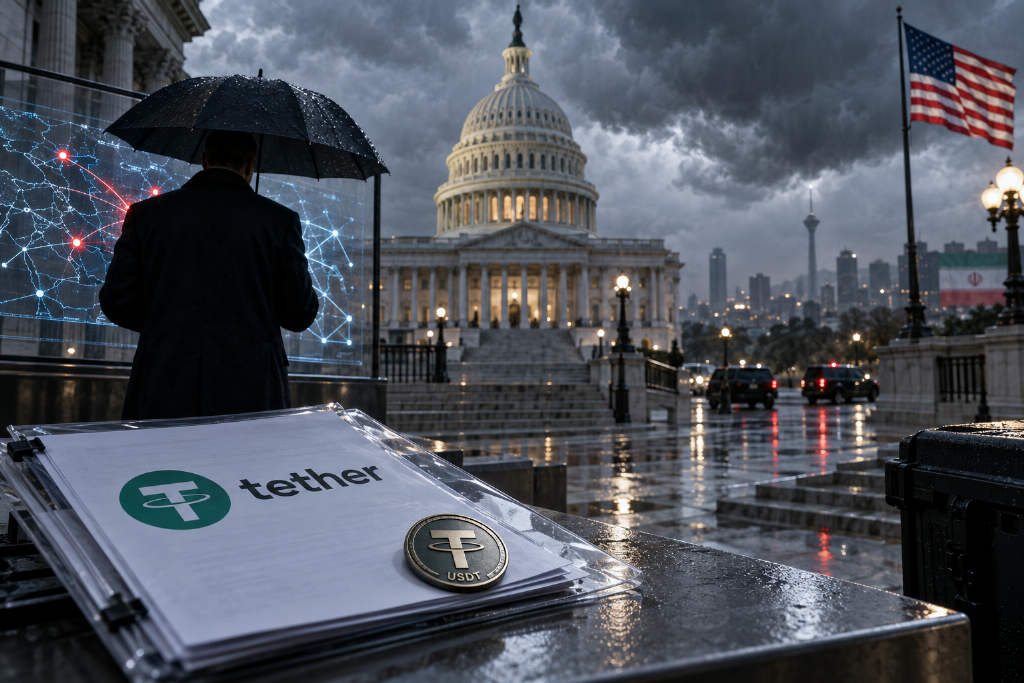
Democratic investigators on the U.S. Senate Permanent Subcommittee on Investigations released a 28-page report on Monday accusing Tether and its flagship stablecoin, USDT, of becoming a central tool in Iran’s “shadow banking system.” The report said Tehran has used the token to bypass sanctions and fund regional proxies, missile and drone programs, and human rights abuses.
The report was led by Senator Richard Blumenthal and drew on an analysis of on-chain transaction data tied to 846 sanctioned or Iran-linked crypto wallets. In a statement, Blumenthal said the findings showed how Tether and its token enabled the Iranian government to defy the sanctions regime. The full report and Blumenthal’s letters to Attorney General Todd Blanche and Treasury Secretary Scott Bessent were released the same day.
Report says 87% of terrorism-financing wallets primarily used USDT
The report’s headline figure focused on wallets tied to Iranian terrorism financing. Of 757 such wallets, 87% primarily transacted in USDT.
Investigators said Iran’s preference for USDT was not surprising. According to the report, crypto exchanges inside Iran widely use USDT, and Tether offers stronger liquidity than alternative stablecoins. With traditional banking channels constrained by sanctions, Iran’s financial network shifted toward on-chain stablecoins, and USDT became the preferred option because of its market share and liquidity.
Investigators focused on whether Tether acted proactively
The report did not frame the issue simply as Iran using USDT. Its main criticism was whether Tether took action on suspicious wallets before receiving formal legal requests. Investigators wrote: “Beyond receiving formal sanctions or seizure notices, Tether has also failed to act on wallets with strong indicators of illicit finance, even though those wallets’ ties to Iranian entities or terrorist organizations were already public.”
In the report’s account, Tether’s freeze mechanism is reactive. It moves when the U.S. government or another jurisdiction sends a formal request, but it did not step in on wallets showing unusual on-chain patterns, financial links to known Iranian entities, or publicly available indicators that investigators said were already sufficient to raise alarms. The report said that falls short of the anti-money-laundering obligations expected in traditional banking.
In his letters to Blanche and Bessent, Blumenthal urged both officials to investigate whether Tether may have violated sanctions and banking laws.
Report also highlighted political ties around Tether
The report also turned to Tether’s political connections in Washington. Blumenthal pointed to Commerce Secretary Howard Lutnick, who led Cantor Fitzgerald before entering government. Cantor Fitzgerald serves as Tether’s custodian, and Lutnick’s sons now run the firm.
It also named Bo Hines, described in the report as a former executive director of the White House crypto council who is now CEO of Tether U.S.
Blumenthal questioned whether Iran’s continued use of USDT, given Tether’s close ties to the Trump administration, suggested that the company had benefited from looser federal enforcement and less oversight on its anti-money-laundering obligations. The report raised that question directly in the context of possible regulatory favoritism.
Tether said it froze $550 million in Iran-linked USDT over the past year
Tether responded the same day in an official statement, saying it had helped freeze $550 million worth of Iran-linked USDT over the past year.
CEO Paolo Ardoino said USDT is not a safe haven for sanctioned actors, terrorist groups, or criminal networks. He said public blockchains provide visibility into fund flows that cash does not, and that Tether takes action when law enforcement provides credible information.
Ardoino’s core argument was that Tether’s role is to cooperate with law enforcement, not to conduct its own investigations. In that framing, blockchain data may be transparent, but Tether acts when authorities provide clear information or instructions. Whether the company should proactively screen wallets is not an obligation it accepts in its response.
Stablecoins were cast as both a sanctions tool and a sanctions workaround
The PSI report placed stablecoins in a dual role. On one side, USDT’s freezing capability makes it a tool for tracing and locking funds. On the other, as long as a wallet has not been flagged, the token can also function as a channel for moving money around sanctions barriers.
The report also noted that after the GENIUS Act passed, U.S. stablecoin issuers were required to hold large amounts of short-term U.S. Treasuries, tightening the link between stablecoins and the U.S. financial system. In that context, the report could become a new pressure point for regulators seeking to push stablecoin issuers toward more proactive anti-money-laundering screening rather than freezing assets only after receiving notice.