

U.S. markets produced an unusual mix in September 2026: Treasuries sold off sharply, while technology shares, especially semiconductors, kept moving higher.
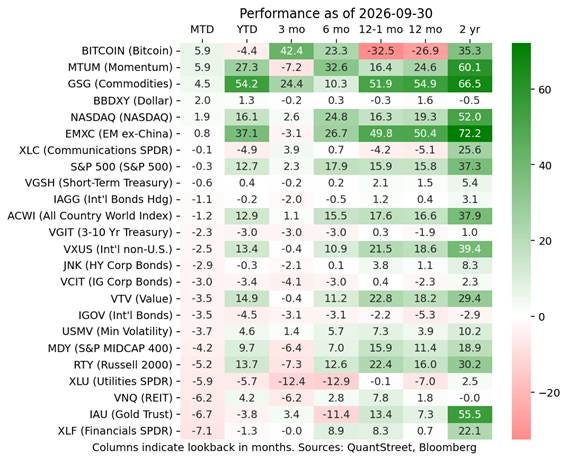
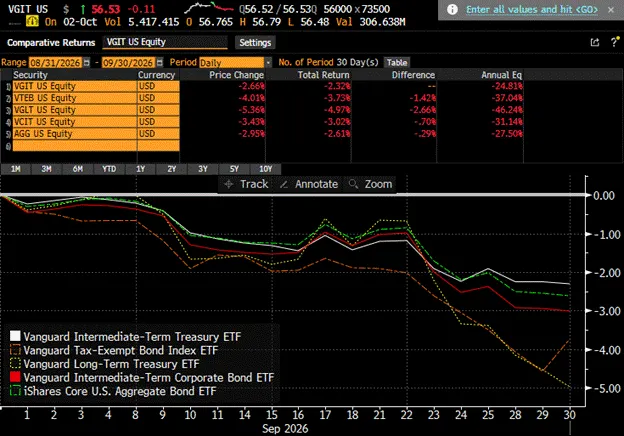
Data cited from the U.S. Treasury showed the 10-year Treasury yield rising from 4.75% at the end of August to 5.29% at the end of September, a 54 basis-point jump in one month. QuantStreet Capital said some U.S. fixed-income assets fell 2.3% to 5% over the same period. Equities did not fall in a uniform way. Bitcoin, momentum strategies with heavy semiconductor and technology exposure, and the Nasdaq all held up, while U.S. small caps, the equal-weight S&P 500, and rate-sensitive groups such as REITs, utilities, and financials were sold down.
In his latest monthly investment letter, QuantStreet Capital founder Harry Mamaysky argued that the first question is simple: what exactly was the bond market pricing?
Most of the September move came from real yields
The key feature of the Treasury selloff, based on the yield breakdown, was that nominal yields rose mainly because real yields moved higher, not because inflation compensation surged alongside them.
Nominal yield is the headline Treasury yield investors usually watch. It includes compensation for expected inflation, the required real return, and other risk factors. Real yield can be thought of as the return after stripping out inflation compensation. In the U.S. government bond market, Treasury Inflation-Protected Securities, or TIPS, are commonly used to track how the market prices real returns. The gap between nominal yields and TIPS yields is the breakeven inflation rate, often used as a reference point for long-term inflation expectations, though it also reflects inflation risk and liquidity effects rather than a pure inflation forecast.
For September, the decomposition was clear. The 10-year nominal Treasury yield rose from 4.75% on Aug. 31 to 5.29% on Sept. 30, up 54 basis points. Within that move, the 10-year real yield increased from 2.44% to 2.93%, a 49 basis-point rise. Implied inflation compensation edged up only from 2.31% to 2.36%, a gain of 5 basis points.
That means more than 90% of the increase in the 10-year Treasury yield was tied to higher real yields rather than higher inflation compensation. On that reading, the central shift in September was not a broad repricing of inflation fear. It was a sharp increase in the real return investors demanded for holding long-term government debt.
The distinction matters because rising real yields and rising inflation compensation point to different macro stories. If yields rise mostly because inflation compensation widens, investors may be signaling concern about future prices and purchasing power. If real yields are doing the heavy lifting, attention turns to growth expectations, the future path of real policy rates, and the compensation investors want for holding long-duration assets.
The article did not argue that inflation risk has disappeared. Inflation itself remains elevated, and oil prices, fiscal policy, and the Federal Reserve’s rate path can all affect market expectations. But based on the September move alone, a pure “inflation worries are back” explanation falls short.
Growth repricing and AI capital demand are part of the debate
Mamaysky discussed several possible explanations for the jump in real yields.
One idea is that confidence in the U.S. dollar is fading. But the dollar actually appreciated in September, which does not fit a story of a broad crisis of confidence in dollar assets.
Another is that investors are becoming more worried about the U.S. government’s ability to repay. Mamaysky argued that if fiscal-credit worries were showing up mainly through future inflation risk, long-term inflation compensation should have risen more clearly. September data did not show that pattern. At the same time, he did not dismiss fiscal risk outright. Greater Treasury supply and a higher risk premium for holding government debt could still push long yields higher even if inflation compensation stays relatively stable.
He focused more on a different explanation: the market may be repricing stronger economic growth and, at the same time, repricing the capital needs tied to continued AI infrastructure expansion by large technology companies.
In that framework, AI is the key variable. As investment in artificial intelligence infrastructure keeps expanding, hyperscalers are spending heavily on data centers, GPUs, compute capacity, power systems, and network infrastructure. Those outlays imply larger demand for capital.
At the macro level, if companies want to invest more while the pool of long-term capital does not expand at the same pace, the price of capital can rise. There is another channel as well. If investors think AI will lift future productivity and generate more corporate profit, they may also revise upward the real returns they expect over the long run. Both forces can be linked to higher real yields, but they are not the same story. One is about financing conditions and capital demand. The other is about future economic returns.
ING, in recent research cited by the article, raised a similar point. The effect of AI on bond yields may not come only from debt-funded spending by technology firms. It may also appear through productivity gains and stronger long-term growth expectations, which would show up in real yields.
Still, the piece was careful on causality. These are market interpretations, not confirmed cause-and-effect relationships. Higher real yields do not by themselves prove that AI is accelerating U.S. growth, and they do not prove that AI financing demand was the dominant driver of the Treasury selloff.
For Mamaysky, the attraction of this explanation comes largely from the way equities behaved. If the rise in Treasury yields were entirely a sign of worsening economic prospects, stocks would usually face broader pressure. Yet AI-linked names, especially semiconductors, remained strong in September, suggesting that investors still see long-term earnings growth in at least part of the technology sector.
Why AI stocks can rise even as discount rates move up
Under a standard valuation framework, higher long-term real yields are usually bad news for growth stocks. Stock prices reflect the discounted value of future cash flows. When the required rate of return rises, the present value of future profits falls. That effect is often stronger for growth companies whose profits are expected to arrive farther out in time.
September’s AI trade suggested that another force was also at work.
The VanEck Semiconductor ETF, SMH, rose about 9.4% in September, while the equal-weight S&P 500 index, SPW, fell about 4.8%. That gap pointed to a sharp split between technology leadership and the broader market. Mamaysky framed it as a battle between the numerator and the denominator in valuation. A higher discount rate increases the denominator and pressures valuations. Higher expected profit growth lifts the numerator and can offset part, or even all, of that drag.
In other words, the market may not be ignoring higher rates. It may simply believe that future earnings growth from AI is large enough to absorb higher financing costs and a higher discount rate.
Momentum ETFs with major positions in AMD, Micron, Intel, Cisco, and Applied Materials performed well in September, and semiconductors remained a major driver of the advance. There is some basic business logic behind that move. AI infrastructure buildout requires chips, servers, and related equipment, so upstream suppliers can capture orders and revenue early in the cycle.
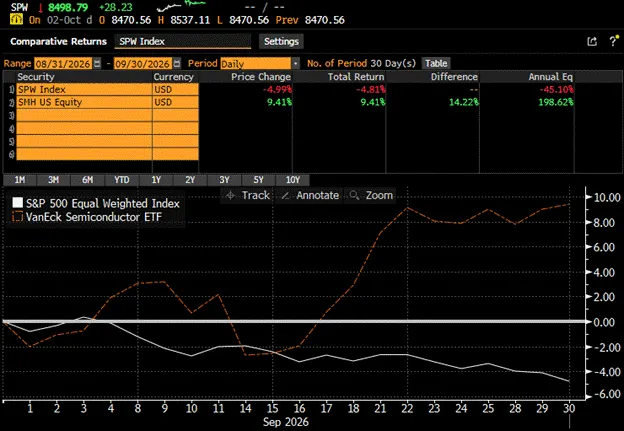
That also leads to Mamaysky’s biggest concern. Semiconductor shares continued to rally while the equal-weight S&P 500 stayed weak. The market is assigning a strong earnings outlook to AI infrastructure suppliers, but not to the rest of corporate America to the same degree.
He referred to that broader group as ROCS, short for the Rest of the Corporate Sector. In his view, companies buying AI chips are willing to commit large amounts of capital because they expect eventual economic returns through higher productivity, and investors are willing to finance those profits before they are fully realized.
It is not surprising, in that sense, that every industry is not rising at the same time. The harder question is about the market’s forward-looking nature. If investors were already convinced that AI would materially improve the future earnings power of non-tech companies, those expectations should begin to appear in the valuations of those companies as well.
That broad repricing did not happen in September. Chip suppliers are already generating revenue, while the companies buying those chips have not yet shown a widespread profit improvement. That leaves an open commercial loop in the current AI trade: the revenues flowing to upstream suppliers ultimately have to be supported by lasting economic value created downstream. If AI fails to generate enough profit across the broader corporate sector, then continued spending on chips, data centers, and financing could start to erode returns.
Mamaysky did not say AI is already a bubble. He said he still believes in AI’s long-term economic value, but the market needs more evidence that the gains are spreading from the technology sector to other parts of the economy.
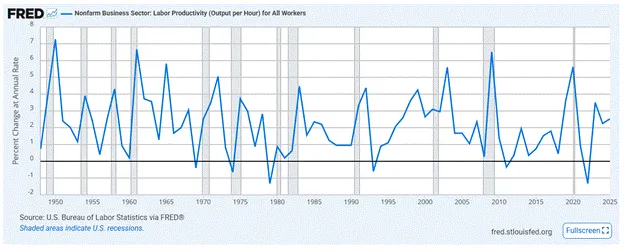
Labor productivity data from the U.S. Bureau of Labor Statistics have shown some encouraging signs, with recent productivity growth running above the long-term average since 2010. But the article noted that this improvement cannot be attributed entirely to AI, and it does not directly prove that companies are already earning enough incremental profit to cover the investment bill. On that reading, both the bond market and the stock market are waiting for the same answer: can future growth deliver the returns that are already being priced in?
Term premium is the other major risk
Reading higher Treasury yields as a sign of stronger growth can explain part of the cross-asset picture, but it has limits. A rise in real yields does not automatically mean better growth expectations.
Long-dated Treasury yields reflect not only expectations for future short-term rates but also term premium, the extra compensation investors demand for taking on the price volatility and other risks of holding long-maturity bonds. Term premium can capture rate uncertainty, fiscal supply, market demand, and a range of other risks. Even if inflation compensation stays fairly stable, long yields can still move up if investors become less willing to lock up money for a long period without more compensation.
That distinction matters in the current setup. Reuters said in a market analysis on Oct. 7 that the term premium on the U.S. 10-year Treasury had climbed to about a 12-year high. That suggests the increase in long-term yields may reflect not just growth expectations, but also a broader reassessment of fiscal conditions, monetary policy, and the risk of owning long-duration bonds.
The article also stressed that real yields and term premium are not two clean, separate figures that can simply be added together. TIPS real yields may themselves contain a real term premium. So the roughly 49 basis-point rise in real yields during September does not mean that all 49 basis points came from stronger growth expectations.
The distinction matters for asset pricing. If higher real yields mainly reflect better growth expectations, future corporate profits may rise as well, allowing some stocks to absorb higher discount rates. If higher real yields and nominal yields are being driven more by term premium, companies may face rising financing costs without a matching improvement in earnings. In that case, higher rates would put more direct pressure on stock valuations, bond prices, and investment activity.
QuantStreet made only limited allocation changes
That is why the article argued it is too early to treat the Treasury selloff as a clear positive signal about growth simply because AI stocks were strong. QuantStreet does not see enough evidence yet to make a broad shift toward one asset class.
On the equity side, the firm remains relatively overweight value stocks and low-volatility shares, aiming to keep exposure to the broader corporate sector while still holding some technology exposure in portfolios with higher risk tolerance.
On the bond side, it has started to make modest adjustments. Mamaysky said bond valuations became more appealing once the 10-year Treasury yield reached about 5.25%. QuantStreet has therefore begun to extend duration somewhat in lower-risk portfolios, increasing exposure to bonds that are more sensitive to rate moves.
That does not amount to a full bullish turn on long-duration bonds. Its models still do not favor longer-duration assets, and overall bond duration remains below benchmark, though the underweight has narrowed.
He also said certain evergreen private equity funds and other alternative assets may play a diversification role for suitable investors, but liquidity and valuation risk in those products still need to be assessed separately.
Those adjustments reflect caution rather than conviction. Long-term yields are becoming more attractive, but there is still no clear answer on whether the forces pushing them higher have started to fade.
Three signals the market is now watching
The article highlighted three areas to watch next.
- First, how long-term real yields and term premium evolve, which may help separate growth repricing from risk compensation.
- Second, whether AI investment begins to improve productivity, margins, and cash flow in non-technology businesses.
- Third, whether Federal Reserve expectations, fiscal financing needs, and long-dated Treasury supply continue to push yields higher.
If growth and corporate earnings keep improving, high real yields and strong equities may coexist for a time. If term premium continues to rise while AI returns fail to materialize, then even the technology shares that have so far held up under higher rates could face a more difficult valuation test.
The main signal from September’s Treasury selloff, according to the piece, was not that inflation expectations had spun out of control again. It was that investors demanded a meaningfully higher long-term real return. The unresolved question is what that higher return requirement actually reflects: stronger confidence that the economy can generate more profit in the future, or rising risk in holding long-duration assets.
Both stories can push Treasury yields higher. They imply very different paths for stocks, bonds, and the AI investment cycle.