
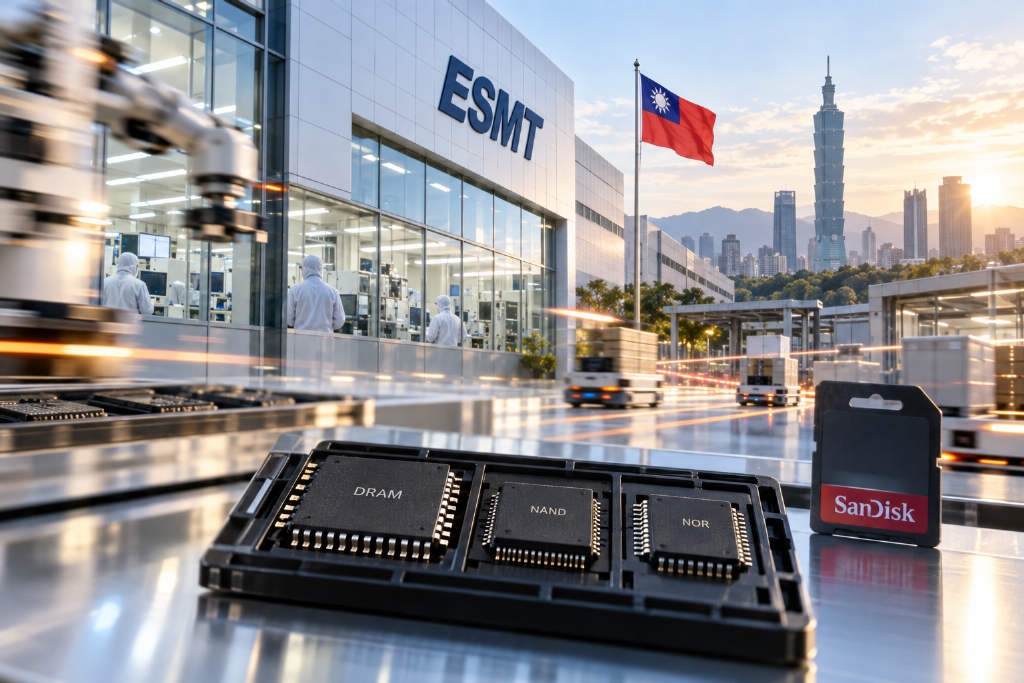
Serenity, described by local communities as the "white-haired stock guru," recently highlighted Taiwan-listed ESMT (3006), arguing that the memory maker could track a move similar to SanDisk (SNDK) after earlier gains tied to rising memory prices.
The case rests on a simple pricing argument. For end products, a legacy memory chip rising by a few dollars may not make much difference. For ESMT, Serenity said, that same increase in average selling price, or ASP, could translate into a meaningful jump in profit.
Why a small DDR2 price move can matter to suppliers
Serenity used DDR2 to explain the idea. Based on pricing from component distribution channels including LCSC, an older DDR2 memory chip costs about $0.96, with some versions around $2.5 depending on specifications.
If ASP were to rise to three times its original level, the added bill-of-materials cost for an end device might be only about $2. The article cited a D-Link network camera priced at roughly $33 as an example. Even if the device absorbed an extra $2 because of higher DDR2 prices, that increase might still be acceptable to the end buyer.
For upstream chip suppliers, the math looks very different. Because the original selling price of the chip is low, a large enough supply gap can push ASP up by multiples, creating strong leverage on gross margin and earnings. That is why Serenity said ESMT could "start cooking like SanDisk."
TrendForce data points to tighter supply in mature DRAM
Market data cited in the report moved in the same direction. TrendForce said in June that major DRAM makers have continued shifting capacity toward HBM and server DRAM, tightening supply for mature-node DRAM. As a result, older-generation products such as DDR2 and DDR3 have seen demand return.
TrendForce estimated DDR2 contract prices rose about 55% to 60% in the second quarter of 2026, with another 35% to 40% increase still possible in the third quarter.
According to the report, large manufacturers did not exit DDR2 because demand disappeared. They moved away because HBM and DDR5 offered better economics, making them unwilling to keep limited capacity on mature products. That, in turn, improved pricing power for Taiwan suppliers still producing DDR2, DDR3 and low-density DRAM.
SLC NAND and NOR Flash are also in an upcycle
Serenity's focus was broader than DDR2 alone. The report said the bigger point is ESMT's overall product mix. In July, TrendForce estimated that SLC NAND contract prices in the second half of 2026 could rise another 120% to 170% from the first half.
The reasons listed were a continued shift of mature NAND capacity toward higher-layer 3D NAND, a shortage of MLC NAND supply, and demand moving into SLC NAND from industrial control, automotive, networking and edge AI customers. That has tightened an already limited supply base.
NOR Flash is also in a price upcycle. TrendForce had previously said cumulative contract-price gains for both NOR Flash and SLC NAND in the first half of 2026 had already exceeded 100%. With no large-scale new capacity added in the second half, prices still had room to keep rising.
In Serenity's framing, DDR2 is only one product category. The main point is that several of ESMT's mature and niche memory product lines are moving through the same pricing cycle at the same time.
ESMT has started prioritizing higher-priced orders
ESMT's operating strategy appears to reflect that supply-demand setup. MoneyDJ reported that the company has begun allocating low-density DRAM and NOR Flash to higher-priced orders with manageable delivery schedules, adopting a more selective approach to bookings.
Its wafer capacity secured for 2026 is broadly similar to last year, and can satisfy only about 60% to 70% of customer demand. According to the report, the company's main constraint at this stage is no longer demand, but supply.