
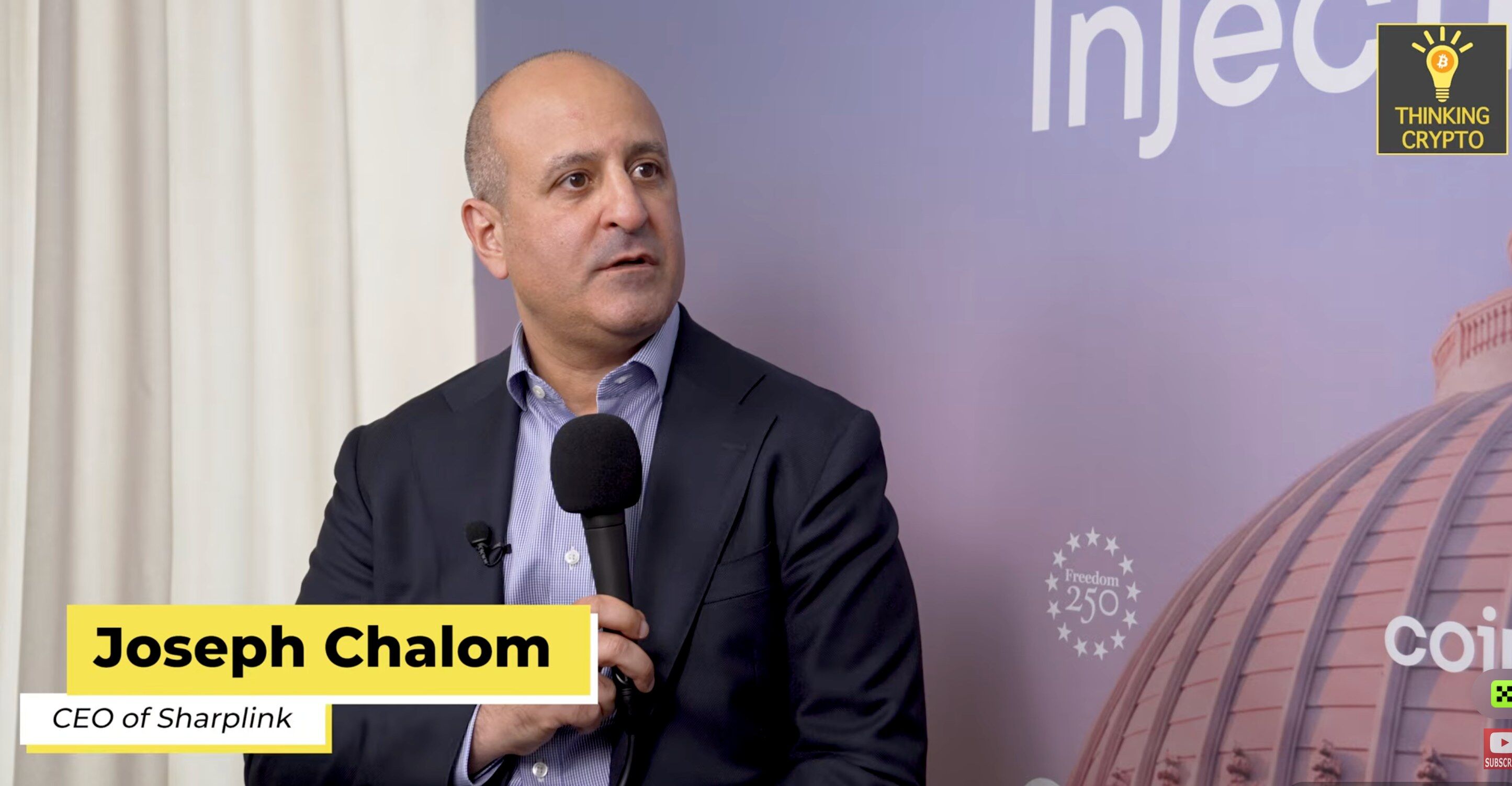
SharpLink executive Joseph Chalom said Ethereum’s market narrative has turned more negative than the underlying data would justify, arguing that sentiment has diverged from fundamentals even as the network keeps its lead in several core sectors.
In an interview with Tony Edward recorded in Washington during Injective Summit 2026, Chalom described SharpLink as a digital asset treasury management company that has raised billions of dollars to buy Ether and put those holdings to work. He said two developments stood out over the past month: the company returned to the public market for equity financing, bought back ETH at what he described as attractive prices, and repurchased some stock; and it also began backing Ethereum ecosystem spinouts alongside ConsenSys founder Joe Lubin and Bitmine’s Tom Lee.
Chalom says Ethereum is still leading where institutions are looking
Asked about the wave of criticism aimed at ETH and the Ethereum Foundation, Chalom said the gap between reality and sentiment has been visible for roughly the past year and a half.
He pointed to Ethereum’s share of more than 50% of stablecoin transaction volume, close to 60% of tokenized real-world assets, and what he called the overwhelming majority of DeFi activity. On that scorecard, he said, Ethereum is still winning.
In his telling, the darker tone in the market has come partly from the broader slowdown in the crypto industry and partly from the way the Ethereum Foundation has handled a restructuring of its role. Chalom said the foundation, despite what he called a strong decade of work, chose to slim down and let more of the roadmap execution shift to outside participants. That change, he said, was not communicated clearly enough to preserve confidence across the ecosystem.
He added that some large ETH holders and long-term ecosystem participants have stepped in as stewards, backing that position with capital rather than statements alone.
Three Ethereum Foundation spinouts backed by SharpLink, Lubin and Tom Lee
Chalom said the Ethereum Foundation is now concentrating more tightly on privacy, censorship resistance and the principles needed to preserve Ethereum’s credible neutrality over the coming decades. As a result, several key functions and people have spun out into separate teams.
According to him, three such groups emerged over roughly the past three weeks and have received support from Lubin, Chalom and Lee.
- ETH Labs, which he described as a group of top Ethereum developers building the scaling capabilities institutions need.
- Ethereum Institutional, which he said serves as Ethereum’s market-facing and business development arm after spinning out of the foundation.
- EthSystems, focused on next-generation privacy and compliance capabilities on Ethereum, which Chalom said are essential for large institutions that need to transact without exposing sensitive data.
He framed those efforts as three separate pieces of the same institutional adoption push: scaling, go-to-market execution and privacy-compliance infrastructure.
Why institutions start with Ethereum
Chalom said institutions preparing for tokenization and deeper DeFi activity tend to begin with Ethereum before expanding elsewhere. He tied that to a specific set of attributes: outside Bitcoin, Ethereum has been running the longest, has never gone down, remains highly trusted, offers deep liquidity and still has a multi-year, aggressive scaling roadmap.
He also spent time on decentralization itself. In his view, a truly decentralized blockchain matters because once rules are set, no single actor should be able to change them. For institutions moving financial rails that may be 40, 50 or 60 years old, a network that is not controlled by one person or one treasury is a major consideration.
Drawing on his 20 years at BlackRock, Chalom said large financial firms making a once-in-a-generation infrastructure shift will look first to systems they view as reliable, secure and liquid.
SharpLink’s playbook: buy ETH, stake it, use DeFi and avoid leverage
On how SharpLink creates shareholder value through a down market, Chalom said the first step is straightforward: deploy raised capital into ETH, then make those assets productive from day one.
He called ETH a productive asset because it can be staked. He put staking yield at roughly 2.5% to 3%, and said SharpLink has been doing that while trying to outperform the native staking baseline.
The company is also using DeFi. Chalom said SharpLink has announced a $125 million fund with Galaxy, another public company, using ETH to seed new protocols and help them build total value locked, or TVL, and initial capital. In his words, that approach pushes ETH returns above plain staking.
He said the real test for public digital asset treasury companies comes when a business is only a few months old and runs straight into a consolidation phase or a crypto winter. SharpLink’s answer, he said, has been to stay conservative: no borrowing, no preferred shares and no loans secured by its ETH. That, he said, is how the company protects investors while carrying billions of dollars’ worth of Ether through a weak market.
Chalom acknowledged that a downturn is not enjoyable, but said disciplined treatment of investors matters most in that period. He added that ETH has risen about 20% from its low since the latest announcements, and said short-term conditions remain difficult even as the longer-term adoption case looks stronger than ever in his view.
His contrast with Bitcoin treasury models
Chalom said he respects Michael Saylor and credited him with creating a new form of public-market exposure to Bitcoin through listed companies.
Still, he argued that Bitcoin treasury vehicles face a structural issue that Ethereum does not. Because Bitcoin is not a productive asset on its own, he said, companies often need to financialize their equity through instruments such as convertible debt or preferred stock if they want to keep compounding exposure or generating returns. That can leave them in a position where they may eventually need to sell reserve assets.
He said that dynamic has been a challenge for Bitcoin treasury companies because large net buyers can turn into sellers, which he argued is not helpful for short-term price action.
How he sees tokenization taking shape
Chalom said tokenization, whether in the form of dollar stablecoins or tokenized Treasuries and other real-world assets, has been around for roughly eight to nine years. Progress, he said, has been slower than many expected because regulatory clarity has been limited.
He laid out a simple stack for how the market fits together. Stablecoins are the money layer or value layer of future finance, tokenized assets are the exposure layer, and DeFi is the execution layer. Once those layers are in place, he said, the system can move. He added a fourth layer as well: agentic systems, which he described as the automation layer.
In his account, the market is already moving beyond tokenizing only new funds. Existing multibillion-dollar funds are being tokenized, and stocks are now entering that process as well. Institutions, he said, have moved from learning to experimentation and are now entering production, turning the market into a race not to fall behind.
Why the Clarity Act matters, in his view
Chalom said he fully supports the Clarity Act and sees three effects from it.
First, he said the bill would draw a clearer line between DeFi developers who provide software and protocols that actually hold customer assets. In his description, software providers should not be responsible for every action that occurs on top of the code, while protocols that custody customer assets should be regulated and held accountable. That distinction, he said, would brighten the path for DeFi.
Second, he argued the act would improve sentiment and momentum. Even a modest tailwind can have an outsized effect in crypto markets, he said.
Third, he said large institutions whose leadership already has an interest in digital assets would move faster once there is a visible sign of government approval and clearer oversight. He said he expects to see a lot of momentum this summer and believes tokenization will move toward becoming normal rather than exceptional.
His case for 24/7 markets
On the coexistence of tokenized securities and traditional securities, Chalom said the main challenge is fragmented liquidity. For digital versions of stocks or funds to succeed, they need trading volume and liquidity comparable to their traditional counterparts.
At the same time, he said it is normal for analog and digital systems to coexist during a technology shift. He compared them to slow trains and high-speed trains running on parallel tracks, with the faster system eventually setting the direction.
He gave a concrete example. If a government announces a war in the Middle East on a Friday night, an investor holding a digital onchain version of an asset can react immediately over the weekend. A holder of the traditional version cannot. Whether the trade is buying oil companies or selling consumer cyclicals, the digital format allows views to be expressed in a 24/7 market.
At some point, he said, fiduciaries deciding between analog and digital versions are likely to prefer onchain assets because they trade around the clock, are programmable and can settle instantly. He added that this tipping point is still years away and that liquidity must also shift toward the stronger venue.
Chalom also pointed to moves by Nasdaq and the New York Stock Exchange toward 23-hour, seven-day or full 24-hour trading windows. He added that DTCC, which he said clears and settles about $400 trillion in transactions annually, launched onchain collateral tokenization this week. Announcements like that are becoming ordinary, he said, even though they would have moved the market sharply three or four years ago.
SharpLink’s roadmap: accumulate ETH and act as an ecosystem steward
Chalom said SharpLink’s most important job now, aside from accumulating ETH and maximizing its productivity, is to step up as a steward of the Ethereum ecosystem. That means funding new capabilities, backing the teams spun out of the Ethereum Foundation and helping Ethereum go to market.
He said the logic is straightforward: helping Ethereum win, at both the Layer 1 and Layer 2 levels, aligns directly with shareholder interests if ETH becomes a high-demand settlement and trust asset.
He also drew a line around what SharpLink will not do. The company does not intend to take part in Ethereum core protocol governance, which he described as fully decentralized. It will, however, fund talent and market-development efforts that it sees as important to Ethereum’s long-term adoption.
Odaily’s additional note on holdings and market data
Odaily said in its introduction that ETH briefly approached $2,000 this week, while the ETH/BTC ratio reached 0.03, the highest level in nearly three months. The outlet also noted that after about eight months without a major new purchase, SharpLink bought another 10,000 ETH in June at an average cost of about $1,611. That brought the company’s total ETH holdings to 886,725 ETH.