
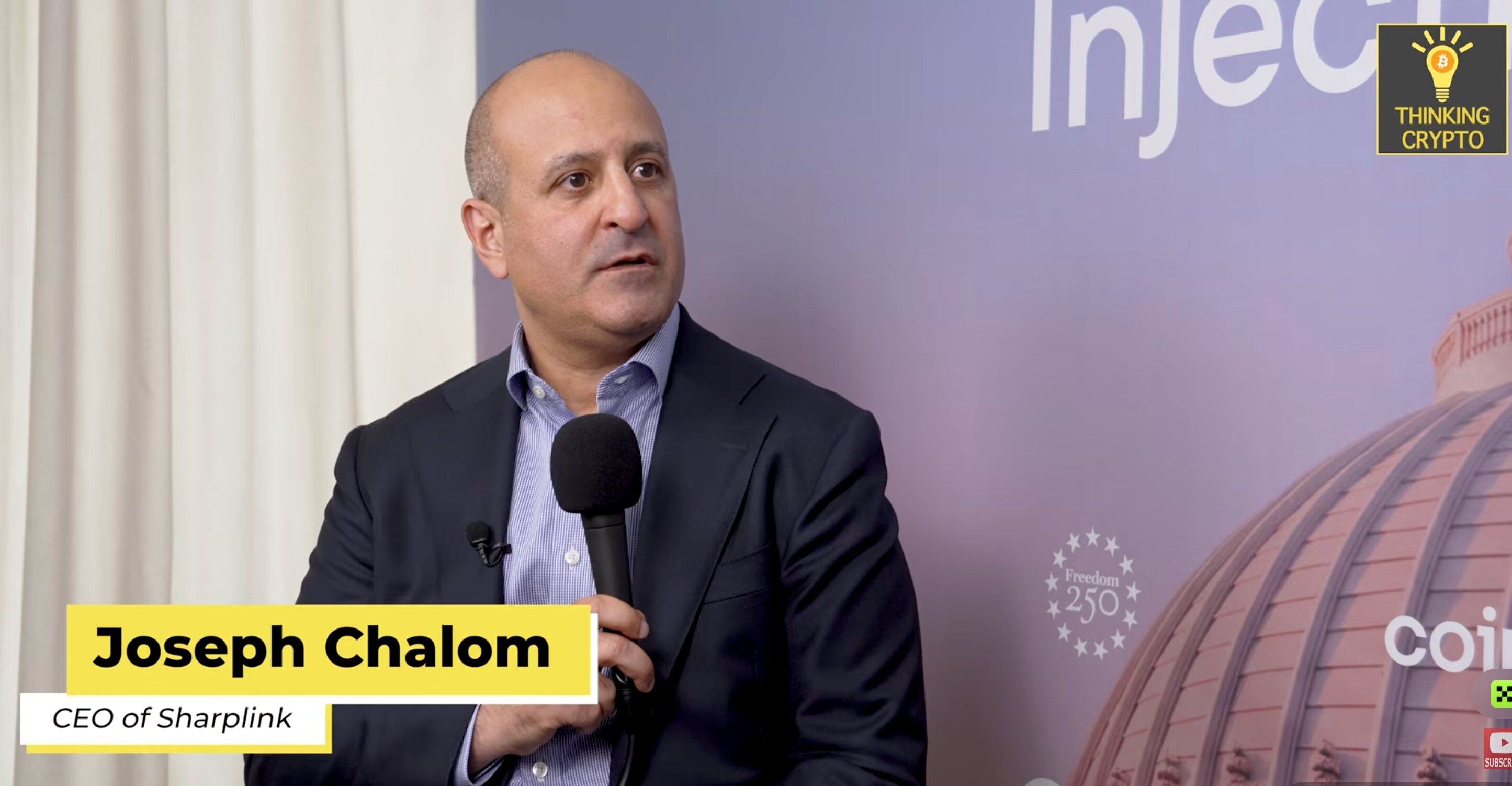
SharpLink co-CEO Joseph Chalom said sentiment around Ethereum has become disconnected from fundamentals, arguing in an interview at the Injective Summit 2026 in Washington that the network is still leading in several of crypto’s most important segments even as the market remains downbeat.
Chalom said SharpLink has raised billions of dollars to buy Ethereum and make those holdings more efficient. Over the past month, he said, the company returned to public markets for an equity raise, bought back ETH at what he described as attractive prices, repurchased some stock, and began backing Ethereum ecosystem spinouts alongside ConsenSys founder Joe Lubin and Bitmine’s Tom Lee.
“Ethereum is winning,” but the message has not landed
Asked about persistent negativity around ETH and criticism directed at the Ethereum Foundation, Chalom said the gap between reality and market mood has been building for roughly the past year and a half.
His case was straightforward: Ethereum accounts for more than 50% of all stablecoin transaction volume, nearly 60% of tokenized real-world assets, and the great majority of DeFi activity. By those measures, he said, Ethereum is still ahead.
He tied the weak mood to two things. One is the broader industry slowdown. The other is the Ethereum Foundation’s decision, after what he described as about a decade of strong work, to slim down and let more parts of the ecosystem help carry the roadmap forward. In his telling, the way that transition was communicated left the ecosystem with less clarity and less confidence even while core performance stayed strong.
That, he said, is why some of Ethereum’s large holders and ecosystem stewards have stepped in with capital rather than statements. Chalom said the effort is meant to support capabilities the market will need in the next phase.
Three spinout teams backed by SharpLink, Lubin and Tom Lee
Chalom described Ethereum as the longest-running blockchain after Bitcoin, one that has never gone down and still offers the strongest mix of security, trust and liquidity. He also said Ethereum has a multi-year and aggressive scaling roadmap already in motion.
The Ethereum Foundation, he said, is now concentrating more tightly on privacy, censorship resistance and core principles needed to preserve credible neutrality over decades. As that happens, some important people and functions are moving outside the foundation.
Over roughly the past three weeks, three teams have spun out of the Ethereum Foundation with backing from Lubin, Chalom and Lee. He said all three are directly tied to institutional adoption.
- ETH Labs, a group of leading Ethereum developers building scaling capabilities institutions need.
- Ethereum Institutional, the ecosystem’s market-facing and business development arm, now operating outside the foundation with external support.
- EthSystems, a team building next-generation privacy and compliance capabilities on Ethereum for large institutions that need to transact while protecting sensitive data.
Chalom said they may look like separate efforts, but taken together they cover what he sees as the most important pieces for driving institutional adoption over the next year and beyond.
Why institutions start with Ethereum
The interviewer noted that many institutions preparing for tokenization and deeper DeFi activity tend to begin on Ethereum before expanding elsewhere. Chalom agreed and framed the issue through his own background, saying he spent 20 years at BlackRock and understands how large financial firms think about infrastructure shifts.
When firms are considering moving financial rails that have been in place for 40, 50 or 60 years, he said, they first look for systems they trust: systems that do not go down, that are secure, and that have the deepest liquidity.
He also said decentralization remains underappreciated in those discussions. For institutions making what he called a once-in-a-generation infrastructure migration, a chain cannot be controlled by one person or one treasury. Rules must not be changeable at the discretion of a single actor. That, in his view, is one of Ethereum’s strongest institutional selling points.
SharpLink’s bear-market playbook: buy ETH, then make it productive
On how SharpLink creates shareholder value during a downturn, Chalom said the digital asset treasury boom last summer produced roughly six or seven Ethereum treasury companies and about five Solana treasury companies. Only a small number, he said, were able to raise billions and launch at scale.
SharpLink’s approach is to buy ETH with that capital and put it to work immediately. In his words, ETH is a productive asset. It can be staked to earn 2.5% to 3%, and SharpLink has been doing that while trying to outperform the native staking baseline.
The company also uses DeFi. Chalom said SharpLink announced a $125 million fund with fellow public company Galaxy, using ETH to deploy into new protocols so they can bootstrap and build what he called TVL, or total value locked, as well as initial capital. The result, he said, is a higher yield on the company’s ETH than simple native staking would provide.
Chalom drew a line between that strategy and more aggressive balance-sheet management. SharpLink, he said, has not borrowed money, issued preferred stock, or pledged its ETH as collateral for loans. The company chose to stay conservative through the market winter, and he presented that decision as a way to protect investors when conditions turned difficult.
He added that surviving a cold period is rarely enjoyable, but the point is to come out of it with the balance sheet intact. In his view, SharpLink is now positioned well for a recovery, and he said ETH has already rebounded by about 20% from its lows since the company’s recent announcements.
His contrast with the Bitcoin treasury model
Chalom said he respects Michael Saylor and credits him with creating a new kind of listed vehicle for gaining bitcoin exposure through public equities.
Even so, he argued that bitcoin treasury structures face a built-in limitation because bitcoin itself is not productive. To keep building exposure and generating additional returns, companies often need to financialize their stock through instruments such as convertible debt or preferred shares.
That can create pressure later, he said, because firms may find themselves having to sell reserve assets. Chalom called this a challenge for the Bitcoin treasury model and said digital asset treasury companies, including Michael Saylor, have shifted from being major net buyers of bitcoin to becoming sellers, which he said is not helpful for short-term price action.
Tokenization is moving from learning to production
Turning to the institutional outlook, Chalom said tokenization has already been around for eight to nine years, whether in the form of dollar tokenization through stablecoins or tokenized Treasuries and other real-world assets. Progress, he said, has been slower than many expected because regulatory clarity has been lacking.
He broke the stack into simple layers. Stablecoins are the dollar layer or value layer of future finance. Tokenized assets are the exposure layer. DeFi is the execution layer.
Once those three layers are in place, he said, the market can really start moving. He pointed to not only the tokenization of new funds, but also the tokenization of existing multi-billion-dollar funds and of equities themselves.
He then added a fourth layer: automation. In his framing, agentic systems will become that layer on top of cash, assets and execution. Institutions, he said, have already moved beyond learning into experimentation and are now entering production. The competitive dynamic from here is simple: firms do not want to be left behind.
Why he sees the Clarity Act as a catalyst
Asked whether passage of the Clarity Act would give institutions more confidence, Chalom said yes, “100%.”
He listed three reasons. First, he said the bill would help draw a clearer line around responsibility in DeFi. If a party is merely a software provider, it should not be responsible for actions taken on top of that software. If a DeFi protocol is actually holding client assets, then it should be regulated and held responsible for what happens there. That distinction, he said, would make DeFi’s path clearer.
Second, he said the bill would change sentiment and momentum. Crypto can move quickly with even a modest tailwind, in his view.
Third, he said institutions whose leadership is already interested in digital assets could move faster once they have what he described as a government stamp of approval. Chalom said he expects more momentum this summer and thinks tokenization will eventually become normal rather than exceptional.
The big challenge for tokenized assets: liquidity cannot stay split forever
On the issue of tokenized versions of stocks existing alongside traditional versions, Chalom said the main challenge is fragmented liquidity. For tokenization to succeed, he said, digital versions of stocks or funds need trading volume and liquidity that are comparable to their traditional counterparts.
He said old and new systems often coexist during technological transitions, comparing them to slow trains and high-speed trains running on parallel tracks. Over time, he expects the market to converge on the faster system.
He made the point with a specific example. If a government announces a war in the Middle East on a Friday night, an investor holding the traditional version of a stock cannot react over the weekend. A holder of the digital on-chain version can trade 24/7, go long oil companies, or sell consumer cyclical names immediately.
At some point, he said, fiduciaries choosing between analog and digital forms of the same asset are likely to favor the on-chain version because it offers round-the-clock trading, programmability and instant settlement. He added that the tipping point may still be years away, but he was clear about the direction.
Nasdaq, NYSE and DTCC are already moving
The interviewer said exchanges, major institutions and banks are all moving toward round-the-clock markets. Chalom answered that Nasdaq and the New York Stock Exchange are transitioning toward 23-hours-a-day, seven-days-a-week trading, or full 24-hour access.
He also pointed to DTCC, the Depository Trust & Clearing Corporation, which he said this week launched on-chain collateral tokenization. Chalom described DTCC as the clearing and settlement infrastructure that handles about 400 trillion transactions a year.
Announcements like that now arrive almost daily, he said. Three or four years ago, the same kind of news would have been enough to shake the market. To him, the fact that they now feel routine is a sign that momentum is building rather than fading.
SharpLink’s roadmap: keep accumulating ETH and act as an ecosystem steward
Near the end of the interview, Chalom said SharpLink’s most important job today, beyond accumulating ETH and earning yield on it, is to act as a steward for the ecosystem.
That means putting capital into new capabilities, backing projects spun out of the Ethereum Foundation, and helping Ethereum go to market more effectively. He said that work is fully aligned with shareholder interests because helping Ethereum win, at both Layer 1 and Layer 2, also supports the long-term case for ETH as a settlement and trust asset in high demand.
He set limits as well. SharpLink will not take part in Ethereum’s core protocol or in governance, he said, because those functions should remain fully decentralized. What the company will support is talent and go-to-market capacity.
The introduction to the interview also noted that ETH briefly approached $2,000 this week and that the ETH/BTC ratio reached 0.03, its highest level in nearly three months. After about eight months without a major additional purchase, SharpLink bought another 10,000 ETH in June this year at an average cost of about $1,611, bringing total holdings to 886,725 ETH.