
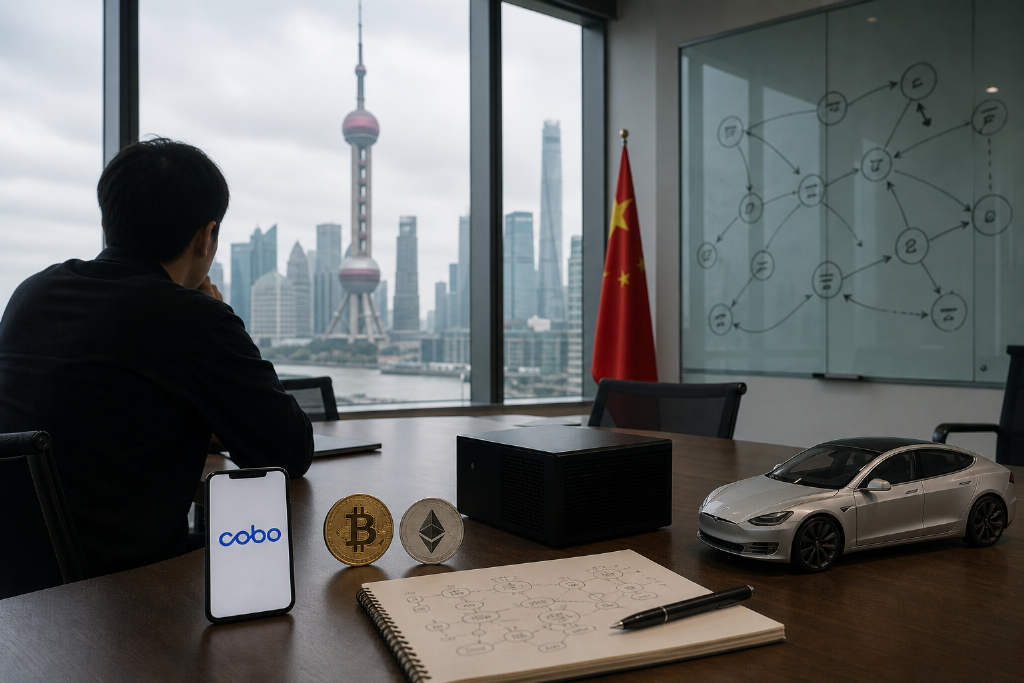
Author: Da Qianzi, PANews

Cobo co-founder Shenyu and Jilian Technology founder Jin Ming recently sat down for an extended discussion on AI, entrepreneurship, investing, Bitcoin, Web3, Agents and personal purpose. Shenyu has been active in crypto since 2011 and is described in the interview as one of China’s earliest Bitcoin advocates and participants. Jin Ming, a member of China’s national freediving team, leads Jilian Technology and has long worked on video AI technology and its commercial use.
The conversation moved across startup motivation, the relationship between humans and technology in the AI era, death anxiety, portfolio construction, BTC, RWA, Agents and Ethereum’s future. Across those topics, Shenyu returned to the same core point: AI has cut the cost of execution sharply, which raises the importance of human will, while good assets do not need endless new narratives if their underlying logic is sound.
AI has lowered the cost from idea to execution
Jin Ming opened by recalling Shenyu’s last interview appearance, which he said had been in 2017, when Shenyu made a widely remembered remark: 「这么多钱,我一下不知道该怎么花了」. Shenyu replied that he knows how to spend it now, but said the bigger change is that personal intent matters more than before.
His view is that many things that once took major amounts of time and capital can now be built quickly if a person simply has a clear idea. In his telling, the shift from an idea to a finished product has become much cheaper on the back end. What used to remain a seed or a dream can now move toward delivery much faster, because AI compresses and structures large amounts of human knowledge and lets individuals access that capability at low cost.
For Shenyu, that has opened a much wider field of possibility. Things that felt unrealistic 10 or 20 years ago are now far easier to produce. As technology keeps improving, whether something gets built increasingly depends on whether someone has the drive to make it happen.
A Builder mindset, but no fully clear path yet
Asked whether he is satisfied with his current life and whether he feels happy day to day, Shenyu said he is doing fine, though he still feels some confusion. He contrasted that with his earliest startup years, when he felt a strong sense of mission. Now, he said, he is in a more chaotic phase: AI has opened many possibilities and this feels like the best era, yet the concrete path remains unclear. He said he has not fully figured out either his mission or a precise business route, so his present focus is exploration and self-improvement.
Looking back at the early startup period, he described seeing a window of opportunity that triggered a powerful creative impulse. It was the kind of situation where, if he did not act, he felt he would regret it for the rest of his life.
That led into his account of the mining business in 2013. He said the central issue then was computing power. Mining started in the United States and later began moving to China. In the early Chinese ASIC miner era, machines still had to connect to U.S.-based mining pools. That created two problems: latency and packet loss on the international internet, which hurt mining efficiency, and a settlement model across the mining industry that he viewed as unreasonable. He said the business they built was aimed at solving those two issues.
He framed that kind of entrepreneurship as identifying a niche market with unmet demand and being in a position to satisfy it. In that setting, a Builder does not move because of slogans. The urge comes from seeing a market gap and knowing it can be addressed.
"I still define myself as a Builder"
When Jin Ming asked what his mission is now, after many years in the industry, Shenyu answered in simple terms: he still wants to build things. He said he has always defined himself as a Builder. Since the rise of AI, he has made a number of small tools and dashboards, but he has not yet found the kind of truly large and systematic thing worth committing to at a deeper level, so he is still watching and waiting.
He said a founder can become more confused after spending years on the front line building. At that point, it often becomes necessary to study history and older systems of thought: how similar events unfolded in the past, how philosophers approached related questions, and how those ideas feed back into present-day judgment. Right now, he said, many possible futures are visible, but the specific route is still missing.
Jin Ming then raised the idea of purpose awareness, comparing life to a scale with legacy and big creation on one side and experience and pleasure on the other. Shenyu said he does not feel strongly drawn to either extreme. He has used AI to break down a good deal of psychoanalytic material, yet still believes his core nature is that of someone with an inner urge to construct things. His words were direct: 「我就是想 build 一些东西。东西做出来了,我就会很爽。」
He added a broader line that captured his view of purpose: 「我希望呈现出一些东西,因为我觉得,活着某种意义上就是因为你的存在,让这个世界的可能性变多了一点。」
Anxiety, switching off and talking about death through freediving
Jin Ming said many people who want to be Builders also carry a tendency toward anxiety, because their life purpose is tied to constant building. When they are not actively moving forward, they can become uneasy. Shenyu said he definitely has some of that, but now knows how to switch states.
He said he has had ways of emptying his mind since childhood, including caring for animals and pursuing hobbies. As a result, he usually makes room every week for that kind of mental reset.
The discussion then turned to freediving. Jin Ming described breath-hold training as a confrontation between rational thought and instinctive bodily signals. He compared freediving to a spiritual practice, one that requires entering the water with a strong sense that you are safe.
He explained that the autonomic nervous system eventually takes over. On land, he said, it is difficult to truly hold one’s breath to death. At the limit, a person may briefly black out, or experience what he called BO, and after roughly 10 seconds the airway reopens and natural breathing resumes. Underwater, the danger is different: if consciousness is lost and the airway opens, the person inhales water rather than air, which can lead to drowning. That, he said, is why freediving training must involve a buddy.
At the same time, he described the process as peaceful rather than violent. Beginners may only reach around 50% of their limit after 10 sessions, 2 months or 3 months of training. With experience, they can move closer to 70%, 80% or even 90%. In his view, the barrier for newcomers is often not the body’s actual limit but unfamiliarity with the body itself. As trust builds, the experience can become far calmer than outsiders expect.
When Shenyu asked whether the process changes a person’s relationship with death, Jin Ming said long-term freediving and breath-hold practice had greatly reduced his fear of death. Early sessions still carried obvious fear, but that had largely faded. Shenyu answered that, on some level, he still feels anxiety, and that observers and even his Agent companions would say he carries death anxiety.
AI Agents as a new information interface
On information intake, Shenyu said he now relies on AI for almost everything. When he wakes up, AI tells him it has already read through everything he engaged with the previous day. He currently uses three AI Agents: one that is tool-rational and tells him what he should do, one that is softer and more feminine in tone and explores deeper inner questions, and one that reviews what he did the previous day and points out blind spots.
He said one of these Agents might tell him that a particular chapter in a historical book addresses a problem that ancient thinkers also faced and that it closely matches his current condition, then suggest he spend 15 minutes reading it. The material would then appear immediately.
He also said he has a note system that connects what he has paid attention to in the past with issues in his life through an evolutionary lens. In his words, his attention acts like a kind of god that decides which ideas or propositions survive. AI generates a batch of new combinations each day, then selects one and tells him which article is worth reading next.
As a result, he said he rarely reads raw material directly now. Instead, AI pre-processes daily digests and long reads for him, and he usually compresses them into PPT form for quick review.
His investment framework formed after DeFi
Jin Ming noted that AI may be less useful for real-time breaking developments. Shenyu said he does not care much about that, arguing that the most important information will find its way to you. He also said he does not trade in a very short-term way and realized early on that this was not his strength. Longer-term decisions suit him better.
He said he only truly started investing after going through DeFi. In his view, DeFi forced him to relead investment history. It showed him, starting from what he called the “underground Federal Reserve,” how traditional finance was invented and how the system evolved over two centuries. That process generated many questions, which pushed him to study financial history and related knowledge. Only then, he said, did he begin to invest seriously.
He described himself as fortunate on day one, saying he somehow picked up some decent methods and ended up on a path that was “not too wrong.” But the knowledge structure and investment framework came later, after DeFi. Before that, he said, he did not have a complete framework at all.
During his mining years, he did not even think of himself as investing. At most, he had a loose instinct that he should hold some Bitcoin, mixed with a basic idea of position management. He described himself as an ISTJ personality and said most of his thinking comes from practice first, abstraction later: build a framework, train intuition, encounter new questions, then abstract again.
From DeFi to RWA: focus on what the product does
Jin Ming said very few people build an investment framework from DeFi because many participants approached it through “farm, sell and withdraw” mechanics rather than investment logic. Shenyu said the real issue is understanding what these financial products are actually doing and what market need they satisfy. To him, DeFi mattered because it built a financial market on-chain from 0 to 1.
He said his attention was on that creation process, not on arbitrage or yield farming as isolated tactics. Those activities were more like muscle memory and instinct. The deeper value came from the experience accumulated along the way and the large number of questions it created. Once those questions were answered, many historical threads started to connect.
On the current wave of RWA moving on-chain and U.S. equities being brought onto crypto rails, he said it effectively extends the product understanding developed in DeFi into traditional finance. Once U.S. equities are placed in front of you in that form, he said, you are forced to understand the logic behind them as well.
He added that when he was mining a decade ago, he had never imagined himself holding U.S. stocks. At that time, he said, he did not even really understand why others wanted to borrow money to speculate in them. Later, a growing list of questions and the arrival of AI tools sharply accelerated his learning speed, allowing him to move through books and materials much faster and understand why these things happened.

Bitcoin is still digital gold
Asked whether his view of BTC has changed after more than a decade, Shenyu said it has not. He still sees Bitcoin as digital gold. His reasoning is that Bitcoin remains one of the few assets that can be held without an intermediary, while many other assets sit behind one, two or even three layers of intermediation.
When Jin Ming said some members of his group have become more pessimistic on Bitcoin, Shenyu replied that BTC’s value tends to show up under extreme conditions. In prosperous market phases, he said, it is normal for people not to care much about it.
On whether Bitcoin has strengthened the sovereign individual under a classical liberal framework, Shenyu said a core part of sovereignty is the ability to control and dispose of one’s assets. AI strengthens capability, while BTC stands out as a core asset in how a sovereign individual manages those assets. Both, he said, matter.
As for the claim that the current cycle is ending without a new Bitcoin narrative, his answer was blunt: 「好的资产不需要叙事,而且越久反而越能够证明一些东西。」
Agent adoption may be a turning point for Web3
Jin Ming said the current Web3 cycle may really have only two major narratives so far: Ethena’s all-asset arbitrage model and RWA moving on-chain, both of which still look early. He argued that the bigger missing piece is a mass-market consumer application in Web3, something ordinary users could use the way they use WeChat.
Shenyu returned to a view he said he has held for a long time: ecosystems such as Ethereum may not ultimately be built mainly for direct human use, but for Agents. In that version of the future, the chain functions more like a network, and people are not necessarily the ideal end users.
He said today’s on-chain products still require too much expertise and security awareness from users. If humans remain the direct terminal layer, the barrier stays high. If Agents sit in the middle, the interface may become much better.
Asked about Ethereum, Solana and similar ecosystems, he said the point he is watching now is whether Agents can achieve large-scale adoption within environments such as Ethereum. If that happens, he said, it could mark a turning point.
Jin Ming also argued that one of Web3’s most underestimated values lies in the shift from readable, to writable, to ownable internet structures. Applied to finance, he said that in traditional markets, users trade through software and a large part of the fee pool belongs to the platform. In Web3, participants may also share in platform growth through tokens, buybacks and similar mechanisms, becoming both users and owners. Shenyu said he expects comparable structures to appear in the future, including around data in the AI era. The possibility, he said, is already visible, even if large-scale adoption still takes time.
Gold or Bitcoin? He favors concentration over broad diversification
On gold, Shenyu said he does not pay much attention to it and considers Bitcoin the better form of gold. Jin Ming countered that both assets are forms of consensus, but among different groups: Bitcoin has built consensus among sovereign individuals, while gold carries stronger consensus among sovereign states, especially central banks, which he said are still buying it globally.
Shenyu framed the split as two camps: one centered on “digital currency + AI,” the other on the more traditional “gold + industrial manufacturing power.” He said he and his circle probably lean toward the former side of that spectrum.
Jin Ming then raised a Nobel-linked idea associated with James Tobin, arguing that an investor could hold both Bitcoin and gold because they are positively correlated in some periods and showed some degree of negative correlation over the past year. That, he suggested, could improve diversification.
Shenyu rejected the idea that truly negative-correlation assets are easy to rely on in a crisis. Under normal conditions, he said, assets may look diversified and weakly correlated, but they often share a few core constraints. When those constraints shift in a systemic way and the market enters an extreme regime, many assets begin to behave similarly.
Even when Jin Ming cited examples such as oil versus some credit assets or U.S. Treasuries versus credit, Shenyu pointed to cases where Treasuries and equities both sold off. For him, the real problem is the most extreme scenario. That is why he does not consider himself a classic diversification advocate. He prefers to concentrate on a small number of things he genuinely understands, because time and attention are limited.
Investment comes down to personality, cognition and position sizing
Jin Ming argued that some assets do not need to be fully understood to justify ownership. He used gold as an example, saying its long-term consensus among sovereign central banks could make it a valid part of a diversified portfolio even for someone who does not study it deeply.
Shenyu answered from the standpoint of psychology. If an asset hurts your state of mind when it falls, he said, the simplest answer is not to own it. Bitcoin can drop without creating panic only if the holder has real conviction, and that conviction requires a lot of prior work.
Jin Ming said the barrier for ordinary people is often practical rather than theoretical. Most are not professional investors, so position management, drawdown control and emotional control are hard to execute calmly. That led Shenyu back to the relationship between training and temperament, drawing a parallel with freediving.
Jin Ming said both matter. He expects sport to become a necessity for many people as health and physical maintenance take on a larger role. In his view, steady commitment to one athletic discipline can eventually make a person a kind of athlete, bringing both happiness and a sense of achievement.
He said these elements can add up to a more complete trading lifestyle. Within that framework, Bitcoin drawdowns can look like accumulation opportunities for a certain class of investor. He offered a concrete example: at $120,000 Bitcoin may feel hard to buy, and he personally would not be eager to accumulate much above $100,000. Below $90,000, though, he would see opportunity and add gradually at $90,000, $80,000, $70,000 and $60,000 because his long-term view remains positive.
Is AI just a cycle, or the next era’s utility layer?
Jin Ming said it is inaccurate to treat AI as a pure cyclical trade. In his view, AI will become one of the most important productive forces of the next era and replace a large share of how the current world operates. If that assumption is correct, then AI is not merely cyclical but something closer to the next era’s “water, electricity and coal.” If not, it can be treated as a cycle. The key, he said, is whether one believes in that underlying premise.
Shenyu brought in the historical parallel of the 2000 internet bubble. Back then, he said, investors also believed the internet was unquestionably the future, infrastructure became the key trade, and many bought Cisco, only to watch it spend a long period digesting valuation. His question was whether the present might produce something similar.
Jin Ming agreed that all outcomes carry probabilities but said AI-era storage demand could become enormous if the transition really happens. Today, he said, the market mostly sees conversational bots and some coding bots. The truly massive demand may come from embodied intelligence, in other words real robots.
He noted that homes still do not have genuinely embodied intelligent robots, and that workplace deployment remains concentrated in a limited number of factories. Large white-collar office environments have not been broadly replaced. Looking further ahead, he said, the human brain itself may require more external storage, whether through multiple backups or a brain-computer-interface-enabled “external brain.” Those needs are not here yet, but he believes the eventual demand could be very large. For him, the central question remains simple: do you believe the AI era will arrive? He said he does.
How he filters core assets
Shenyu said the discussion loops back again to trading lifestyle. Personality affects investment philosophy and framework, which then affects position sizing and emotional management. Jin Ming added that people differ widely, but those who perform well eventually build an internal system that fits them personally. Even a so-called tier-zero asset can rank very differently under another person’s framework.
Shenyu then outlined a three-layer process for identifying core assets. The first step is spotting an anomaly, something like saying, “This company is a bit unusual.” At that stage, they do not take a heavy position. The initial allocation may be no more than 2%, and often just a few tenths of a percent or less as an observation position, while they spend time studying it.
If the logic holds up, the position can be upgraded, moving from tiny weights into low single-digit allocation, though generally not beyond 10%. Moving from around 10% toward a roughly 20% core holding requires what he called a leap of faith.
At that level, he said, fundamentals and logical projection are no longer enough by themselves. The investor also needs a vision large enough to support a very large TAM, alongside a strong business logic and a real strategic choke point. He summarized the current core framework as “monopoly plus growth.” Assets that qualify for the highest-conviction bucket need a very large TAM and a sufficiently large vision.
Current core assets: Bitcoin, Ethereum and Tesla
Asked directly which assets currently meet that standard, Shenyu named Bitcoin, Ethereum and Tesla. SpaceX, he said, is still in the timing and observation phase and has not yet been upgraded into that group.
Ethereum remains in the core bucket for now, though he said there have been recent discussions about whether it should be downgraded. Jin Ming recalled that when Shenyu sold Ethereum a year earlier, he himself had said in a group chat that he slept better, and that Shenyu had said the same. Shenyu replied that the reason then was simple: he was no longer farming DeFi.
Even so, he said the logic they are watching today is that Agents may eventually run on Ethereum, and that thesis has not yet been disproven. When Jin Ming asked why Agents could not just run on Base or Solana instead, Shenyu said they could. Still, he said Ethereum may be a better match because its stack includes a broader base of decentralized infrastructure. He added that although much of that infrastructure has not fully materialized in a major way, the foundation has been trying to push in that direction, including registries and ecosystem infrastructure tied to Agents. Nothing very large has emerged yet, he said, but some groundwork has been done and the market has at least been given a reason to keep watching.