
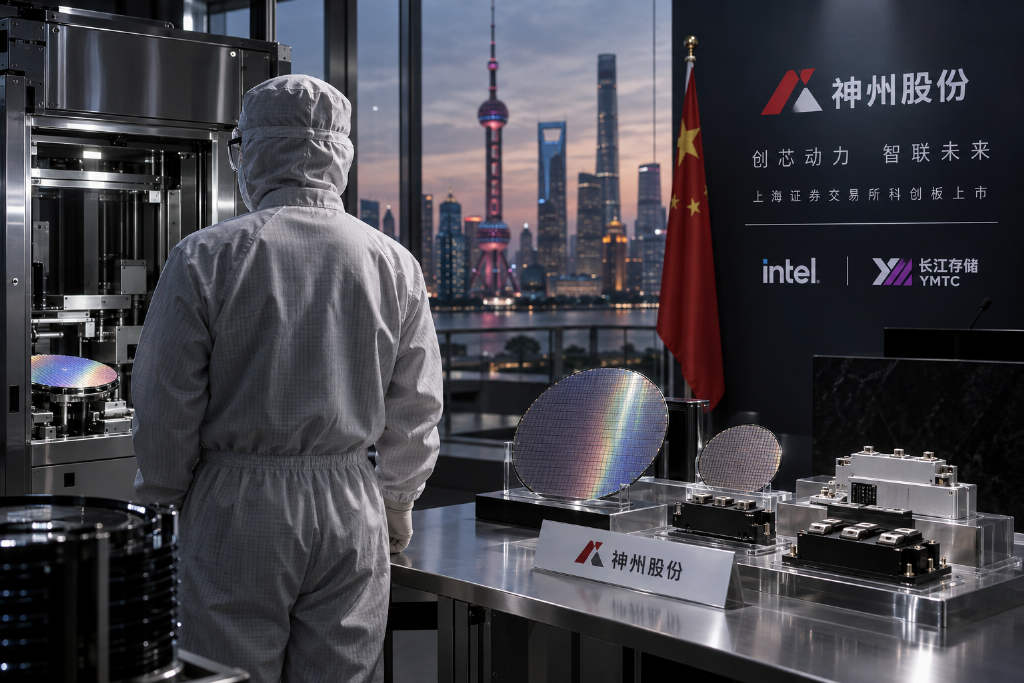
Jiangsu Shenzhou Semiconductor Technology Co., Ltd., known as Shenzhou Shares, has updated its prospectus and is preparing for a listing on Shanghai’s STAR Market. The company plans to raise RMB 2.52 billion for projects tied to advanced-process integrated circuit power components, service capacity expansion, a Shanghai industrialization base, an R&D innovation center, and working capital.
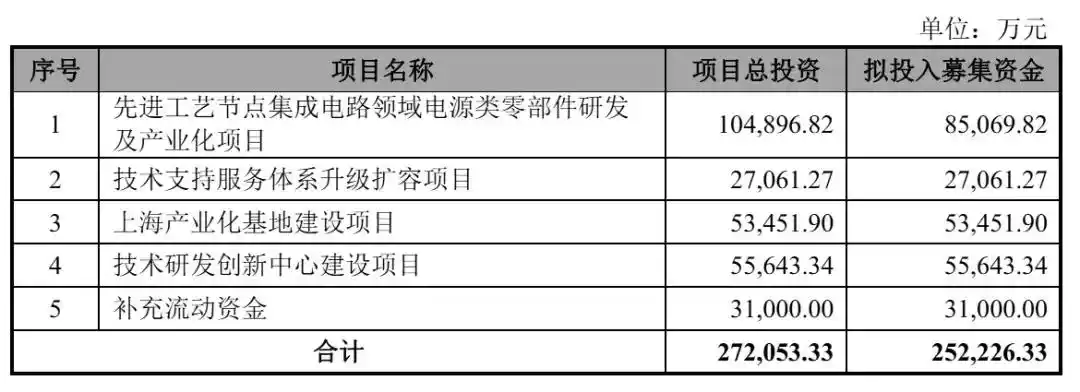
How the proceeds are planned to be used
According to the prospectus, Shenzhou Shares intends to allocate RMB 850 million to an R&D and industrialization project for power-related components in the integrated circuit sector at advanced process nodes. Another RMB 271 million is earmarked for upgrading and expanding its technical support service system, RMB 535 million for building a Shanghai industrialization base, RMB 556 million for a technology R&D and innovation center, and RMB 310 million for supplementary working capital.
Core business and technology base
Shenzhou Shares focuses on the research and development, production, sales, and technical support services of core components used in key semiconductor process equipment. The company says it is built around plasma source technology, a key semiconductor manufacturing process technology, and provides high-end plasma power system products and technical support services for the advanced semiconductor process chain.
The filing says plasma source technology is widely used in semiconductors, photovoltaics, display panels, optical coating, medical devices, and scientific research instruments. In semiconductors, it is described as a necessary technical means for achieving advanced chip manufacturing processes.
Financial performance through the first half of 2026
The prospectus shows revenue of RMB 261 million in 2023, RMB 446 million in 2024, and RMB 654 million in 2025. Net profit came in at negative RMB 22.32 million in 2023, then RMB 136 million in 2024 and RMB 210 million in 2025. Net profit after deducting non-recurring gains and losses was RMB 56.39 million, RMB 134 million, and RMB 200 million in those three years.
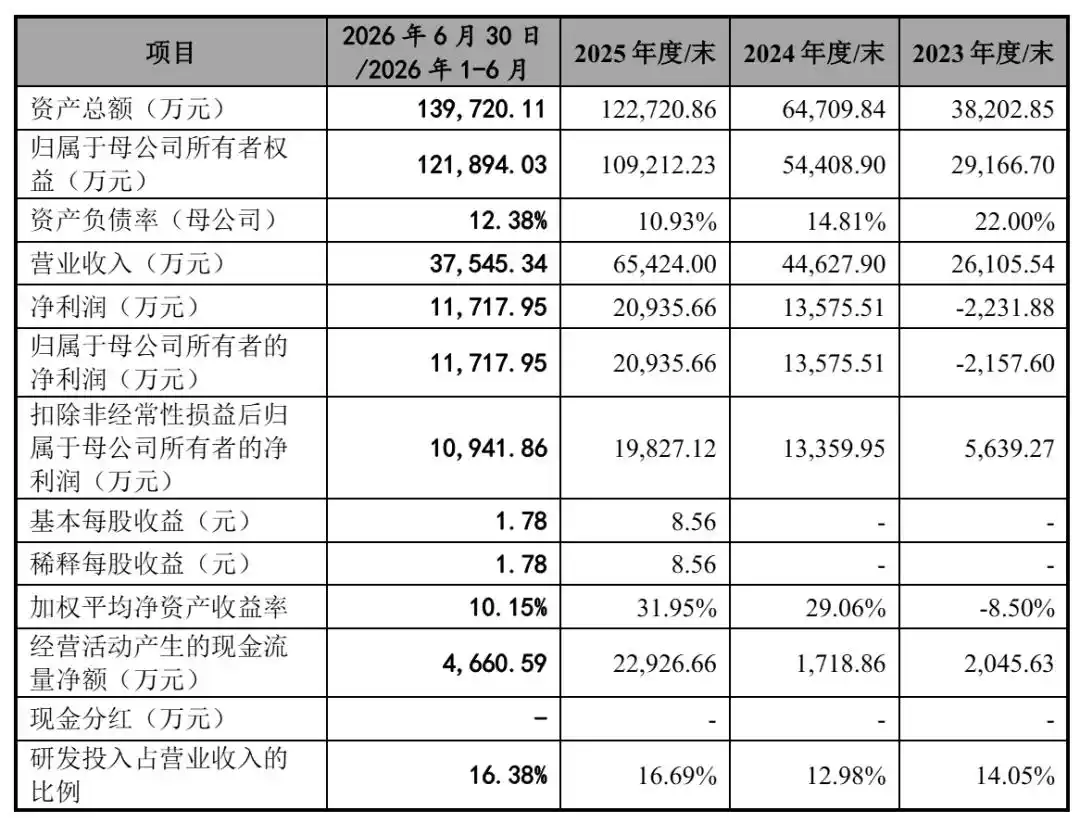
For the first half of 2026, the company reported revenue of RMB 376 million, net profit of RMB 117 million, and net profit after deducting non-recurring items of RMB 109 million.
Customer concentration, inventory, and receivables
During the reporting periods, sales revenue from Advanced Micro-Fabrication Equipment Inc. China, or AMEC, accounted for 2.94%, 31.12%, 49.19%, and 38.89% of the company’s main business revenue, respectively. Gross profit from sales to AMEC accounted for 2.95%, 33.90%, 52.63%, and 43.36% of Shenzhou Shares’ total gross profit over the same periods.
At the end of each reporting period, the book value of inventory stood at RMB 113 million, RMB 195 million, RMB 213 million, and RMB 270 million, accounting for 36%, 36%, 20%, and 23% of current assets, respectively. Inventory impairment provisions were RMB 12.95 million, RMB 11.98 million, RMB 19.75 million, and RMB 24.8676 million, equal to 10.26%, 5.79%, 8.50%, and 8.43% of gross inventory balances at each period end.
Accounts receivable book value was RMB 85.67 million, RMB 170 million, RMB 200 million, and RMB 256 million at the end of each reporting period, representing 27.53%, 31.55%, 19.18%, and 21.77% of current assets.
Zhu Peiwen holds control over 64.74% of voting rights
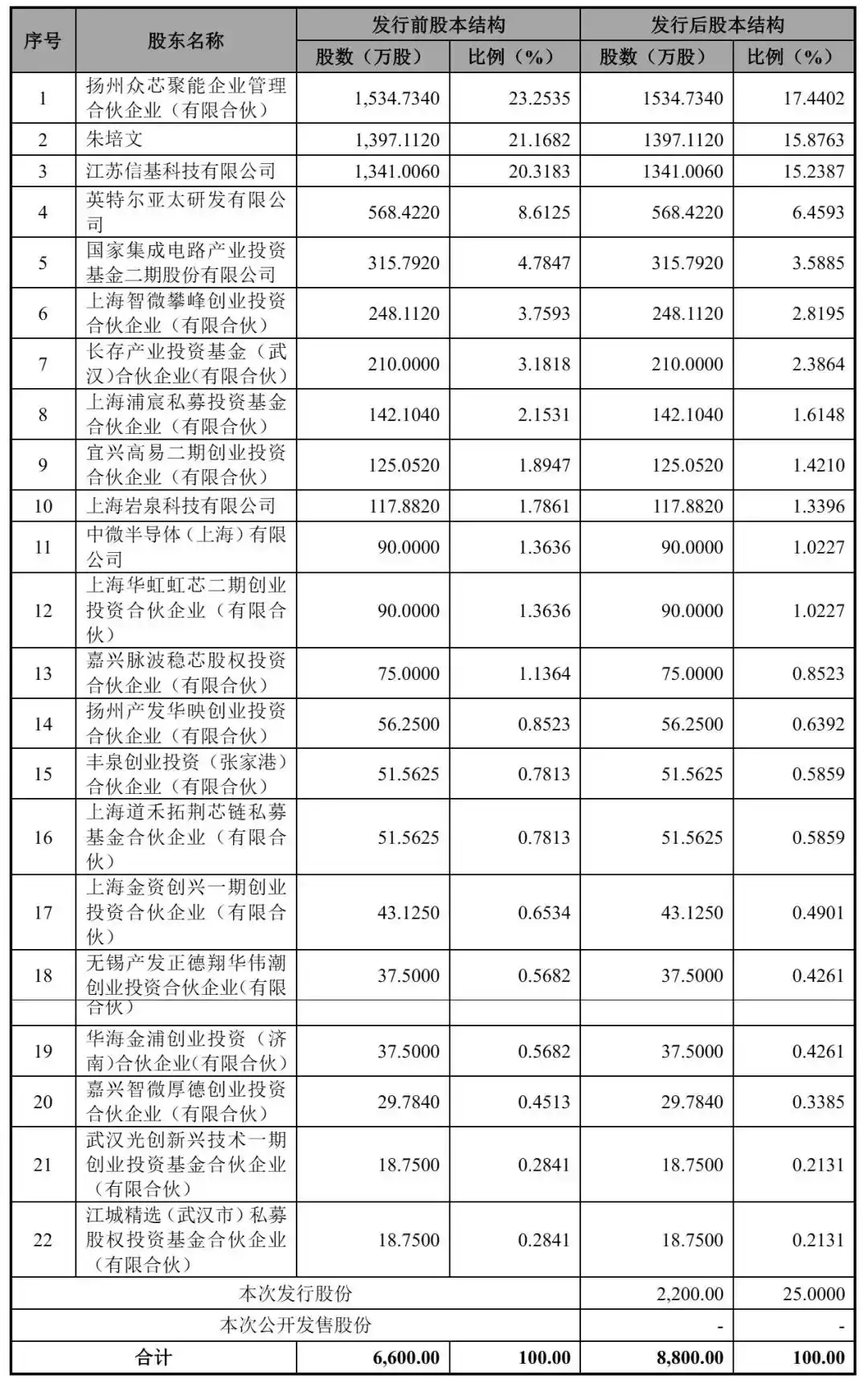
As of the signing date of the prospectus, Zhu Peiwen directly held 21.1682% of Shenzhou Shares. He also serves as the executive partner of Zhongxin Juneng and controls that entity, through which he indirectly held 14.1498% of the company. On that basis, Zhu directly and indirectly held a combined 35.3180% stake.
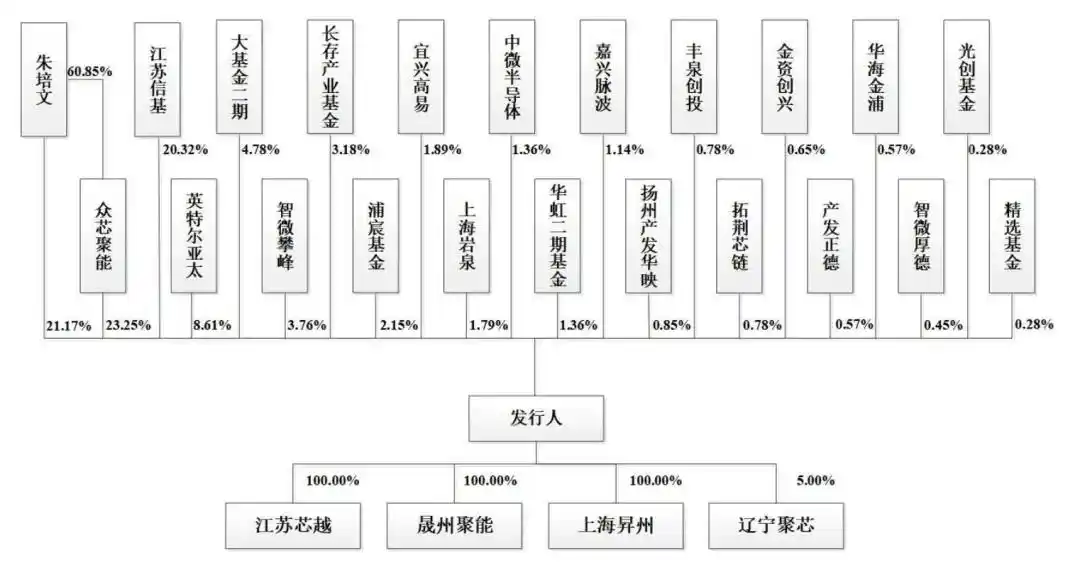
The filing says Zhu also signed a concerted action agreement with Chen Juexiao, Jiangsu Xinji, and Zhongxin Juneng. Through that agreement, he controls another 20.3183% of shares, bringing the voting rights under his control to 64.74%. Zhu is also the company’s chairman, general manager, and legal representative, and is identified as the actual controller.
Pre-IPO shareholder structure
Before the IPO, Yangzhou Zhongxin Juneng Enterprise Management Partnership (Limited Partnership) held 23.2535%, Jiangsu Xinji Technology Co., Ltd. held 20.3183%, Intel Asia Pacific R&D Ltd. held 8.6125%, China Integrated Circuit Industry Investment Fund Phase II Co., Ltd. held 4.7847%, Shanghai Zhiwei Panfeng Venture Capital Partnership (Limited Partnership) held 3.7593%, Changxin Storage Industry Investment Fund (Wuhan) Partnership (Limited Partnership) held 3.1818%, and Shanghai Puchen Private Equity Investment Fund Partnership (Limited Partnership) held 2.1531%.
Yixing Gaoyi Phase II Venture Capital Partnership (Limited Partnership) held 1.8947%, Shanghai Yanquan Technology Co., Ltd. held 1.7861%, AMEC Semiconductor (Shanghai) Co., Ltd. and Shanghai Huahong Hongxin Phase II Venture Capital Partnership (Limited Partnership) each held 1.3636%, Jiaxing Maibo Wenxin Equity Investment Partnership (Limited Partnership) held 1.1364%, and Yangzhou Chanfa Huaying Venture Capital Partnership (Limited Partnership) held 0.8523%.
Fengquan Venture Capital (Zhangjiagang) Partnership (Limited Partnership) and Shanghai Daohe Tuojing Xinlian Private Fund Partnership (Limited Partnership) each held 0.7813%, Shanghai Jinzi Chuangxing Phase I Venture Capital Partnership (Limited Partnership) held 0.6534%, Wuxi Chanfa Zhengde Xianghua Weichao Venture Capital Partnership (Limited Partnership) held 0.5682%, Huahai Jinpu Venture Capital (Jinan) Partnership (Limited Partnership) held 0.5682%, Jiaxing Zhiwei Houde Venture Capital Partnership (Limited Partnership) held 0.4513%, and Wuhan Guangchuang Xinxing Technology Phase I Venture Capital Fund Partnership (Limited Partnership) and Jiangcheng Jingxuan (Wuhan) Private Equity Investment Fund Partnership (Limited Partnership) each held 0.2841%.
Post-IPO shareholding structure
After the IPO, Yangzhou Zhongxin Juneng Enterprise Management Partnership (Limited Partnership) would hold 17.4402%, Zhu Peiwen 15.8763%, Jiangsu Xinji Technology Co., Ltd. 15.2387%, Intel Asia Pacific R&D Ltd. 6.4593%, China Integrated Circuit Industry Investment Fund Phase II Co., Ltd. 3.5885%, Shanghai Zhiwei Panfeng Venture Capital Partnership (Limited Partnership) 2.8195%, Changxin Storage Industry Investment Fund (Wuhan) Partnership (Limited Partnership) 2.3864%, and Shanghai Puchen Private Equity Investment Fund Partnership (Limited Partnership) 1.6148%.
Yixing Gaoyi Phase II Venture Capital Partnership (Limited Partnership) would hold 1.421%, Shanghai Yanquan Technology Co., Ltd. 1.3396%, AMEC Semiconductor (Shanghai) Co., Ltd. and Shanghai Huahong Hongxin Phase II Venture Capital Partnership (Limited Partnership) 1.0227% each, Jiaxing Maibo Wenxin Equity Investment Partnership (Limited Partnership) 0.8523%, and Yangzhou Chanfa Huaying Venture Capital Partnership (Limited Partnership) 0.6392%.
Fengquan Venture Capital (Zhangjiagang) Partnership (Limited Partnership) and Shanghai Daohe Tuojing Xinlian Private Fund Partnership (Limited Partnership) would each hold 0.5859%, Shanghai Jinzi Chuangxing Phase I Venture Capital Partnership (Limited Partnership) 0.4901%, Wuxi Chanfa Zhengde Xianghua Weichao Venture Capital Partnership (Limited Partnership) 0.4261%, Huahai Jinpu Venture Capital (Jinan) Partnership (Limited Partnership) 0.4261%, Jiaxing Zhiwei Houde Venture Capital Partnership (Limited Partnership) 0.3385%, and Wuhan Guangchuang Xinxing Technology Phase I Venture Capital Fund Partnership (Limited Partnership) and Jiangcheng Jingxuan (Wuhan) Private Equity Investment Fund Partnership (Limited Partnership) 0.2131% each.
The article was originally published via the WeChat account Leidi, identified as touchweb, and credited to Lei Jianping.