
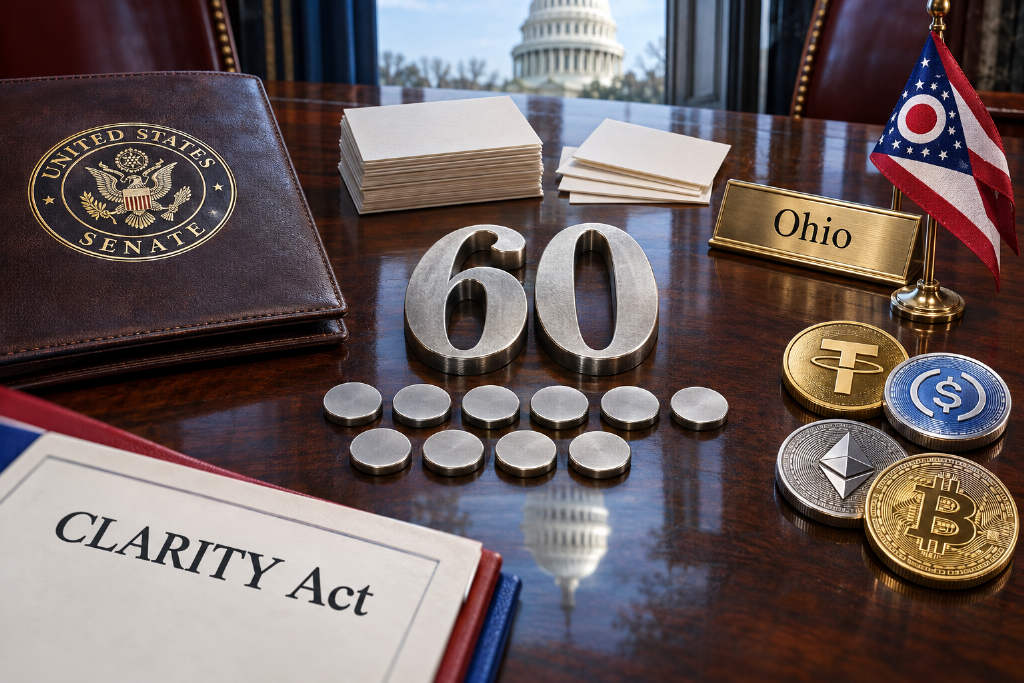
The Associated Press has called Ohio’s Senate race, and The Block reported that former Democratic Sen. Sherrod Brown defeated Republican incumbent Sen. Jon Husted on Nov. 3, 2026. The immediate significance is not simply which party controls the Senate. It is that the CLARITY Act still needs 60 votes to clear cloture, and that requirement forces a bipartisan coalition no matter who holds the majority.

Brown’s return matters in that context. During his time as chair of the Senate Banking Committee, he set the chamber’s crypto agenda and was described in Bloomberg Law’s reporting by a crypto trading executive as having repeatedly blocked attempts to move stablecoin legislation.
What kind of election this was in Ohio
This was not a standard six-year Senate election. It was a special election for the remainder of a Class III term. The seat had belonged to JD Vance. After he became vice president, the seat was vacated and Husted was appointed by the governor to fill it, making a 2026 election necessary to determine who would serve out the rest of the term.
That distinction matters for the timeline. The winner is taking over the unexpired portion of the term, not beginning a fresh six-year term.
Why the spending numbers range from $30 million to more than $68 million
The spending figures cited in coverage of this race can look contradictory at first glance. They are not. They refer to different layers of political spending.
- Fairshake itself pledged $30 million on Sept. 21.
- According to crypto.news’ review of Federal Election Commission filings, Defend American Jobs, a Republican-aligned affiliate of Fairshake rather than Fairshake itself, reported cumulative Ohio spending of $46,672,296.18.
- On AdImpact’s basis, total industry spending in the race exceeded $68 million.
The $46,672,296.18 reported by Defend American Jobs was about $16.67 million above Fairshake’s $30 million pledge, a difference of 55.6%. That gap shows why a public commitment by one super PAC and actual spending in a race by affiliated committees are not the same thing.
The crypto.news summary of FEC filings said Defend American Jobs’ Ohio total included nearly $11 million in media buying through Main Street Media Group.
Another super PAC, Digital Freedom Fund, was founded by the Winklevoss brothers. Its cumulative spending reached $5,940,397.25. Of its latest disclosed $2,970,198.58, $990,066.19 was used to support Husted and $1,980,132.39 was used to oppose Brown. The anti-Brown portion accounted for 66.7% of that disclosed amount.
Ohio was the most concentrated battleground of the cycle
A separate Oct. 27 tally based on campaign finance filings through Oct. 20 put total digital asset industry spending across more than 100 congressional races at about $176 million in the 2026 cycle. Fairshake and its affiliated groups accounted for about $150.8 million, or 85.7%, while other industry-linked organizations made up about $25 million, or 14.2%.
Fairshake’s own FEC filings for the 2025-2026 cycle showed about $138.2 million in receipts and about $169.5 million in spending as of Oct. 14. Transfers to affiliated entities totaled $139 million, equal to 82.0% of spending, and cash on hand stood at about $33 million. The structure matters. The parent committee raises money, then routes funds to party-specific affiliates that execute the spending. Counting only the parent committee’s direct spending would understate the real scale of deployment.
Ohio stands out even inside that broader picture. On AdImpact’s more than $68 million measure, the state alone represented 38.6% of the industry’s $176 million total. It was also 6.2 times the roughly $11 million spent in Nebraska, the next-highest state. In the source article’s framing, this was not just another priority race. It was the single most concentrated battleground of the cycle.
A contrast with Ohio in 2024
The article draws a comparison with 2024, when the industry spent about $12 million in Ohio to back Republican candidate Bernie Moreno and won. By this year’s different measures, spending in the state was 3.89 to 5.67 times that earlier level, yet the outcome went the other way.
The point made in the source is not that political spending does not matter. It is that there is no stable linear relationship between the amount spent and the election result. In this case, using spending size alone to predict the outcome would have led to the wrong conclusion.
Brown’s record on crypto policy
The article argues that Brown’s impact should be judged by what he did at specific legislative chokepoints rather than by a broad label. As Banking Committee chair, he set the agenda for crypto-related matters and called for action against the use of crypto assets to finance terrorism and evade sanctions.
On legislation, Bloomberg Law reported that a crypto trading executive said Brown repeatedly blocked efforts to advance stablecoin bills. The article stresses that this kind of blocking power is procedural. A committee chair can influence whether a bill gets on the agenda, whether hearings are scheduled, and whether the committee votes on it at all. That is a different level of influence from simply voting no.
Committee assignments remain unconfirmed
The next question is where Brown could land in the committee structure, but the article repeatedly notes that every scenario is still conditional.
The Block said Brown could become chair of the Senate Agriculture Committee if Democrats win the Senate majority. That committee has jurisdiction over digital assets and prediction markets. The Block also cited a source saying Brown would be unlikely to proactively introduce crypto legislation if he were to hold that gavel.
Bloomberg Law, in an Oct. 27 report, said Senate Banking’s top Democratic slot is still expected to remain with Elizabeth Warren under seniority rules. Brown’s alternatives could include an agriculture or finance-related subcommittee role, or a seat on the Appropriations Committee.
On the House side, the top Democratic position on the Financial Services Committee is expected to stay with Maxine Waters, while Sean Casten is seeking it and Bill Foster is also considering a run.
None of those arrangements has been finalized. Senate control, committee assignments, and subcommittee structures are expected to be settled around the opening of the 120th Congress in January 2027. Until then, treating any specific post as a confirmed fact would go beyond the available information.
The real constraint is the 60-vote threshold
The article’s central argument is that the market often focuses on the wrong mechanism. It is common to translate election results into Senate control and then translate Senate control into a forecast for legislation. For crypto market structure bills, the source says that chain of reasoning misses the key procedural barrier.
The CLARITY Act, H.R. 3633, passed the House on July 17, 2025 by a 294-134 vote. It then stalled in the Senate. On Sept. 15, 2026, a cloture vote on the motion to proceed failed 49-50, leaving the bill 11 votes short of the 60 required.
The timing is important. Republicans already held the Senate majority when that vote failed, yet the bill still could not move. The senators voting against cloture included Republicans Collins, Hawley, and Moran. Sen. Tillis also voted no in order to preserve the procedural option of bringing the matter back for another vote.
Under congressional procedure, any bill not enacted during the 119th Congress must be reintroduced in the 120th Congress, which begins in January 2027, and must go through the full process again. That has two consequences. First, market structure legislation will need bipartisan support to reach 60 votes regardless of which party controls the chamber. Second, the House’s earlier 294-134 passage does not carry over automatically.
In that framework, Brown’s return changes the difficulty of assembling the needed votes. It does not make the bill’s prospects a simple function of majority control.
What this means for markets
The article says the market impact of this kind of legislative development is likely to be slow and indirect rather than immediate. The reason is timing. The 120th Congress does not begin until January 2027, and restarting a bill can take months or years. Bitcoin trades on a much shorter clock.
The source places that in the current macro setting. The Federal Reserve’s target range is 3.75% to 4.00%. It raised rates by 25 basis points in September, then held steady in October by a 10-2 vote, with the two dissents favoring another increase. The probability of a December rate hike was cited in a range of 75% to 87.5%. With the 10-year yield near 5%, the article says a non-cash-flow asset such as BTC is more sensitive in the short run to real rates than to a legislative calendar.
It also notes that statistical relationships between election cycles and Bitcoin price action depend heavily on the chosen starting point, and that the sample size behind such seasonality claims is too small to support strong inferences about a single cycle.

Three things the article says to watch next
- Formal committee assignments, especially control of the Senate Agriculture Committee, because it has jurisdiction over digital assets and prediction markets.
- The reintroduction of market structure legislation in the next Congress, with the focus not on filing the bill itself but on whether supporters can assemble 60 votes and whether the procedural path preserved by Tillis is used.
- What regulators do while legislation is stalled. The article says interim rules built by the Securities and Exchange Commission and the Commodity Futures Trading Commission under existing authority could matter in practice, while administrative rules are easier to challenge and reverse than statutes.
The source article’s own editorial view
In its editorial section, the source says this result reinforces a point it sees as repeatedly tested: in Ohio, industry spending was 3.89 to 5.67 times the 2024 level, yet the result flipped. That does not prove political spending is ineffective. It does, in the article’s view, show that using spending totals to predict election outcomes is methodologically weak.
The same section says the market’s most likely mistake is to convert this race into a simple majority-control story and then use that to predict the fate of the CLARITY Act. The bill’s own path already showed otherwise. When cloture failed on Sept. 15, Republicans already controlled the Senate, but the measure still stopped at 49-50, 11 votes short of the threshold, with three Republican senators among the opposition.
The article also argues that the Senate Agriculture Committee may matter more than Banking in the next phase. Under seniority rules, Warren is still expected to keep the top Democratic Banking slot. Agriculture, however, has jurisdiction over digital assets and prediction markets. If that committee ends up led by someone unwilling to push crypto legislation, the pace of any reintroduced market structure bill could be affected in a meaningful way. The source says that question is unlikely to be settled until around January 2027.
For cross-asset investors, the article frames the lesson as one of matching time horizons. Legislative processes move on quarterly and annual timelines. Crypto assets are priced on daily and weekly ones. Linking the two too tightly can create repeated expectation gaps. In the current environment, with December hike odds near 85% and the 10-year yield near 5%, the article says short-term pricing is driven more by discount rates than by bill calendars. The value of legislation lies in changing medium-term institutional certainty, and that kind of shift is usually not priced the day after an election.
Key points repeated in the FAQ section
The FAQ at the end of the source reiterates that the Associated Press called the race and that The Block reported Brown defeated Husted. It also repeats that this was a special election triggered by the vacancy created when JD Vance left the seat.
On spending, it again separates the figures into layers: Fairshake’s $30 million pledge, Defend American Jobs’ $46,672,296.18 in disclosed Ohio spending, Digital Freedom Fund’s $5,940,397.25 in cumulative spending, and AdImpact’s more than $68 million industry-wide estimate for the race. The article says any citation of those numbers should specify which layer is being used.
On why the numbers differ, the FAQ repeats that Fairshake uses a structure in which the parent committee raises funds and transfers them to party-specific affiliates. In the 2025-2026 cycle, those transfers totaled $139 million, or 82.0% of spending. That is why counting only the parent committee’s direct spending understates the real total. It also says ad-spending measures and FEC filing measures cover different categories.
The FAQ restates Brown’s policy record, his prior role as Banking chair, and the Bloomberg Law report that cited a crypto trading executive saying he repeatedly blocked stablecoin legislation.
It also repeats that no committee assignment has been confirmed, that Warren is still expected to retain the top Democratic Banking role, and that Brown could become Agriculture chair if Democrats win the Senate, though that remains unresolved until around January 2027.
On the CLARITY Act, the FAQ again notes the House’s 294-134 vote on July 17, 2025 and the failed 49-50 Senate cloture vote on Sept. 15, 2026, leaving the bill 11 votes short of the 60 needed. Because the bill did not pass in the 119th Congress, it must be reintroduced in the 120th Congress and go through the full process again.
On market impact, the FAQ says any short-term effect on Bitcoin is likely limited because the legislative timeline is long while the macro backdrop is immediate. It repeats the Fed’s 3.75% to 4.00% target range, the cited 75% to 87.5% probability of a December hike, and the near-5% 10-year yield as the more immediate variables for pricing.
The final FAQ answer again lists the three next checkpoints: committee assignments, reintroduction of market structure legislation and the 60-vote question, and interim regulatory action while Congress remains without a statute.
Disclaimer in the source
The source says the article is for general information only and does not constitute investment, financial, legal, tax, or trading advice. It adds that crypto assets, stocks, and other related financial assets can be highly volatile, that campaign finance data, historical statistics, and third-party analysis cited in the piece do not guarantee future outcomes, and that election results and committee assignments may change with certification and party procedures. It also says readers should conduct their own research and, where necessary, consult qualified professionals. MEXC Crypto Pulse said it does not accept liability for direct or indirect losses arising from use of the information.



