
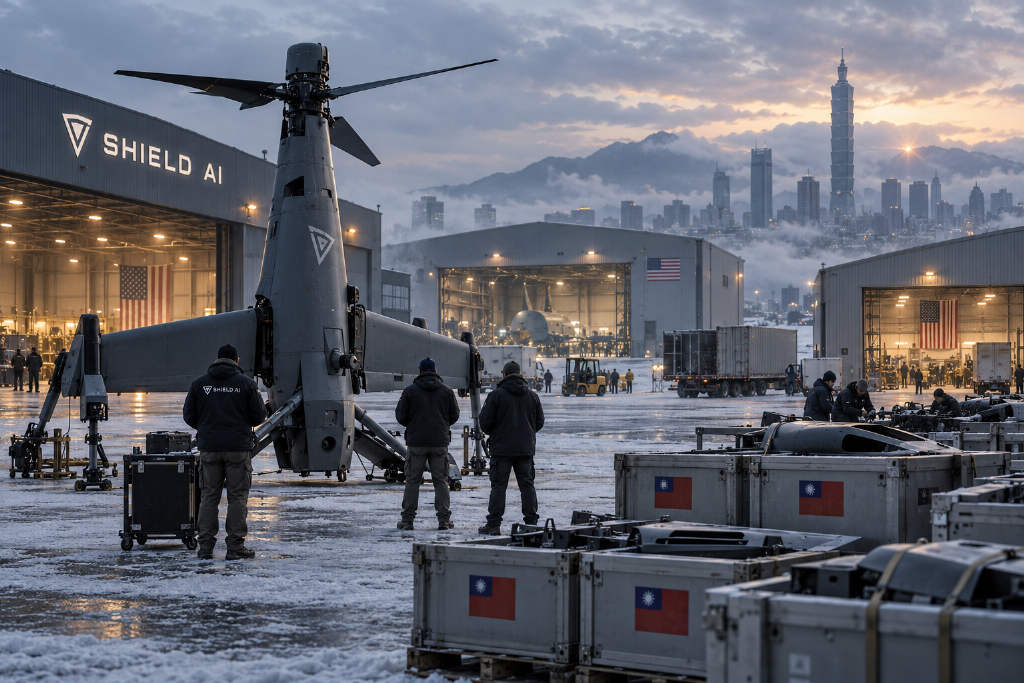
Shield AI has announced a production and test plan for X-BAT and said it will deepen cooperation with Taiwan’s supply chain as it pushes toward larger-scale manufacturing and defense deployment in the U.S. and Taiwan.
Three X-Forge sites will split the X-BAT program
The company said X-BAT will be organized across three production hubs designed to cover the aircraft’s full lifecycle.
X-Forge 2 in Newton, Kansas, will handle flight acceptance testing, research and development flight tests, and later maintenance, repair, and overhaul, or MRO. X-Forge 3 in Des Moines, Washington, will take on primary manufacturing, drawing on a regional aerospace workforce of more than 45,000 people and a supplier base of 1,500 companies.
Those facilities will work alongside X-Forge 1 in Frisco, Texas, the program’s prototype development base. Together, the three sites are meant to cover prototype work, manufacturing, delivery, and lifecycle operational support.
Shield AI said X-BAT is expected to start production in 2029 and reach full production in the early 2030s.
Economic impact estimates run through 2046
According to the economic impact analysis cited in the report, the Newton site is projected to create about 2,900 jobs and contribute roughly $5 billion to the local economy by 2046. The Seattle-Tacoma-Bellevue area is projected to generate about 27,000 jobs and $73 billion in economic output over the same period. In Texas, the estimate is about 7,900 jobs and $18.6 billion in economic impact by 2046.
X-BAT specifications and autonomy stack
Shield AI described X-BAT as the world’s first AI-piloted attack aircraft with vertical takeoff and landing capability, long range, and high survivability. The aircraft is designed to operate from ships, islands, or remote areas without a runway.
X-BAT uses the F110 engine made by GE Aerospace. Shield AI said its internal weapons bay capacity is comparable to the F-35, with payload capacity of up to 2,000 pounds and a combat radius of 1,000 nautical miles. The aircraft is also designed to support high-power electronic warfare and ISR, short for intelligence, surveillance, and reconnaissance, missions.
Its autonomy system is built on Shield AI’s Hivemind software. The company said the software allows an unmanned aircraft to sense its environment, plan routes, and execute decisions on its own in denied environments, including cases where GPS is jammed or communications are cut off. Flight tests are scheduled to begin before the end of this year.
Taiwan sourcing and local partnerships
In the Asia-Pacific defense market, Shield AI said it is working closely with Taiwan’s defense industry. The partners named were the National Chung-Shan Institute of Science and Technology, Aerospace Industrial Development Corp. (2634 in the source appears as 2364 for Hanxiang/AIDC), and Thunder Tiger.
Co-founder Brandon Tseng said the company is increasing procurement in Taiwan. For V-BAT, its flagship VTOL long-range tactical reconnaissance drone, the share of parts and materials sourced from Taiwan suppliers is expected to rise from 16% to 25%. The procurement list includes PCBA, or printed circuit board assembly, and other electronic components.
Shield AI also plans to expand its Taiwan team from 11 people to 20 within the next nine to 12 months and add procurement engineering roles in Taichung. Over a three- to five-year period, the company said it aims to hire hundreds of employees.
Work in Taiwan spans defense and coast guard use
On the technology and business side, Shield AI said it is helping the National Chung-Shan Institute of Science and Technology develop the AI Pilot autonomous system. It is also working with Thunder Tiger to introduce software intended to speed local drone mass production.
For police and coast guard use, V-BAT has already begun cooperation with Taiwan’s Coast Guard Administration, with Aerospace Industrial Development Corp. handling project management and maintenance support. The company said it also plans to take part in future drone procurement tenders from Taiwan’s Ministry of National Defense.
Key points listed in the source
- X-BAT is described as the first AI-piloted attack aircraft with VTOL capability, long range, and high survivability.
- The three X-Forge sites in Kansas, Washington, and Texas divide work across testing, production, prototype development, and mission-system integration.
- Production is scheduled to begin in 2029, with full output in the early 2030s.
- By 2046, the projected economic impact is $73 billion in Washington state, $5 billion in Kansas, and $18.6 billion in Texas.
- Taiwan-sourced content for V-BAT is expected to increase from 16% to 25%.
- The Taiwan team is set to grow from 11 to 20 people in nine to 12 months, with plans to hire hundreds over three to five years.