
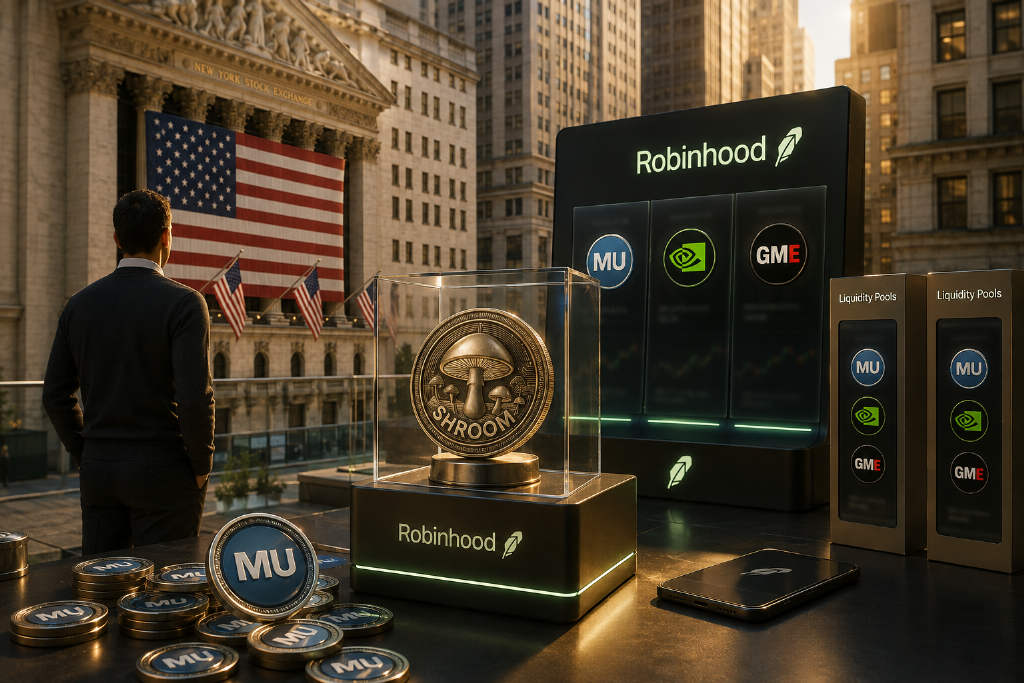
SHROOM, a meme coin on Robinhood Chain, rose to roughly $44 million in market capitalization, while its main trading pool gained 442% over the past 24 hours. The token only opened its first liquidity pool on Sept. 2, so the reported all-time high has a history of just three days.
According to the BlockTempo report, citing DexScreener data, SHROOM’s market cap briefly reached about $58.33 million. The token was quoted at $0.0432, and combined 24-hour trading volume across 30 pools totaled about $25.59 million.
On-chain data showed the contract’s full name is MUSHROOM, with a fixed total supply of 1 billion tokens. Of that amount, 12,682,719 tokens have been sent to a burn address, equal to 1.268% of total supply.
SHROOM is being used to market-make against tokenized stocks
SHROOM is positioned as a liquidity network for stock tokens. The setup described in the report is straightforward: the protocol holds its own liquidity pools, pairs SHROOM with different assets, routes trades between those assets, and collects fees from trading activity and price swings.
The project website shows 62 protocol-owned liquidity pools. The report notes that the previously circulated figure of 53 pools is outdated. Pairs visible on DexScreener include USDG and ETH, while most of the rest are tokenized U.S. equities: Micron (MU), NVIDIA (NVDA), Microsoft (MSFT), Coinbase (COIN), GameStop (GME), AMC, Eli Lilly (LLY), Hims & Hers (HIMS), and the gold ETF GLD.
Performance varies widely across pools. The MU pair recorded about $3.29 million in 24-hour volume, making it one of the most active pools. By contrast, the GLD pair was up 53.78% over the same period. That means SHROOM can show different prices depending on which paired asset is used as the quote asset, and the headline percentage move depends on the pool being referenced.
Holder rewards are paid in Micron stock tokens
SHROOM holders can periodically receive MU rewards. MU is the ticker for Micron Technology’s stock token on Robinhood Chain, not a separate reward unit. The website says a cumulative 251 MU has already been distributed, with Pons handling the payouts.
Using Micron’s Sept. 4 closing price of $1,016.59, those 251 MU were worth about $255,000. Micron shares closed up 6.1% from the previous day, according to the report.
The same report compared that figure with on-chain supply data and said the total amount of Micron stock tokens on Robinhood Chain was only 4,223.30 shares, worth about $4.29 million. The 251 MU already distributed represented about 5.9% of that total. Adding the 281.5 MU locked in the SHROOM-MU liquidity pool brings the combined share to about 12.6% of all Micron stock tokens on the chain.
$2.92 million in liquidity against a $44 million market cap
DexScreener showed about $2.92 million in total liquidity across 30 trading pools. The project website, meanwhile, listed $4.04 million in TVL across 142 pools. Set against a market cap of about $44 million, the multiple works out to roughly 11x to 15x.
The website also disclosed cumulative fee revenue of $213,646. According to the project’s stated approach in the report, all fees are currently being recycled back into the pools to deepen liquidity. Once liquidity reaches what the project calls a critical scale, excess fees would then be used to buy back and burn SHROOM on the market.
Key figures cited in the report
- Market cap around $44 million, with a peak near $58.33 million
- Main pool up 442% over 24 hours
- First liquidity pool launched on Sept. 2
- 62 protocol-owned liquidity pools
- About $25.59 million in 24-hour trading volume across 30 pools
- About $2.92 million in liquidity across those 30 pools
- $4.04 million in TVL across 142 pools on the project website
- 251 MU distributed, worth about $255,000 at Micron’s Sept. 4 close
- Cumulative fee revenue of $213,646
Two points from the project FAQ
On the question of what MU rewards are, the report says MU is Micron Technology’s stock token on Robinhood Chain. The website shows 251 MU distributed so far, worth about $255,000 based on Micron’s Sept. 4 closing price of $1,016.59, with Pons responsible for distribution.
On how the liquidity network works, the project says it operates 62 protocol-owned pools that pair SHROOM with various stock tokens, route trades between those assets, and recycle fee income back into the pools. The website figure for cumulative fee revenue was $213,646.