
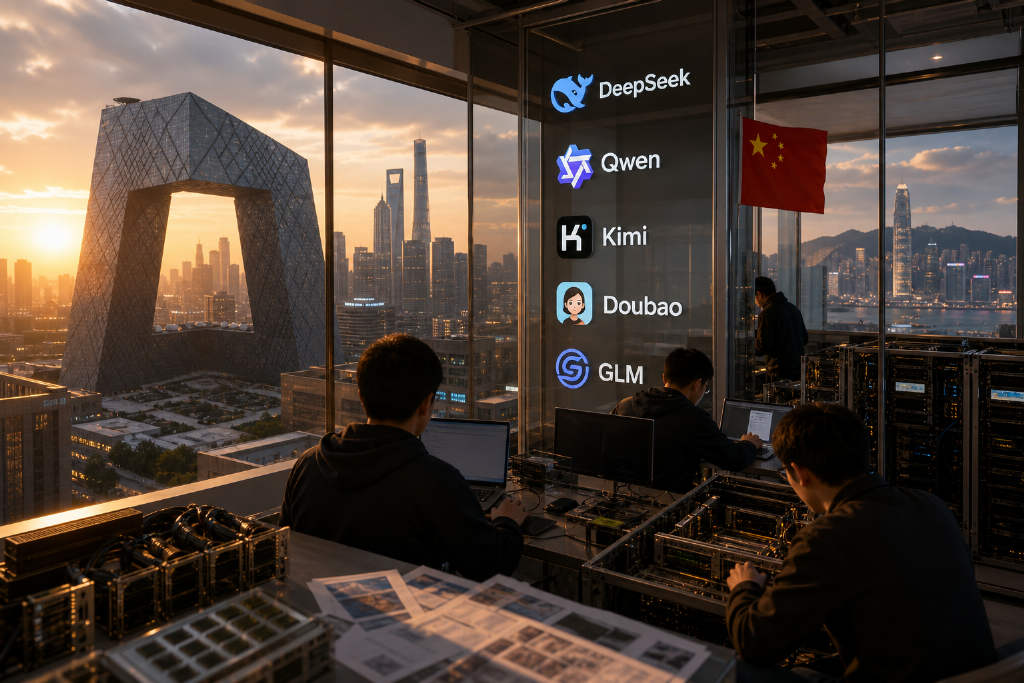
PANews published a report summarizing a TechFlow compilation of an internal letter from Silicon Valley venture firm Dimension. The letter said Dimension partners Nan, Adam and Zavain led a week-long trip in August to Beijing, Shanghai and Hong Kong to examine China’s top AI labs and infrastructure ecosystem, with a focus on compute, open models and the question of technological decoupling.
Export controls and a push toward systems-level optimization
According to the report, the team’s field observations did not match the familiar public narrative in Western media and politics that US-China AI decoupling is already complete. The central claim in the letter was that US chip export controls did not shut down China’s AI development. Instead, they created strong evolutionary pressure that pushed Chinese teams into extreme optimization work at lower levels of the stack.
One example in the article involved DeepSeek’s V3 model, which the report said was trained on 2,048 H800 chips. To work around connectivity limits, engineers reportedly bypassed the mainstream CUDA framework and wrote at the lower PTX level, while reallocating 20 streaming multiprocessors per GPU, 132 in total, for cross-node communication.
The letter framed this as a difference in incentives rather than talent. In the account relayed by PANews, US labs are more likely to spend additional dollars on more one-off compute, while Chinese labs are more likely to hire more engineers to reduce compute demand at the architectural level. The report described the result as a distinct full-stack efficiency culture spanning kernels, optimizers, serving systems and chips.
Chinese frontier labs face fierce competition at home
The letter also argued that China’s internal AI competition is harsher than many outsiders assume. The report named five leading labs: DeepSeek, Alibaba’s Qwen, Moonshot AI’s Kimi, ByteDance’s Doubao and Zhipu’s GLM.
It said the gap among them is narrow enough that rankings can change almost every quarter. These labs are competing both on model capability and iteration speed, while also pushing aggressively on open source. The report contrasted that setup with the US market, which it described as being dominated by two closed-model leaders, OpenAI and Anthropic.
What the visitors found in Beijing and Shanghai
The article said Dimension did not find the simple picture it expected of large pools of low-cost data labeling factories. Instead, the firm said it encountered a group of younger Chinese startups building infrastructure around model evaluation and validation.
The report mentioned US data providers including Mercor, AfterQuery and Turing, saying they had already documented business ties with Ant Group, Alibaba and ByteDance. On the ground, though, the visitors focused on a newer layer of companies serving other parts of the AI workflow.
One example was UniPat, described as an AI evaluation and forecasting company founded by a Peking University PhD. According to the report, UniPat is less than 24 months old and has pushed revenue above $100 million by relying on very high-quality human supervision to offset a compute disadvantage.
Human intervention as a substitute for scarce compute
The article said one of the biggest surprises for the visiting investors was seeing top Chinese researchers use what it called a very primitive but effective path toward “weak self-improvement,” or RSI. Because compute is scarce, researchers themselves step in and manually assist parts of the training process to speed model development.
The report compared that approach to early “centaur chess,” where human-machine combinations beat pure machines. In this case, the claim was that some teams are using labor and time to close part of the compute gap.
A wide revenue gap, but a different approach to monetization
On revenue, the letter said the gap between US and Chinese AI remains close to two orders of magnitude. By August 2026, Anthropic’s annual recurring revenue had passed $6.5 billion, while OpenAI had reached $40 billion, according to the figures cited in the article. In China, the strongest large-model business by revenue, ByteDance’s video model business, was said to be generating about $2 billion to $3 billion on an annualized basis, while pure foundation-model labs were generally in the hundreds of millions of dollars.
Even so, the report said Chinese companies stood out for their pragmatism and ability to commercialize. It cited ByteDance’s Doubao as having 345 million monthly active users, more than the combined total of Qwen and DeepSeek. Its daily revenue is still below RMB 1 million, the article said, but nearly all of that comes from e-commerce commissions.
The report used that example to draw a cultural contrast: while Silicon Valley debates the dignity of advertising and commerce as monetization models, Chinese founders appear more focused on whether a model can make money at all.
A Pacific data loop rather than a clean break
Another major point in the letter was that hardware decoupling below the semiconductor layer has not produced a similar split in software and data. The report said the opposite may be happening there, with integration moving faster than governments can react.
Dimension described the current loop this way: leading US labs train top-tier models, Chinese teams distill them and release open weights, US vertical AI companies fine-tune those Chinese open models, and the final products are then sold to American enterprises.
Based on that framework, the report argued that a growing share of US vertical AI applications may be running on Chinese open weights while carrying intelligence derived from leading US models. It gave two examples: Cursor’s Composer 2, which the article said is based underneath on Kimi’s K2.5, and Harvey Tenet from legal AI startup Harvey, which it said was post-trained on Kimi’s open model K3.
The letter’s conclusion on this point was that China may not be capturing Western revenue directly, but it is moving into the workflow layer of the Western AI era. Open models, the report added, can pass around strict enterprise procurement gates in Europe and the US because free software leaves buyers with fewer reasons to reject a supplier.
Valuation multiples seen as hotter than Silicon Valley
The letter also addressed valuation. PANews said the report argued that, given the large revenue gap between Chinese and US model companies, leading Chinese labs are often valued at 5x to 10x the multiples of their US peers.
Moonshot AI was the example cited. The article said the company raised $3.5 billion at a $35 billion valuation in late July, which worked out to about 115 times its $300 million ARR. It also said Moonshot is working on a pre-IPO financing round at a $50 billion valuation. As a comparison, the article said Anthropic trades at about 20 times.
In public markets, the report added, companies including Zhipu AI and MiniMax have seen violent swings in valuation before and after listing.
“Chips decouple, intelligence still flows”
The article closed with a line from the social media comment section after the letter circulated overseas: “Chips are decoupling, intelligence still flows.” PANews said that line captured the broader point of the report.
According to the summary, Dimension’s closing argument was that using administrative bans to force a clean break would more likely slow the innovation pace of US companies themselves. Its view, as relayed in the article, was that the US and China are already deeply entangled in distillation, open models, data and inference.