

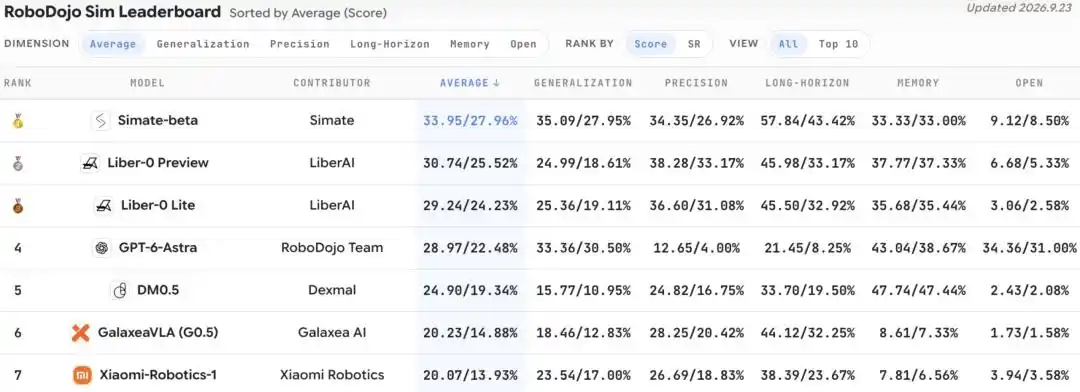
Simate, or Silicon Mate, has released Simate-beta, its first general-purpose fast system for Physical AI, and said the model has reached the top of the RoboDojo leaderboard. Based on data the company provided from the leaderboard updated on Sept. 23, 2026, simate-beta ranked first with an average score of 33.95 and a success rate of 27.96%. Simate said the base model used in the evaluation was not specially optimized for that benchmark.
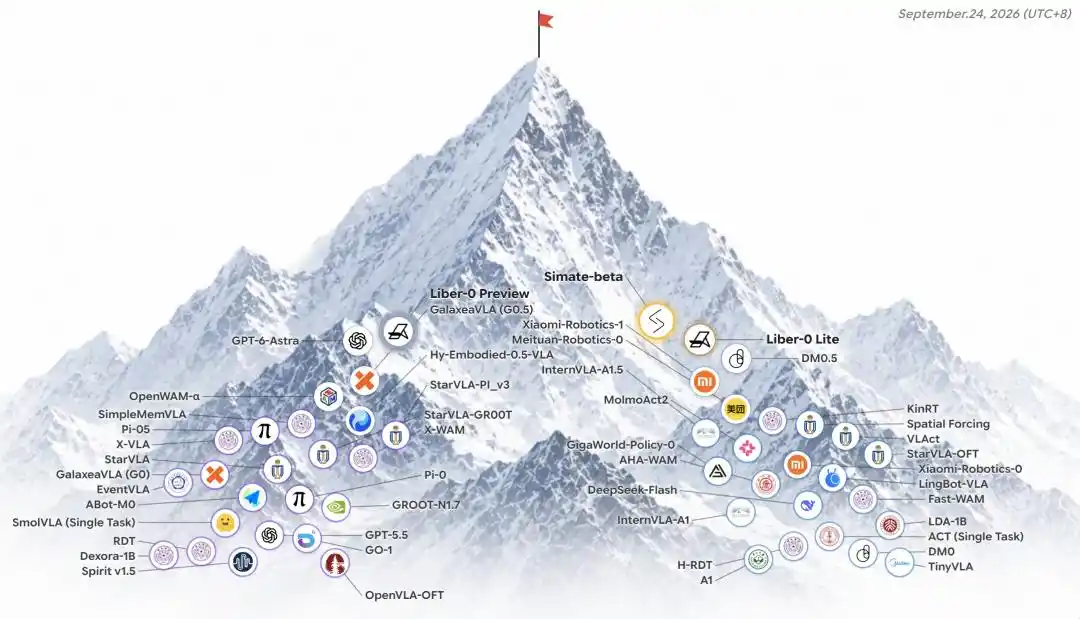
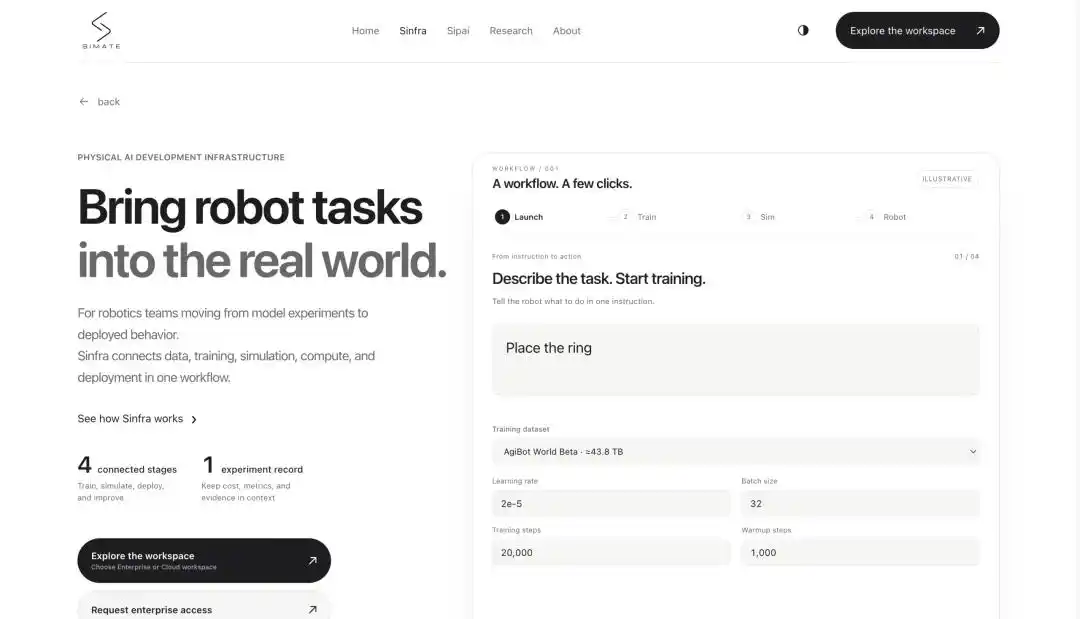
The company is only three months old. Alongside the model launch, Simate said it has been moving research infrastructure, external testing and fundraising in parallel. According to the company, researchers from MIT, the California Institute of Technology, Tsinghua University and Peking University have joined the private test of its AutoResearch platform. Its supporting Sinfra infrastructure covers training, simulation and inference, with resource availability confirmed through applications. During the same period, Simate said it completed multiple financing rounds worth several hundred million yuan each.
Simate said its core team previously pushed a single-stage end-to-end autonomous driving model to a level benchmarked against Tesla Full Self-Driving, or FSD, and brought it into mass production. The company also said it has formed a technical path aimed at zero-shot generalization for complex tasks and plans to release staged results by the end of this year. Work covering the model and automated research, among three research tracks, will be disclosed through papers and technical reports, with the related results to be open-sourced in phases.
Simate-beta targets zero-shot and few-shot Physical AI operation
Simate said its long-term target is general-purpose Physical AI operation under zero-shot and few-shot settings. In the company’s framing, a system operating in a new environment should not need a fresh round of data collection, retraining and engineering adjustment every time a new task is added.
The company’s current answer is what it calls a general-purpose fast system. Simate maps that to “System 1.” In its description, a slower system handles high-level planning and complex reasoning, while a strong fast system deals with real-time perception of a changing physical world and produces actions at high speed. Simate said it is focusing on the latter for now, scaling up the fast system to explore whether zero-shot generalization can emerge while pushing the upper limit of deployable edge models in both scale and capability.
The company broke that path into two core components.
- 4D physical perception: capturing spatial structure and temporal change at the same time so physical representations can directly support action.
- Hierarchical temporal memory: retaining relevant past events in long-horizon tasks, tracking state through continuous operation, and keeping immediate reactions from slowing under a large historical context.
Simate said those two parts are meant to align with the way a human fast system handles a continuous world. It added that the route extends the team’s earlier work in large-scale vision models, temporal modeling, real-time inference and mass-production deployment. The specific architecture and model size will be disclosed in later technical reports.
The state the company says it is aiming for is a model that knows what is happening in front of it, remembers what just happened, and can decide the next move in time. It also expects that capability to work alongside the general reasoning represented by frontier models such as GPT-6, with the goal of pushing toward zero-shot execution on complex tasks.
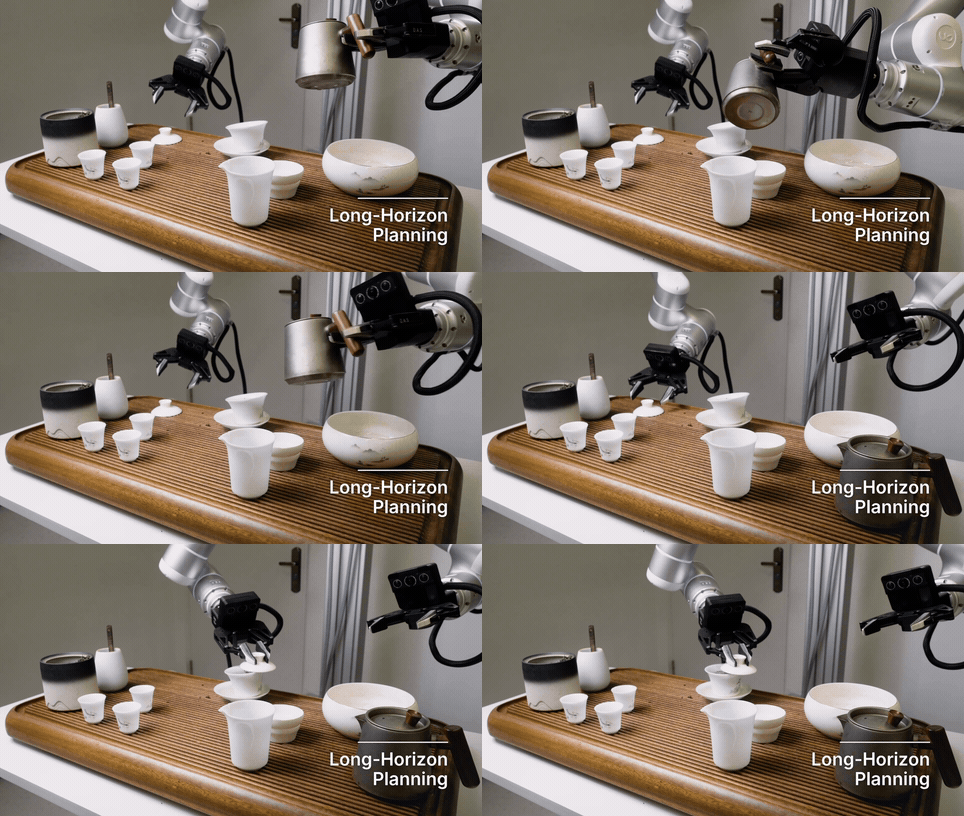
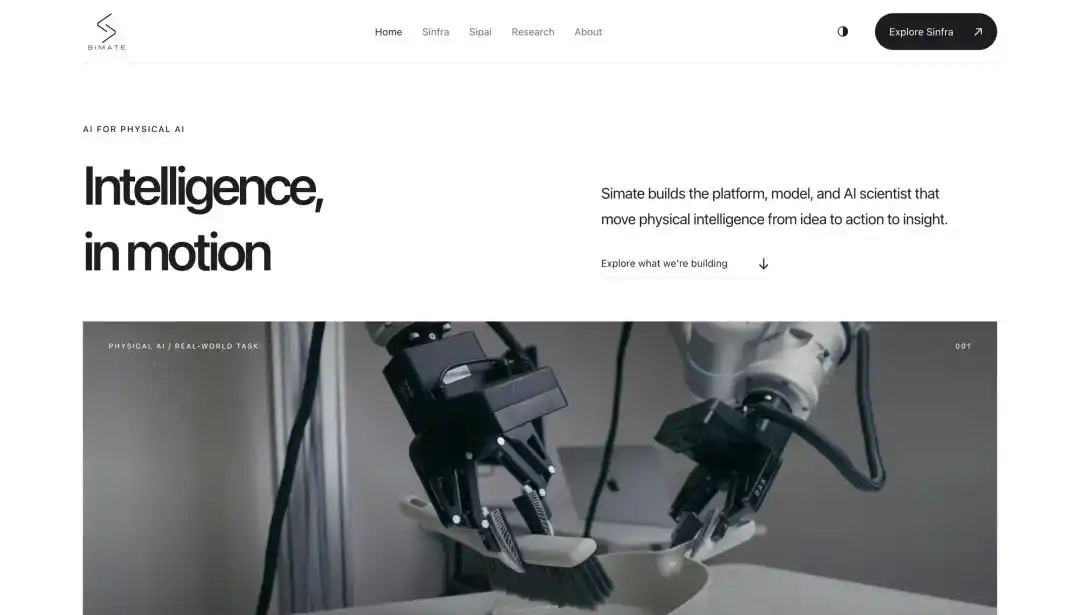
From the hardware demos released by the company, current tests center on demonstration-driven task adaptation, memory, complex long-horizon execution and fine manipulation. Simate also said the RoboDojo result belongs to leaderboard evaluation, while real-world machine performance is presented separately.
AI for Physical AI: putting AI into the research loop
The more distinctive part of Simate’s pitch is the development method it says it chose on day one: AI for Physical AI. In practical terms, the company wants AI systems to participate in the research and iteration of physical intelligence itself. It says model design, data, compute and experimentation are organized around that path, with Simate-beta serving as the first output of this AI-native R&D system.
The team argues that in AI research, code writing is only a small part of the job and iteration speed often decides who moves first. A robot can fail on a long-horizon task for several different reasons, including distorted data distribution, an architectural bottleneck, imbalanced trajectory ratios, or a training strategy that does not work. Each possible cause can lead to dozens of experiments.
If researchers have to manually modify configurations, launch jobs, watch training, run evaluation and then organize the results by hand, the process slows sharply. Simate said that is why it built AutoResearch. In the company’s description, human researchers propose hypotheses, set goals and define constraints, while the AutoResearch engine takes over the remaining stages by breaking down experiments, running them and feeding back the results through an automated workflow. Simate links that process directly to its three-month run from founding to the top of RoboDojo.
A three-layer stack: SiPAI, AutoResearch and AI-native Infra
Simate describes its automated research system as a three-layer architecture made up of SiPAI, AutoResearch and AI-native Infra. The company’s argument is that robotics research runs through model code, data pipelines, training clusters, evaluation environments, hardware feedback and months or years of experimental records, which means a single agent is not enough on its own. The harder problem is giving the agent a shared interface that can reach the entire research context.
SiPAI: making model architecture researchable by AI
SiPAI is described as a pluggable model framework built natively for automated research. The idea is to structure robot models in a way AI can parse easily, with clear module boundaries, system interfaces, configuration items and validation procedures. That allows an agent, once assigned a research task, to identify which module should be changed, what the impact of the change will be, and how the result should be validated.
According to the company, this infrastructure is already in place and connected to several mainstream architectures, including world models, world action models, VLA and VLM. Both human researchers and agents can combine components freely, modify local implementations and still use the same training and evaluation pipeline.
AutoResearch: refreshing research context in real time
If SiPAI provides a more static structural layer, AutoResearch is meant to close the dynamic information gap. Simate said it connects external frontier papers, internal discussion materials, model code, data ratios, historical experiment logs and the latest evaluation feedback into a single evolving research context.
In the company’s account, that context updates in real time whenever a new paper appears, a new code version is committed internally, or a fresh experiment invalidates an earlier hypothesis. That allows every research suggestion from an agent to point to a specific code branch and experiment version.
Simate said the most interesting part is the coupling between human experience and agent-led experimentation. Researchers can inject constraints and tuning directions at any time. Once an experiment verifies an effective component, it becomes the new starting point for later work. If one branch yields a usable method, the next agent can reuse it directly. In that setup, research output becomes an input for the next research cycle.
AI-native Infra: keeping the research flywheel running 24/7
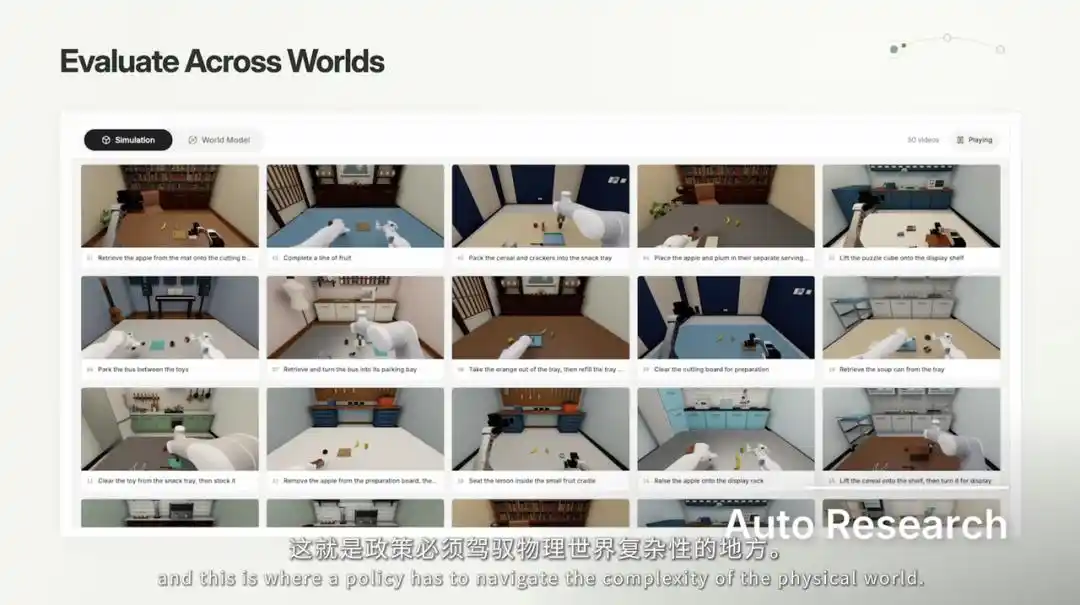
Simate said it has connected training, inference and evaluation to an in-house infrastructure layer that can orchestrate tasks and allocate resources across dozens of independent research routes at the same time. To avoid wasting compute, the company uses a high-frequency filtering process. Every route first goes through a fast screening round inside a world model plus simulation environment, which eliminates most ineffective directions. Only the approaches that continue to show potential move on to hardware testing.

New issues found on real machines are then fed back into the research context, closing the loop. Simate’s description is straightforward: a human only needs to throw out an exploration direction, and the underlying system can drive dozens of experiment rounds in parallel. The company points to that system as a key reason it reached the top of the leaderboard within three months.
Simate also said this internal productivity tooling will be opened directly. Researchers from Tsinghua University, MIT and the Hong Kong University of Science and Technology have already joined the private test.
Team background and fundraising
Simate founder Zhang Ying is described by the company as a former core technical lead at a major autonomous driving company. The company said Zhang worked on three generations of autonomous driving systems, including map-based, mapless and end-to-end approaches, and also has years of mass-production experience. Simate said the autonomous driving system he helped build was the closest in China to Tesla FSD.
The company also highlighted two other members.
- Zhan Fangneng: assistant professor at the Hong Kong University of Science and Technology and head of World Mind Lab, with long-term research focused on world models and Physical AI.
- Ji Mazeyu: a young scientist born in the 2000s whose work spans 3D perception, dexterous manipulation and whole-body control for humanoid robots. Before joining Simate, he was a founding member of Silicon Valley-based Assured Robot Intelligence. The company said ARI was later acquired by Meta.
On financing, Simate said it completed multiple funding rounds within its first three months, each worth several hundred million yuan.
How Simate defines Physical RSI
Simate says it has been building around Physical RSI since day one. The company divides RSI into three forms.
Weak SI: clear boundaries and fast closed loops
In this setup, researchers define the goal and constraints in advance. During normal execution, they do not need to participate step by step, while exceptions can be escalated for handling. Simate said its RoboDojo result serves as the engineering validation for this first stage.
Medium SI: the direction is known, but the answer is not
That covers questions such as how to improve model memory or how to set the data ratio for a task category. The direction is visible, but the effective solution still has to be found through repeated experiments. Simate said the agent’s role here is to organize context, implement proposals, run tests and compare outcomes, while researchers filter hypotheses, explain conflicting evidence and make key choices. The company described this as the most practical category at the current stage.
Strong SI: even the research problem must be discovered
This is the hardest category in Simate’s framework, including questions such as how to raise generalization on entirely new tasks. The company said such problems no longer come with a clear solution path. A system would need to understand the objective, identify which problems are worth studying and keep its sense of direction over a long period while adjusting the route along the way. That starts to involve what the team calls research taste. For now, Simate said senior researchers still lead this part, while agents support literature review, evidence gathering, experimentation and route exploration.
The company also stressed that weak, medium and strong SI are not ranks. All three can coexist inside the same R&D system.
Next steps and disclosure plans
Simate said it sees GPT-6 taking part in operations in the physical world as a natural development, and it believes breakthroughs in Physical AI may arrive faster than many expect. The company wants to reduce dependence on task-by-task adaptation and post-training, with the goal of pushing Physical AI toward what it called its own “GPT-3 moment.”
The team added that automated research does not need to wait for a stage with zero human involvement before it becomes useful. Before stronger autonomous research systems emerge, shifting high-cost and processable stages such as experiment design, training, evaluation and feedback to agents can already lift research throughput. In Simate’s view, the RoboDojo result offers one validation that a human-machine co-driving model is workable in Physical AI.
The AutoResearch research platform is now in private testing. The company listed its website as https://mate-robot.cn/ and the AutoResearch platform page as https://mate-robot.cn/research/sinfra/ .
The original article was published by the WeChat public account Quantum Bit (ID: QbitAI) and written by Jay.