


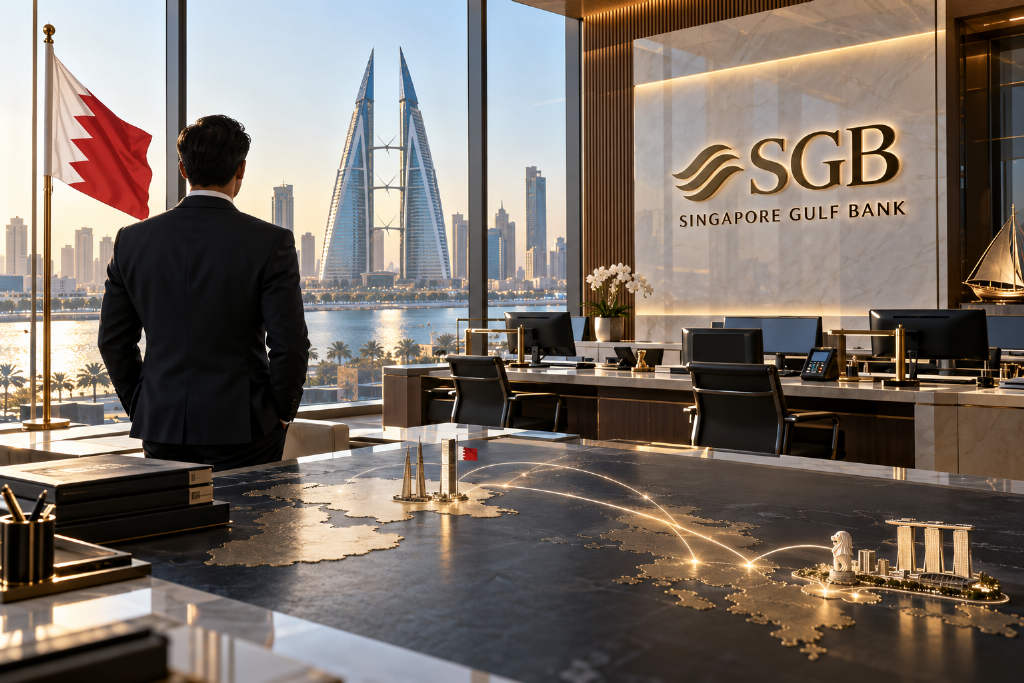
Singapore Gulf Bank, a Whampoa-backed bank licensed in Bahrain, launched corporate banking services in November 2024. By October 2026, a partnership announcement with Payward said monthly fiat trading volume on SGB Net had risen above $20 billion.
The bank carries Singapore in its name, but its licensed operating base is Bahrain. The services it has rolled out point to a specific role: providing accounts for crypto firms and payment institutions, then making those accounts useful for the timing and mechanics of client fund delivery.
Bahrain gave the bank plan a place to land
Whampoa’s digital-asset push started before SGB opened.
In September 2022, the group said it planned to deploy about $100 million into digital-asset startups through a venture fund. Its digital-asset investment arm, Whampoa Digital, focused on early-stage Web3 projects.
In May 2023, Whampoa announced plans to set up a digital bank in Bahrain. Two months earlier, Silvergate had shut down SEN and then said it intended to wind down operations and voluntarily liquidate. Signature Bank was also closed by regulators. Digital-asset firms still needed to receive and send dollars, move positions and complete settlement, but bank service capacity had opened up a gap.
When Shawn later explained the opening he saw, he pointed to that mismatch: companies were already operating across regions, asset classes and currencies, while bank settlement remained fragmented and tied to processing windows.
Owning the bank gave SGB a direct way to build account relationships with clients. Accounts hold funds, the settlement network links counterparties, and later services can be built around what clients need those funds to do.
Bahrain’s appeal can be broken into three parts.
- Regulatory coordination. In a 2025 interview, Shawn said one regulator there covered banking, capital markets and digital-asset activity, making it easier to coordinate business that crosses financial sectors. That matches the Central Bank of Bahrain’s role as an integrated regulator.
- Client scope. In February 2024, Mumtalakat announced an investment in SGB. The statement said the bank had received a Central Bank of Bahrain license and specifically mentioned account opening for offshore clients.
- Local capital and regional positioning. Mumtalakat is Bahrain’s sovereign wealth fund, and both sides publicly framed the bank around linking Asia with the Middle East and North Africa.
Regulation, client access and a local shareholder were folded into the same bank-building plan. SGB’s legal status is a conventional wholesale bank regulated by the Central Bank of Bahrain, with each activity carried out within the scope of the relevant approvals.
About a year and a half passed between the initial buildout announcement and the launch of corporate banking services. Team formation and system work moved ahead during that period.
The people brought in had already spent years in institutional banking
In August 2023, Ali Moosa joined SGB as executive vice chairman.
He spent about 30 years at JPMorgan and, before leaving, oversaw regional business across Central and Eastern Europe, the Middle East and Africa. Historical biographies list responsibilities spanning wholesale payments, treasury services, trade finance, institutional client coverage and regional governance.
Going back further, Ali was already discussing in a 2011 interview how to use financial-institution relationships to help Middle East banking clients expand cash management and trade finance, and how to work with local banks to fill service gaps for multinational companies.
Connecting client demand, bank products and financial institutions across markets had long been part of his work.
In January 2024, Edmund Lee was appointed chairman of SGB. He had served as vice chairman for Asia Pacific at JPMorgan, as the bank’s senior country officer in Singapore, and also had operating experience at DBS Vickers.
The finance and operations hires that followed came with similar backgrounds. CFO Ali AlShamma had been CFO at Goldman Sachs Saudi Arabia and Citigroup Saudi Arabia. COO Elaine Leong had been COO at Sygnum and also worked at GIC. Keith L., who leads institutional business and private banking, lists Binance on his public profile. Co-founders Shawn Chan and Justin Han came from legal and investment backgrounds, respectively.
That mix maps to the practical work of institutional banking: meeting clients, understanding trading flows and deposit and withdrawal activity, designing account services, running operations, and explaining the business to partner banks.
One point mattered especially for SGB. Behind the direct client, there may be another layer of clients.
An incoming payment for a payment company may be a treasury transfer, or it may be settlement on behalf of that company’s own customers. An exchange’s operating funds and the customer money it handles on platform do not serve the same purpose. A bank needs to understand whose business an account is carrying and what kind of fund activity sits underneath it.
People who know institutional banking understand what another bank will ask. People who know digital-asset businesses understand how client money actually moves. Put together, those two kinds of experience can help account opening, product design and day-to-day handling move into the same working language faster.
That makes the link between management résumés and client acquisition more concrete. Institutions choose a bank when someone understands how they operate and can turn that into a service they can keep using.
First make the account work, then make accounts useful to one another
In November 2024, SGB launched corporate banking services, highlighting crypto-compatible banking and remote digital onboarding. Eligible offshore institutions could establish banking relationships through a digital process.
System work had been moving in parallel before launch. Digital China disclosed that it had won the core banking system project for SGB, and its first-quarter 2024 report still referred to related delivery work.
A bank first needs to record and process balances. After that, it can expand what those accounts are able to do.
In May 2025, SGB launched SGB Net, offering 24/7, real-time, free transfers within the network. The target participants were clearly named: exchanges, stablecoin issuers, market makers, OTC desks and institutional brokers.
Those firms already move money between one another. Under the usual mechanics of internal bank transfers, if two institutions hold same-currency accounts at the same bank, one pays and the other receives by changing the allocation of deposit liabilities between clients. No separate interbank transfer has to be initiated.
The value of SGB Net rests on that shared account relationship. It brings part of institutional delivery and settlement into a bank ledger environment that can keep running.
Free transfers encourage frequent use. A client arranges balances to meet a payment obligation, the counterparty receives funds, and those funds may then be used for the next transaction. Once accounts start turning over repeatedly, the bank has an opening to provide cash management, FX and conversion services on top.
Whether the network is useful depends on where a client’s regular counterparties are. One institution opening an account creates a banking relationship. When its actual trading counterparties join too, that relationship gains a daily use case.
The client list began to show the shape of a network
The client mix turned out broader than the team first expected.
According to Shawn in a November 2025 interview, the team had expected most early clients to come from crypto, but close to half at that point came from traditional payments.
Payment firms brought needs that extended into client fund management, payment identification and operating disbursements. SGB’s later disclosures on clients and partnerships covered those different uses:
- Binance Bahrain: SGB Link, supporting direct USD transfers between eligible client bank accounts and exchange accounts.
- OSL: client money accounts and fiat settlement through SGB Net.
- Matrixport / Fly Wing: client money accounts, settlement services, and virtual account capabilities used by Fly Wing.
- Zerocap / LTP: connecting SGB Net to OTC, institutional brokerage and treasury transfer workflows.
- MetaComp: USD collections and payments plus settlement within the network.
- First Digital: multi-account structures, cash management and related settlement for FDUSD operations.
- Payward: access to SGB Net, with the first phase covering USD settlement for some institutional clients; a separate liquidity arrangement involving Kraken Prime was also outlined.
These relationships span bank clients, product integrations and partnership arrangements, and they do not all reflect the same depth of use. The use case says more about SGB’s position than the length of the list.
In March 2026, Zerocap said it had integrated SGB Net into its global OTC infrastructure, enabling same-day USD settlement during Asian hours. It listed family offices, payment companies and digital-asset funds among its institutional clients.
For that kind of business, the timing of fiat delivery after a trade directly affects what funds can be used for next. If a trading desk misses a dollar processing window, it has to wait, track incoming funds and manage available balances in the meantime.
SGB’s role in that process was to improve the timing and predictability of fund delivery. Treasury teams could then plan how much money was usable that day and when the next payment could be made.
The OSL case pointed to the internal logic of the network as well. Fiat settlement improved most when both sides were already inside the SGB network, and the case linked more internal delivery to broader use of SGB by more OSL clients.
That gives clients a reason to bring regular counterparties onto the platform. A client list turns into network value only when real payments start moving between names on that list.
Early clients also needed service performance to build trust. A Matrixport case said some cross-region transfers were cut from about two days to a matter of hours, and it also pointed to the team’s understanding of Web3 operations.
Distribution and ecosystem ties created other entry points. Aquanow brought SGB banking services to its institutional client base. Fireblocks Network offered service discovery and connectivity, while onboarding review still sat with the bank.
Matrixport founder Wu Jihan is also a member of SGB’s Global Advisory Board. Matrixport and Fly Wing appeared separately in the bank’s client and product case materials.
Those public overlaps help explain how SGB got close to some early clients. Keeping those relationships deep still depends on whether institutions use the bank again in the next funding cycle.
The internal network still needed links to the outside dollar system
Early SGB Net announcements stressed that transfers between participants did not rely on SWIFT. Outside the network, clients still needed to receive money from other banks and send money to them.
In 2026, SGB kept adding those links.
In January, it opened a correspondent account with JPMorgan and adopted Wire 365. The announcement said the service supported receiving USD payments on weekends and public holidays and crediting them to client accounts. In April, SGB joined the BNY correspondent banking network. In May, it established a banking relationship with Standard Chartered covering multicurrency and cross-border flows across markets including the Middle East and Asia. In October, it added BNY’s 24/7 USD Book Transfers, covering eligible accounts held directly at BNY and correspondent accounts that clear through BNY and participate in the service.
Together, those arrangements expanded coverage, but each came with its own account scope, direction of flow and processing conditions.
Client balances sit on SGB’s books. External USD receipts and payments still require correspondent accounts and matching operational arrangements. Internal ledger entries, correspondent balances and final crediting by the receiving bank are different points in the payment chain.
That is why any claim of 24/7 service has to be checked against the actual payment path: who can initiate, which account receives the funds, and when those funds become usable balance for the recipient.
The same division of labor explains SGB’s commercial space. Large banks provide correspondent and clearing services to SGB as a bank. SGB, in turn, handles onboarding, accounts, payments and day-to-day support for its own institutional clients. It uses established banking rails to extend service to the crypto and payments firms it covers.
Upstream banks still need to understand SGB’s clients and fund activity. The Wolfsberg correspondent banking principles list management, client base, products and financial-crime controls among the areas used to understand a banking partner.
A recent FinCEN alert around the A7 network also showed how third-country companies can obscure underlying sanctioned connections.
For a bank serving institutional clients, one company name on a client list may stand behind many more customers and business lines. The volume a single client brings has to be weighed against the cost of identifying underlying activity and maintaining upstream banking relationships.
SGB’s network rests on those continuing bank relationships.
Money in the account still has to move into the next business step
As external dollar connectivity expanded, services inside the account relationship deepened too.
In November 2025, SGB said it had selected Fireblocks to support digital-asset wallet infrastructure and related treasury operations.
Fiat balances are recorded in bank accounts. On-chain asset activity still needs wallets, permissions and transaction approval. That infrastructure set up later services.
In February 2026, SGB launched Virtual Accounts, supporting structured account identifiers by payer, invoice or business unit, and combining that with COBO and POBO to improve payment identification and reconciliation.
Once money arrives, institutions still need to know who it belongs to, which business it relates to and what should happen next. Virtual account identifiers help classify and organize incoming funds. Client money accounts then carry the related account and fund management. Whether an underlying customer has a separate bank relationship depends on the specific arrangement.
Fly Wing was named as a user. The wholly owned Matrixport subsidiary used the service to support miner withdrawals and obtain liquidity needed for operating costs such as electricity payments.
That example ties the demand chain together clearly: revenue comes in as digital assets, operating expenses need fiat, and the platform still has to identify each client and each payment. Identification, conversion and payout need to connect inside one operating flow.
Stablecoin services were also moving ahead. In February 2026, SGB announced an upgrade to its fiat and stablecoin platform. In April, it formally launched stablecoin mint and redeem services, initially supporting USDC transactions above $100,000 for corporates and high-net-worth clients, with access through SGB Net.
That same month, First Digital announced a partnership covering banking settlement, multi-account structures and cash management needed for FDUSD operations, including interest-bearing and time-deposit arrangements.
Bank clients may need to convert dollars into stablecoins, while stablecoin operations themselves need bank accounts and cash management. SGB entered that funding chain from both ends.
By October, the Payward partnership brought the bank closer to trading venues, while Kraken Prime was planned as an additional liquidity source.
Once funds can move, counterparties still need pricing and assets. Settlement and liquidity have to sit closer together if institutions are to put capital to work.
Those products moved forward in parallel, gradually increasing how much work one banking relationship could handle.
After volume rises, the question is what business stays with the bank
SGB has disclosed several points that show how usage has grown:
- Full-year 2025: $12 billion in bank transaction volume, including $6 billion on SGB Net. Source and framing: a March 2026 interview report by The Business Times.
- As disclosed in February 2026: monthly fiat trading volume on SGB Net above $2 billion. Source and framing: an SGB announcement.
- As disclosed in October 2026: monthly fiat trading volume on SGB Net above $20 billion. Source and framing: the SGB-Payward partnership announcement.
Annual and monthly figures cover different periods, and the counting methods were not fully disclosed. The numbers show scale of use. The business value still depends on daily balances, client concentration and revenue mix.
There is another commercial layer here. Clients want money to move faster, and banks want clients to keep using them. Better efficiency may reduce the balances clients need to leave idle for each transaction. Higher transaction volume does not automatically move in step with the size of deposits a bank can retain.
So the return on a free network depends on what business remains inside the relationship: how many accounts are used day to day, how balances turn over, and whether FX, conversion and cash-management services can produce recurring revenue. The contribution of those pieces still needs fuller operating data to test.
From an earlier bank-building exploration that did not continue in Singapore to a funding network that gradually took shape in Bahrain, SGB has moved from simply providing accounts to organizing fund activity between institutions. It connects outward to the established dollar system and inward to collections, payments, trading and on-chain services inside clients’ daily operations.
Its name carries Singapore and Gulf. Its day-to-day business runs through exchanges, payment companies and global banks. SGB is trying to turn account relationships between those institutions into a repeat banking business.
Source notes and scope
This article is based on historical management interviews, shareholder and bank announcements, materials published by clients and counterparties, and regulatory documents. Historical decision motives are attributed to the interviewees’ own framing. Explanations of business mechanics and route are analytical summaries based on public facts. The client list is not complete, and bank clients, product integrations and partnership arrangements should be understood separately. Case-study outcomes were disclosed by the parties involved and do not amount to independent audit findings. Annual and monthly transaction figures are presented according to the methodology used by each cited source.
The source notes also state that the client-share reference in this article follows management comments from a November 2025 interview, while transaction scale follows the disclosure basis used by each source. Any discussion of network effects is an analysis based on client use cases and should not be read as proof of a durable competitive advantage. A7 is included as industry risk context. Public materials reviewed for this article do not show that SGB changed account policy or offboarded clients because of it.
- The Business Times, 2026-03-05, "Singapore investors build showcase of banking expertise in Gulf." The article’s references to the earlier Singapore exploration and the bank-building opportunity follow Shawn Chan’s retrospective comments in that interview. The figures of $12 billion in 2025 bank transaction volume and $6 billion in SGB Net volume follow that report’s framing. They are not independently audited by this article.
- Bahrain EDB / SGB, May 2023, Whampoa Group digital bank initiative; Mumtalakat, 2024-02-28, Investment alongside Whampoa Group; SGB, 2024-11-04, Corporate banking launch. This article treats bank exits and SGB’s buildout only as market background occurring in the same period and does not state that those events directly caused the bank plan.
- SGB, 2026-10-05, Payward and Singapore Gulf Bank partner. Some institutional clients, relevant jurisdictions and the initial scope of USD settlement follow that announcement. The later liquidity arrangement involving Kraken Prime is treated separately from settlement already connected.
- Whampoa Group / Reuters, 2022-09-09, digital-assets venture investment plan. The $100 million figure refers to the amount planned for deployment through a venture fund at the time and is not treated as SGB bank capital or completed investment.
- Silvergate / SEC, 2023-03-08, Intent to wind down operations and voluntarily liquidate Silvergate Bank; FDIC, Signature Bank failure information. The former refers to an orderly wind-down and voluntary liquidation plan, and the latter to regulatory closure and receivership. This article does not infer that Signet stopped on the day of takeover.
- CryptoNews, 2025-11-27, interview with Shawn Chan: Asia-GCC payments and digital banking. The integrated-regulator point and the statement that close to half of clients came from traditional payments both follow that CEO interview. The latter is not used as a statement of 2026 client mix and is not independently verified operating data.
- Central Bank of Bahrain, official responsibilities and integrated-regulator description, reviewed on 2026-10-25. Unified regulation does not mean all activities share the same licensing conditions.
- SGB / Bloomberg, 2023-08-28, report on a JPMorgan regional head joining Singapore Gulf Bank.
- Terrapinn, historical speaker biography for Ali Moosa. The page lists responsibilities from his JPMorgan years and does not describe a current role.
- Cash and Trade Magazine, 2011-08-01, "How J.P. Morgan helps clients meet challenges." It lists Ali Moosa’s institutional and treasury-services responsibilities in the Middle East and North Africa at the time and discusses bank partnerships, corporate cash management and trade finance.
- SGB, 2024-01-22, Edmund Lee appointed chairman.
- Keith L. public professional profile; SGB 2024 CFO and COO appointment materials; SGB leadership page. Co-founder, management and advisory roles are treated separately.
- Digital China, 2024-03-28, 2023 results release; 2024-04-29, first-quarter 2024 report; Fireblocks / SGB, 2025-11-04, digital-asset wallet infrastructure. Vendor disclosures are not used to infer undisclosed internal architecture.
- SGB, 2025-05-01, SGB Net launch; 2026-02-02, fiat and stablecoin platform; 2026-04-17, stablecoin mint and redeem service. Initial currencies, transaction thresholds and client conditions follow the relevant announcements.
- SGB, 2025-09-09, Binance Bahrain direct USD transfers. The scope applies to the relevant Binance Bahrain service and is not generalized to all Binance entities or clients.
- SGB, 2025-12-17, OSL customer story.
- SGB, 2025-12-03, Matrixport customer story; 2026-02-07, real-time virtual accounts. Case-study timing should not be read as a universal SLA for all clients or all transactions.
- Zerocap, March 2026, institutional fiat settlement partnership; SGB, 2026-03-24, LTP collaboration.
- SGB, 2026-03-10, MetaComp customer story. The 80% figure refers to the highest cost reduction described in that case and does not apply to all business.
- First Digital, 2026-04-14, banking infrastructure for FDUSD operations. The announcement is not used to claim SGB is the exclusive reserve custodian for FDUSD.
- SGB, 2025-08-12, Aquanow partnership; Fireblocks, 2025-09-11, Banks on the Network for Payments. Service discovery on the network and bank onboarding review are separate, and no specific client source is inferred from that alone.
- SGB, About us and Global Advisory Board pages.
- SGB, 2026-01-12, JPMorgan account and Wire 365; 2026-04-07, BNY corrected release; 2026-05-12, Standard Chartered relationship; 2026-10-12, BNY 24/7 USD Book Transfers. The applicable accounts, directions and participant conditions differ across these services. The April BNY material follows the corrected version and does not use the deleted fixed-income platform wording.
- Wolfsberg Group, Correspondent Banking Principles.
- FinCEN, 2026-10-01, A7 Network alert; Federal Register, 2026-10-05, Proposed special measure regarding A7 Network Sub-Agents. The description of network operation follows regulators’ wording. As of the source date used here, the measure remained a proposal, with comments due by 2026-11-04. This article does not assert any specific account closure at SGB or any link between SGB and A7.