
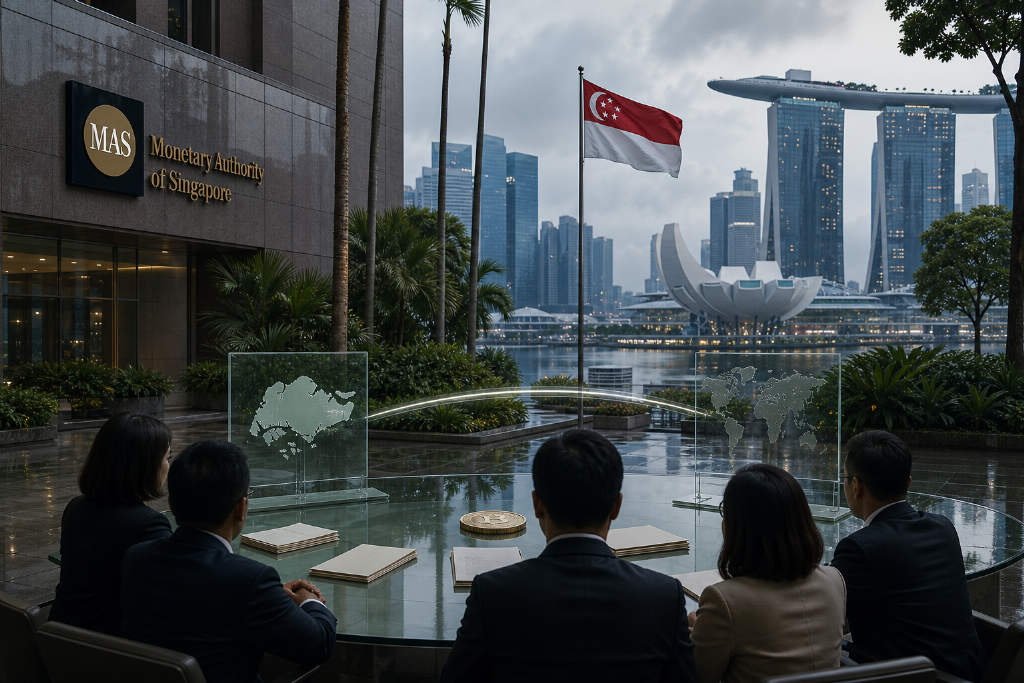
The Monetary Authority of Singapore (MAS) began a public consultation on Sept. 1 to reconsider the “purely domestically issued” requirement in its 2023 stablecoin framework. The proposal would open the door for jointly issued cross-border stablecoins, as well as some foreign stablecoins regulated under comparable overseas regimes, to be brought into the MAS supervisory framework.
The move reopens one of the central design limits in Singapore’s original rulebook and creates room for cross-border regulatory coordination on stablecoins. The consultation is set to run until Oct. 16.
The 2023 framework was built around domestic issuance
Under the stablecoin framework introduced by MAS in 2023, a qualifying stablecoin had to be issued purely in Singapore and could only be pegged to the Singapore dollar or a G10 currency. The original logic, as described in the source material, was straightforward: it was difficult to establish regulatory equivalence with other jurisdictions, hard to put cross-border supervisory arrangements in place, more challenging to trace funding sources in mixed issuance structures, and uncertain whether offshore reserves would be sufficient to meet redemption demand.
MAS is now revisiting that approach through two proposed changes.
Two proposed changes: joint issuance and recognition of some foreign stablecoins
The first proposal covers cross-border joint issuance. Stablecoins issued jointly by a Singapore issuer and a foreign issuer could be included in the framework, provided risks are adequately controlled. Those tokens could be labeled “MAS-regulated stablecoins.”
The second proposal would allow MAS to recognize a limited number of foreign stablecoins that are regulated under what it calls a “comparable framework” overseas. Those stablecoins could then be permitted for cross-border wholesale transactions.
Taken together, the proposals point to a shift away from a closed domestic model and toward a structure that can accommodate regulatory cooperation across jurisdictions.
Core conditions remain centered on backing, liquidity, and redemption
The consultation document keeps the main prudential conditions in place. They include sufficient reserve assets to support value stability, adequate capital buffers at the issuer level, redemption at par on a 1:1 basis, and regular disclosure of reserve composition and liquidity conditions.
Only issuers licensed under the framework would be allowed to describe themselves as a “MAS-regulated stablecoin issuer” and use the term “MAS-regulated” in a coin name or brand.
MAS adds tighter issuer obligations
Alongside the existing standards, MAS is proposing stronger operating restrictions for issuers.
- No interest payments: issuers would not be allowed to pay interest on stablecoins that fall under the framework, in order to avoid confusion with deposit products;
- Stress testing: issuers would need to carry out stress tests to make sure liquidity remains sufficient under extreme market conditions;
- Recovery and orderly wind-down planning: issuers would need plans in place so holders can exit in an orderly manner if the issuer fails;
- Protection of customer funds: customer money received before stablecoin issuance must be protected against misuse.
Stablecoins that do not come under this dedicated framework would continue to be classified under existing rules as digital payment tokens.
Why MAS is revisiting the rules now
The source material points to three drivers behind the change in posture.
First is demand for cross-border payments. Existing cross-border payment rails such as SWIFT are described as slower and more expensive, while stablecoins have an advantage in wholesale transaction settlement. If MAS recognizes some overseas regulated stablecoins, Singapore could strengthen its role in cross-border wholesale payments in Asia.
Second is regional competitive pressure. The source notes that Hong Kong has launched a tokenized bond market, while Japan has proposed tax exemption reforms for custodial stablecoins, citing Cointelegraph’s reporting on Japan’s Financial Services Agency. A more closed framework in Singapore, the source argues, could push crypto-financial activity toward nearby markets with more flexible rules.
Third is accumulated regulatory experience. Since the 2023 framework was introduced, Singapore has already handled multiple stablecoin issuer applications, including in-principle approval for Paxos’ U.S. dollar stablecoin and the launch of the DUS stablecoin by DCS. According to the source, MAS now has a deeper understanding of practical implementation challenges than it did three years ago.
Potential implications highlighted in the report
The source frames the implications for Asia in three layers.
At the first level is the regionalization of cross-border stablecoins. If “MAS-regulated stablecoins” develop into a standard for wholesale payments in Asia, Singapore-issued stablecoins could become a more widely used tool for corporate cross-border payments, complementing rather than replacing the retail presence of USDT and USDC.
Second is a demonstration effect for regulatory cooperation. MAS’s use of the “comparable framework” concept could widen discussion around mutual recognition between Asian regulators. The source specifically mentions Taiwan’s financial regulator, Japan’s FSA, and Hong Kong’s Securities and Futures Commission as potential counterparts if they choose to pursue bilateral recognition arrangements.
Third is a mixed picture of opportunity and risk for Taiwan. The source says Taiwan’s crypto market remains constrained by its Regulations Governing Crypto-Asset Service Providers. If Singapore emerges as a regional stablecoin hub, businesses and institutions in Taiwan may rely more heavily on Singapore-linked stablecoins for cross-border payments, raising a policy balance between opening payment access and limiting regulatory arbitrage.
Consultation remains open until Oct. 16
MAS will keep the consultation open through Oct. 16. Whether the final framework is adopted will depend, according to the source material, on the consultation outcome, the willingness of overseas regulators to cooperate, and MAS’s own judgment on risk boundaries.