
Situational Awareness LP, the fund led by Leopold Aschenbrenner, filed its quarterly 13F in the early hours of Aug. 15 Beijing time, giving the market a detailed snapshot of its public holdings as of June 30, just before the fund’s recent collapse.
That timing matters. Only weeks ago, the fund went through what Odaily described as its darkest moment: large losses tied to a sharp pullback in AI-related stocks, amplified by leverage, forced it to unwind a large portion of its public-market book. Odaily also said most of the stock portfolio was later packaged and sold at a discount to Citadel, the firm founded by Ken Griffin.
A 13F is a quarterly disclosure required by the U.S. Securities and Exchange Commission for investment managers with more than $100 million in assets under management. Eligible firms must file within 45 days after the end of each calendar quarter, disclosing U.S.-listed equities, call and put options, convertible bonds, and certain ETF positions held at quarter-end.
Who is Leopold Aschenbrenner
Odaily said Aschenbrenner worked at FTX’s Future Fund in 2022 and remained there until the exchange collapsed. In 2024, he wrote a 165-page paper titled Situational Awareness: The Decade Ahead and launched Situational Awareness LP in the same year, serving as chief investment officer.
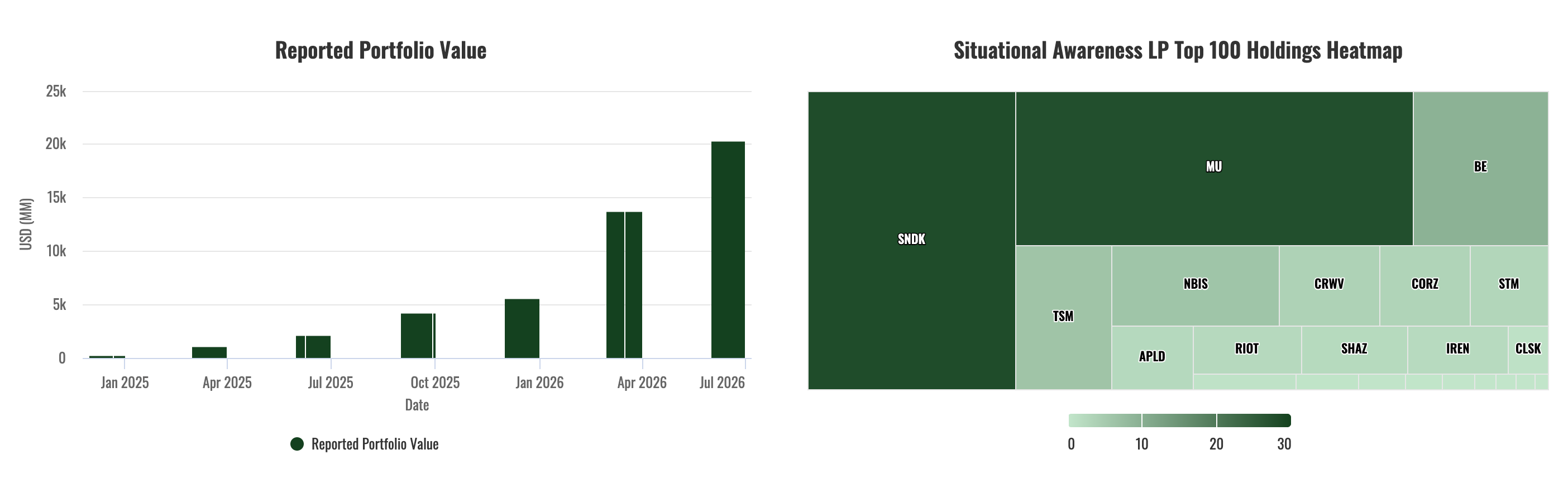
The fund focused on opportunities across the AI supply chain. Its disclosed public holdings stood at just $225 million in 2024 Q4. In the filing disclosed in February for 2025 Q4, that figure had surged to $5.5 billion. By the Q1 filing released in May this year, it had climbed again to $13.7 billion. In the newly released Q2 filing, the fund’s nominal disclosed holdings reached $20.2 billion.
Odaily noted that market values shown for options in 13F filings typically reflect the notional value of the underlying shares, not the premium actually paid by the fund.
Strong returns had previously pushed both Aschenbrenner and Situational Awareness LP into the spotlight as one of the most closely watched AI-focused investing stories online. The latest filing, though, shows that the portfolio structure itself had become highly fragile before the blowup.
A $20.24 billion book built around one broad AI infrastructure trade
As of June 30, Situational Awareness LP disclosed 26 positions with a combined nominal value of about $20.24 billion. A closer look at that pre-collapse ledger shows a portfolio built around a concentrated call on continued expansion in AI infrastructure.
The clearest concentration sat in SanDisk and Micron. The fund held about $5.674 billion of SanDisk, equal to 28.0% of the portfolio, and about $5.574 billion of Micron, or 27.5%. Together, those two positions exceeded $11.2 billion, roughly 55.5% of the whole book.
In practical terms, more than half of the fund’s public-market exposure had been placed on a single direction: memory chips.
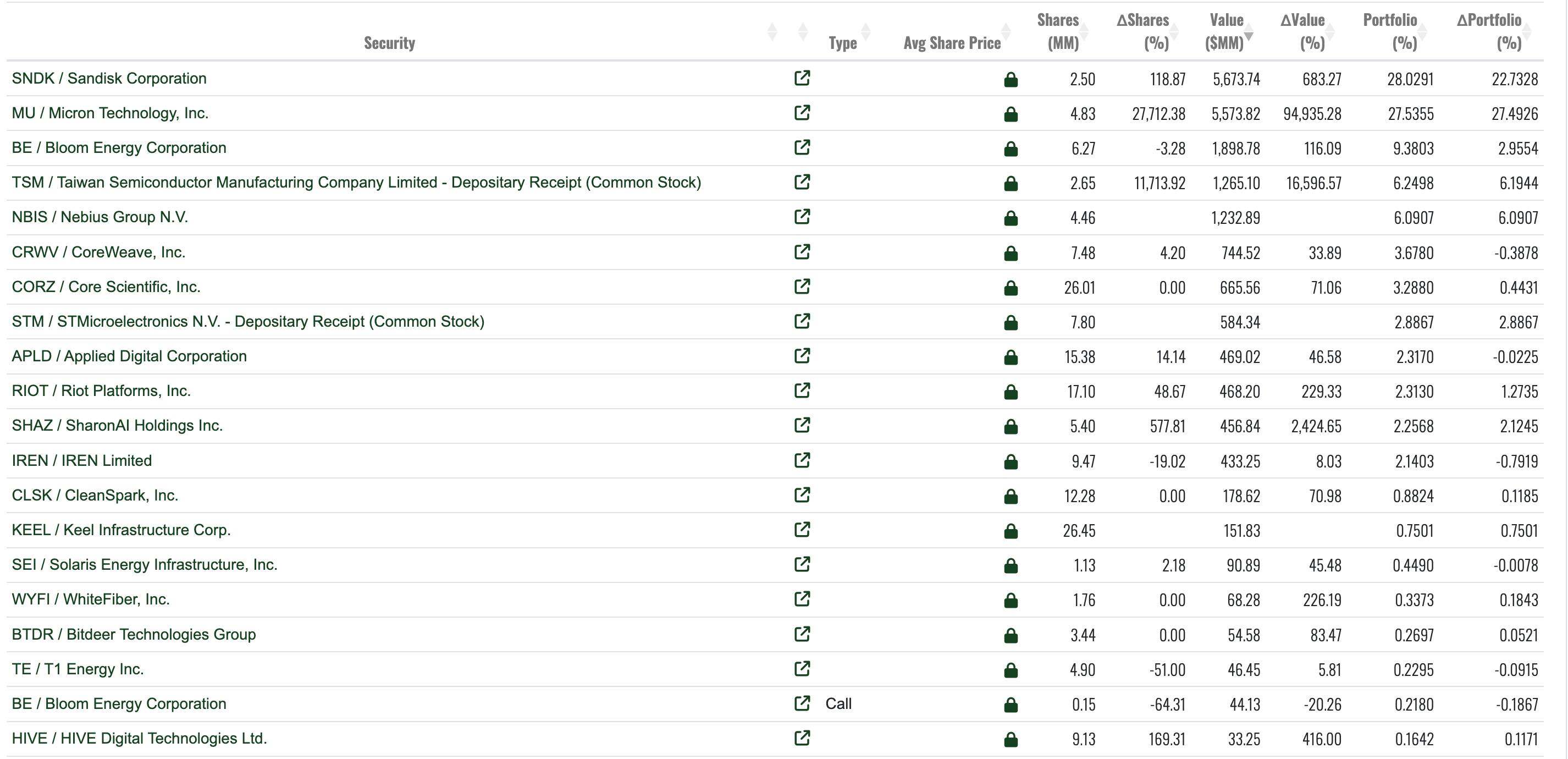
Other positions fit the same thesis. The fund held about $1.899 billion in Bloom Energy, a bet tied to power demand from AI data centers. It held about $1.265 billion in Taiwan Semiconductor Manufacturing Co., linked to advanced manufacturing. It also held about $1.233 billion in Nebius, while names such as CoreWeave, Core Scientific, Applied Digital, and IREN extended the exposure into AI cloud computing, data centers, and energy infrastructure.
On paper, the fund owned more than 20 different securities, including options. In economic terms, much of the book pointed to the same core view: AI compute demand would keep rising, and chips, memory, compute capacity, electricity, and data centers across the chain would continue to benefit.
That structure was less diversified than it looked. In a rising market, the approach could produce far more upside than a single-stock bet. In a coordinated decline across AI infrastructure names, losses in what looked like separate positions could quickly move together. Add leverage, and a liquidity event becomes much easier to trigger.
Q1 was hedged. Q2 was not.
Before this Q2 filing appeared, one question had lingered. In the Q1 holdings report released in May, Situational Awareness LP had shown clear caution toward what it saw as overheated conditions in chips and storage.
According to Odaily, by the end of Q1 the fund held more than $8 billion in notional put options tied to major chip and storage names and related vehicles, including SMH, NVDA, ORCL, AVGO, AMD, and ASML. Those positions accounted for more than 60% of the fund’s nominal disclosed holdings. Had the hedges remained in place, the later market decline would have aligned with that defensive positioning.
The new filing explains why that protection did not help. During Q2, the fund removed it.
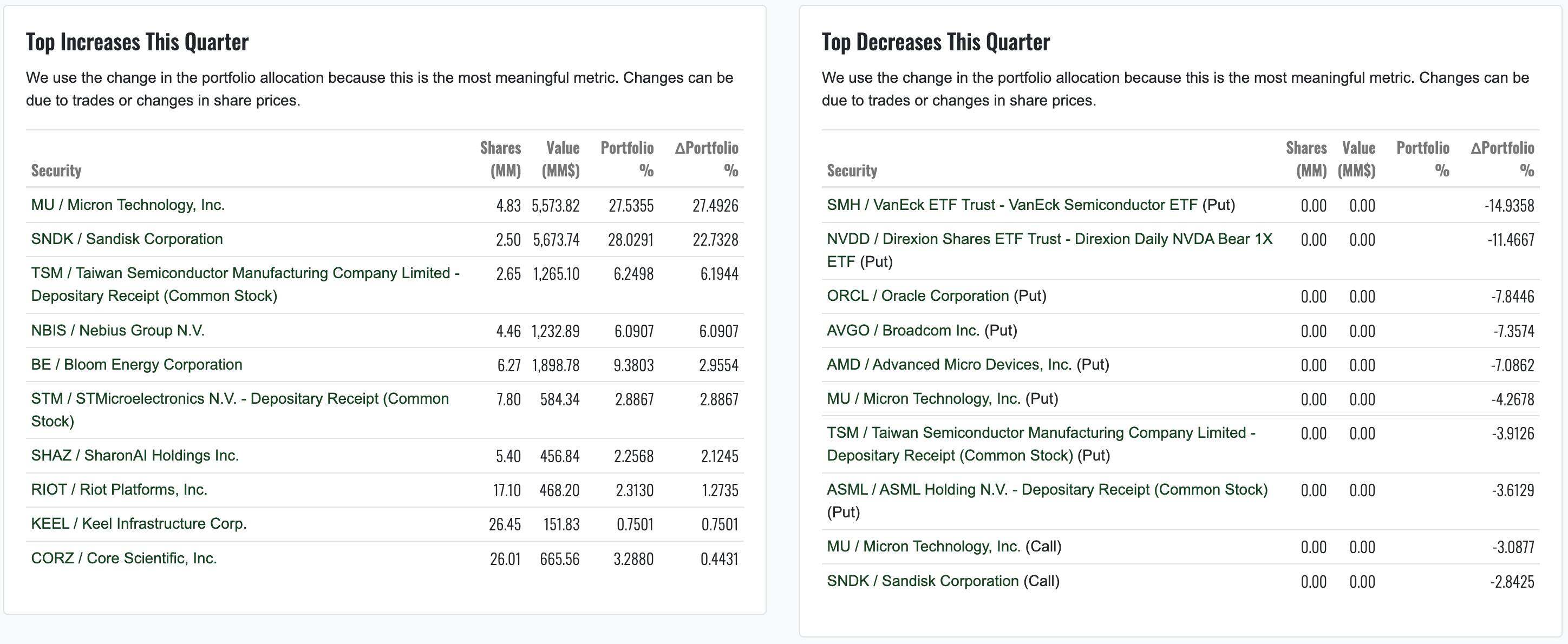
The reduction list in the filing is stark. Situational Awareness LP fully exited all of its chip and storage put positions: SMH Put at -14.94%, NVDA Bear ETF Put at -11.47%, ORCL Put at -7.84%, AVGO Put at -7.36%, AMD Put at -7.09%, TSM Put at -3.91%, and ASML Put at -3.61%.
Those positions had previously formed the downside floor of the portfolio. In Q2, they were abandoned across the board. At the same time, the fund also closed its Micron and SanDisk call-option exposure from Q1, listed at -3.09% and -2.84%, and replaced those derivatives with direct common-stock positions. Micron rose to the No. 2 holding at $5.574 billion, while SanDisk became the largest position at $5.674 billion.
The buying side shows where capital was redirected. Beyond the two storage names, the fund added 6.19% to Taiwan Semiconductor ADRs, 6.09% to Nebius as a new position, 2.89% to STMicroelectronics as a new position, 2.12% to SharonAI as a new position, and 0.75% to Keel Infrastructure as a new position.
Odaily described the shift as a full turn from a hedged portfolio into an unprotected long-only structure. The holdings stretched from a European chip manufacturer to an AI cloud provider with Russian background, then into power infrastructure and bitcoin mining companies, but the underlying expression stayed the same: a heavier, more directional wager on AI infrastructure buildout.
The cost of that change became visible by late July. If the Q1 put options had still been on the book, they might have absorbed part of the drawdown from the broader selloff in AI shares. By Q2, the fund had no short protection left. A portfolio worth tens of billions on a nominal basis, concentrated in a narrow theme and amplified by leverage, proved more brittle than many had expected.
13F filings do not disclose leverage ratios. Still, the move from heavy puts to a fully loaded long book offers a direct view into the position-management decision that preceded the fund’s losses.
July selloff erased the margin for error
In July, AI and storage stocks came under broad selling pressure, and the names at the center of the fund’s book were hit hard, including Micron and SanDisk.
Using June 30 closing prices, Odaily wrote that by July 29, when rumors of a liquidity crisis at Situational Awareness LP started spreading, Micron had fallen from $1,154 to $739, a drop of about 35.9%. SanDisk had fallen from $2,274 to $1,016, down 55.3%.
With leverage on top, those declines rapidly consumed the fund’s cushion. In the end, the record that had helped turn Aschenbrenner into an "AI stock god" in market circles did not survive the reversal, and most of the stock portfolio was taken over at a discount by Citadel.
Public-market losses are locked in, but private holdings remain
Odaily ended on the point that Aschenbrenner is still young and that his investing career does not necessarily end here. More important, the report said he retained what it described as his most important remaining card: a portfolio of private-company investments, including equity in Anthropic.
For a 25-year-old investor, the first major defeat in the capital markets may already have happened. Odaily’s view was that it does not have to be the last chapter.