
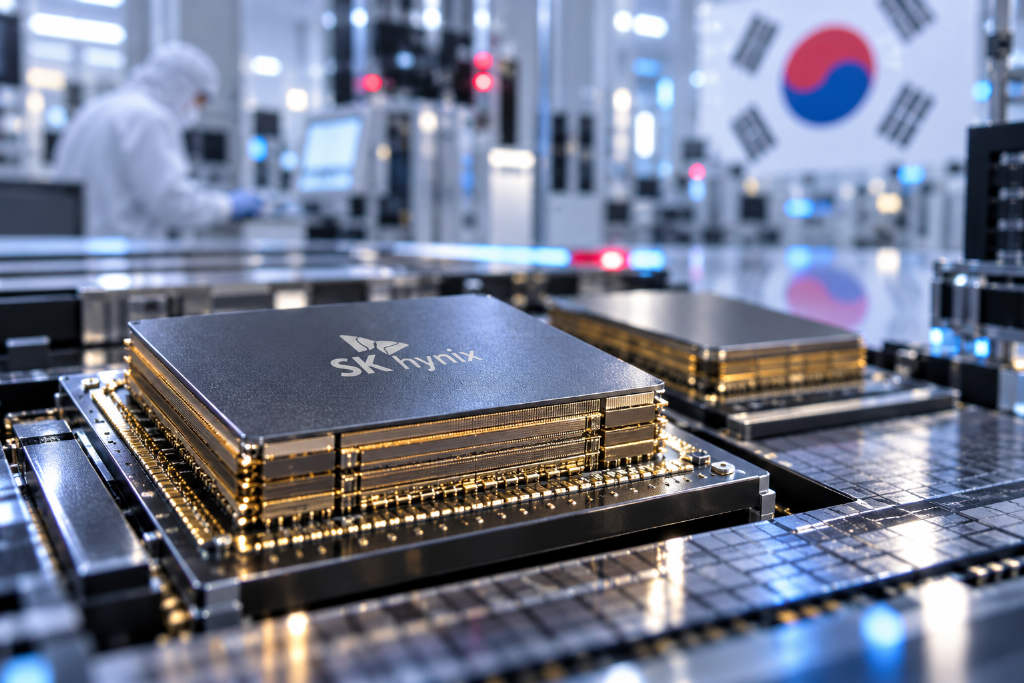
Record quarter for SK Hynix
SK Hynix reported FY2026 third-quarter revenue of KRW 104.62 trillion, up 328% from a year earlier and 32% from the previous quarter. That was the first time revenue moved above KRW 100 trillion and it also topped market expectations of about KRW 98.23 trillion.
Operating profit came in at KRW 83.33 trillion, up 632% year over year and 38% quarter over quarter, again ahead of the market estimate of roughly KRW 76.96 trillion. Operating margin rose to nearly 80%, about 33 percentage points higher than a year earlier. The source said the margin reflected contributions from higher-value products such as HBM, as well as tight supply in AI server memory, conventional DRAM, and enterprise SSDs, which improved both pricing and product mix.
HBM4 began scaling in Q3 and is expected to lead in Q4
The biggest product shift in the quarter was the ramp of HBM4. According to the source, HBM4 shipments materially began in the third quarter, and the company expects HBM4 to exceed HBM3E in both shipment volume and operating revenue in the fourth quarter, formally becoming the main product in SK Hynix's HBM business.
That points to a transition in the company's growth engine from HBM3E to the next-generation HBM4. The report said HBM4 requires more advanced DRAM process technology, stacking, packaging, and customer qualification than traditional memory products. It also carries higher value and is positioned to benefit more directly from upgrades to next-generation AI accelerator platforms.
Growth extended beyond HBM
HBM was not the only driver. Server DDR5 sales increased sharply and supported DRAM growth. On the NAND side, shipments of 321-layer TLC enterprise SSDs expanded, with high-capacity data-center storage demand starting to emerge as a new profit source.
The source said SK Hynix is moving away from reliance on a single HBM product and toward a structure where HBM, server DRAM, and enterprise SSDs all contribute to growth. In the MSX View section, the report argued that AI infrastructure spending has spread from GPU demand to the broader memory stack. AI servers need more than compute chips. Model parameters, training data, and inference cache move continuously among GPUs, HBM, server memory, and storage systems, and larger models with more inference requests raise requirements for bandwidth, capacity, and read speed.
In that framework, HBM handles high-speed data transfer close to the GPU, server DDR5 and SOCAMM provide larger-capacity system memory, and enterprise SSDs store models, training data, and inference results. Because SK Hynix covers all three layers, the company can benefit not only from higher HBM content per GPU but also from the broader expansion of AI data centers.
The report also said simultaneous growth in server DDR5 and enterprise SSDs shows AI memory demand is spreading beyond HBM. That matters because dependence on HBM alone could leave revenue concentrated in a small number of GPU customers and product cycles. Growth in server memory and enterprise SSDs broadens the customer base and expands revenue opportunities within each data center.
Key figures from the quarter
- FY2026 Q3 revenue: KRW 104.62 trillion, up 328% year over year and 32% quarter over quarter
- Market revenue expectation: about KRW 98.23 trillion
- Operating profit: KRW 83.33 trillion, up 632% year over year and 38% quarter over quarter
- Market operating profit expectation: about KRW 76.96 trillion
- Operating margin: about 80%, versus 76% in the previous quarter and 47% a year earlier
- Net profit: KRW 39.78 trillion, up 216% year over year and down 58% quarter over quarter
- HBM4 began scaling in the third quarter
- The company expects Q4 HBM4 shipment volume and operating revenue to exceed HBM3E
- SK Hynix has signed long-term supply agreements with 14 major customers
- Those agreements cover more than 50% of total capacity for 2027 to 2028
- Some long-term agreements typically run as long as five years and include pricing mechanisms linked to market prices within agreed ranges
- The company expects the memory undersupply structure may continue through 2030
- Cash and cash equivalents at quarter-end: KRW 114.5 trillion, up KRW 26.5 trillion from the prior quarter
- Borrowings fell to KRW 15.8 trillion, down KRW 2.8 trillion quarter over quarter
- Net cash rose to KRW 98.7 trillion
- Planned shareholder return for 2026: about KRW 100 trillion
- At least KRW 30 trillion in cash dividends and at least KRW 60 trillion in share buybacks and cancellations
- Third-quarter dividend per share: KRW 20,000, including a KRW 10,000 special dividend
- After the earnings release, SK Hynix shares in Korea rose as much as about 2.4% in early trading
HBM competition is becoming more specialized
In the MSX View section, the report said the expected Q4 crossover, with HBM4 moving ahead of HBM3E, is the most important forward-looking signal in the earnings release. It argued that memory competition used to center on capacity, cost, and price, while HBM competition depends more on product design, advanced process technology, packaging capability, yield, and customer qualification.
Suppliers must work with GPU makers in advance and complete qualification before accelerators enter mass production. That makes HBM closer to a customized semiconductor product than a fully standardized memory commodity.
The report added that SK Hynix plans to bring M15X to maximum capacity by year-end, which it interpreted as a sign that the company has entered the large-scale delivery phase for HBM4. If yields and customer demand remain stable, HBM4 should continue to lift product mix and wafer value, according to the source.
Why the margin may not stay near 80%
The MSX View section also warned against treating an operating margin near 80% as a long-term norm. The report said that level rests on three conditions at the same time: rapid growth in AI memory demand, tight supply of advanced capacity, and continued price increases.
If competitors raise HBM4 capacity, if conventional memory supply increases, or if cloud companies slow capital spending, pricing and margins could come under pressure. That is one reason the company is using long-term supply agreements to reduce cycle risk.
Long-term contracts, expansion plans, and capital allocation
SK Hynix has signed long-term agreements with 14 major customers, covering more than 50% of total capacity for 2027 and 2028, with market-linked pricing mechanisms built into agreed ranges. The report said this structure addresses two issues at once: customers secure supply of HBM and server memory in advance, while SK Hynix can plan wafer, packaging, and equipment investment around contracted demand and improve revenue visibility.
The source also said SK Hynix expects investment to rise meaningfully in 2027, mainly for M15X, the first phase of Yongin, and infrastructure in Korea and overseas. Stronger demand visibility supports the case for expansion, but large capital spending would also increase depreciation and pressure cash flow. If demand remains strong when new capacity comes online, expansion could keep supporting revenue. If supply grows faster than demand, price pressure could return.
Balance sheet improved as shareholder returns increase
By the end of the third quarter, SK Hynix had KRW 98.7 trillion in net cash, showing a much stronger financial position than before. The report said that gives the company room to invest in advanced capacity and return cash to shareholders at the same time, without relying entirely on new debt to fund expansion.
For 2026, the company plans about KRW 100 trillion in shareholder returns, including at least KRW 30 trillion in cash dividends and at least KRW 60 trillion in share buybacks and cancellations. The third-quarter dividend was KRW 20,000 per share, including a KRW 10,000 special dividend. The report also said most gains from the company's Kioxia investment will be returned to shareholders through a special dividend.
In the source's framing, that marks a shift from a cyclical company that once had to prioritize balance-sheet repair to a highly profitable company that can expand capacity and return cash at the same time.
Solidigm IPO plan was halted
The report linked the decision to stop pursuing a Solidigm IPO to the same financial shift. SK Hynix had originally hoped to use outside capital to support Solidigm's expansion and reduce its own funding burden. With cash levels higher and capital-market conditions changed, the need for a separate listing fell. Keeping Solidigm also allows SK Hynix to retain the profit contribution from growth in enterprise SSDs.
Three indicators to watch next
The source said the core takeaway from the earnings release is not only that revenue and profit hit new highs again, but that SK Hynix's business model is changing. HBM is raising product value and technical barriers, long-term contracts are improving demand visibility, server DRAM and enterprise SSDs are broadening AI-related revenue streams, and strong cash flow is supporting both investment and shareholder returns.
It said investors should watch three indicators next: whether HBM4 overtakes HBM3E in the fourth quarter as planned, the yield and profitability of M15X after expansion, and whether higher capital spending in 2027 can continue to generate revenue and free cash flow on a similar scale. The report concluded that SK Hynix has already shown itself to be a major beneficiary of the AI infrastructure cycle, while the next phase is to test whether its HBM technology edge and long-term contracts can preserve profitability and returns above those of the traditional memory cycle as capacity expands.
About MSX
The source described MSX as an RWA trading platform focused on access to global financial markets. It said the platform offers spot and derivatives trading in nearly 400 tokenized stocks and pre-IPO assets, alongside services tied to U.S. equities spot and perpetuals, crypto-to-crypto trading, pre-IPO products, and research.
The original article also carried a risk notice saying that macroeconomic conditions and the U.S. stock market can be highly volatile, and that the content is for academic and research observation by the MSX Research Institute only and does not constitute investment advice.



