
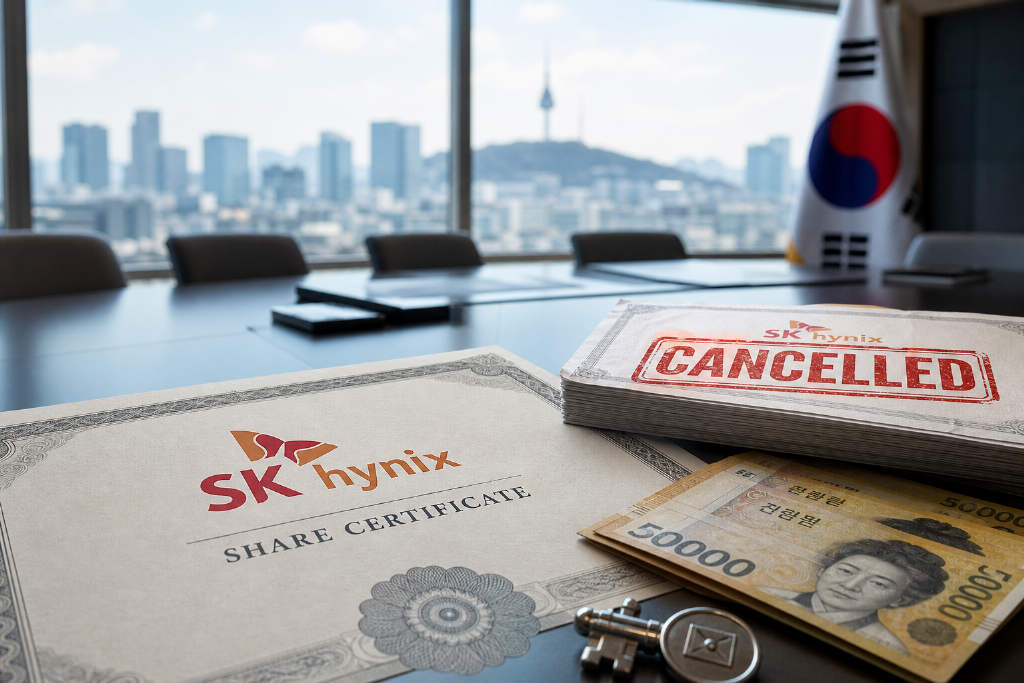
SK Hynix has approved a 40 trillion won share repurchase program worth about $28.6 billion, with all repurchased shares set to be canceled. According to Bloomberg, the plan marks the largest share buyback and cancellation ever announced by a listed company in South Korea. The company also raised its shareholder return target for 2025 to 2027 to more than 50% of free cash flow.
Board approves buyback, all shares to be retired
Bloomberg reported that SK Hynix’s board passed the decision on Aug. 19. The company plans to buy back its own shares in the open market for a total of 40 trillion won.
Using the Aug. 18 closing price of 1.662 million won per share, the repurchase would amount to about 24.07 million shares, or roughly 3.3% of its 730,492,365 outstanding shares. SK Hynix said the shares bought back under the plan will all be canceled and will not be kept as treasury shares.
Record earnings did not stop the stock from falling
At the end of July, SK Hynix reported second-quarter revenue of 79.32 trillion won, up 257% from a year earlier. Operating profit came in at 60.54 trillion won, up 557%, and operating margin reached 76%. All three figures were record highs.
Still, the company’s stock dropped nearly 9% on the day the earnings were released. In its buyback announcement, SK Hynix said its competitiveness, cash-generation ability, and medium- to long-term growth potential were not being fully reflected in the current share price.
Strong cash position, but spending plans are also large
As of the end of the second quarter, SK Hynix had net cash of about 69 trillion won, while its net debt-to-equity ratio stood at negative 26%. The report described the company’s financial position as comfortably strong.
At the same time, the article noted that the company’s striking net profit was driven mainly by gains from the sale of its Kioxia stake rather than its core business. SK Hynix has also raised its full-year capital expenditure guidance to 40 trillion won. Separately, the board approved 54 trillion won, or about $38.3 billion, for two new plants. That spending is part of the company’s commitment to invest more than $720 billion over the next decade.
Memory pricing remains a focus across the sector
In the second quarter, average DRAM selling prices rose about 30% from the previous quarter, while average NAND selling prices increased 50%. DRAM accounted for 73% of quarterly revenue.
Song Hyun-jong, president of the SK Hynix Corporate Center, said on the earnings call that strong demand driven by artificial intelligence infrastructure investment and tight supply conditions were still continuing. The report also said Samsung Electronics had sought DRAM contract price increases of as much as 20% for the third quarter. Samsung’s second-quarter operating profit jumped 19-fold, but the company is also facing investor pressure to increase cash returns.
Investors are still waiting for the dividend decision
The market had previously expected SK Hynix to introduce a shareholder return package totaling close to 100 trillion won, including dividends. The Wednesday announcement covered only the buyback portion, while the dividend decision is expected to be disclosed together with third-quarter earnings.
Josh Gilbert, chief market analyst for Asia-Pacific and the Middle East, said a buyback of this scale was itself a signal that the company did not think memory prices would fall over the next three months. Gary Tan, a portfolio manager at Allspring Global Investments, said the new target of more than 50% of free cash flow was slightly above prior market consensus, and that the real test would be whether the stock later turns into a sell-the-news trade.