
SKHX, the Hyperliquid market linked to SK Hynix, kept sliding on July 29 after SK Hynix shares in South Korea had fallen 14.7% in the previous session, according to monitoring data from Hyperinsight. At the time of publication, SKHX was trading at $973.06, down 10.7% over the past 24 hours.
No wave of large liquidations despite the drop
The decline has not produced a fresh round of cascading liquidations on Hyperliquid. Hyperinsight data showed that no liquidation at the million-dollar level had appeared so far, and forced liquidations above $100,000 were only seen in scattered cases.
At the same time, open interest continued to climb. Outstanding SKHX contracts rose from 385,500 yesterday to 461,600, an increase of 19.7%. Based on the mark price over the same period, notional open interest also increased from about $411 million to $449 million, up 9.3%.
More long accounts, but much larger short positions per account
Current positioning data showed 2,677 long accounts and 791 short accounts in SKHX, with longs accounting for 77% of total accounts. Even so, notional exposure on each side was roughly the same, at about $217 million for longs and $217 million for shorts.
That works out to an average short position of about $274,000 per account, compared with about $81,000 for the average long, making the average short 3.4 times larger. In other words, there were far more long accounts, but their positions were generally smaller. Shorts were fewer in number, but each trade was notably larger. The funding rate stood at +0.036% per hour.
Whales leaned short while small accounts stayed heavily long
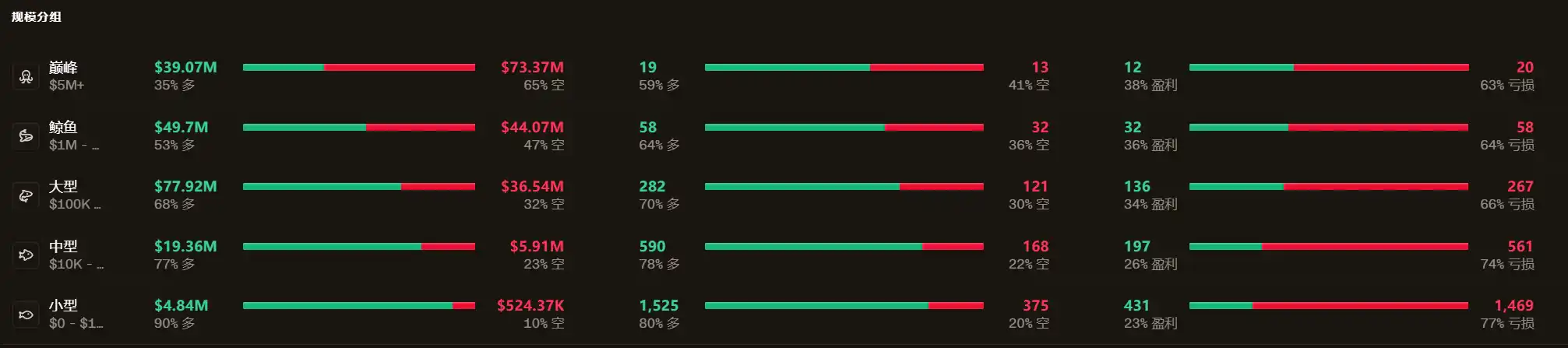
Hyperinsight said positioning turned more bearish as account size increased. Traders with positions above $5 million collectively held $73.37 million in shorts and $39.07 million in longs. Shorts accounted for about 65% of that total, leaving net short exposure at roughly $34.3 million.
By contrast, among accounts smaller than $10,000, about 90% of positions were long. Although around 74% of accounts were currently sitting on unrealized losses, those losses were mainly spread across a large number of small long accounts, while larger positions were concentrated more on the short side.