
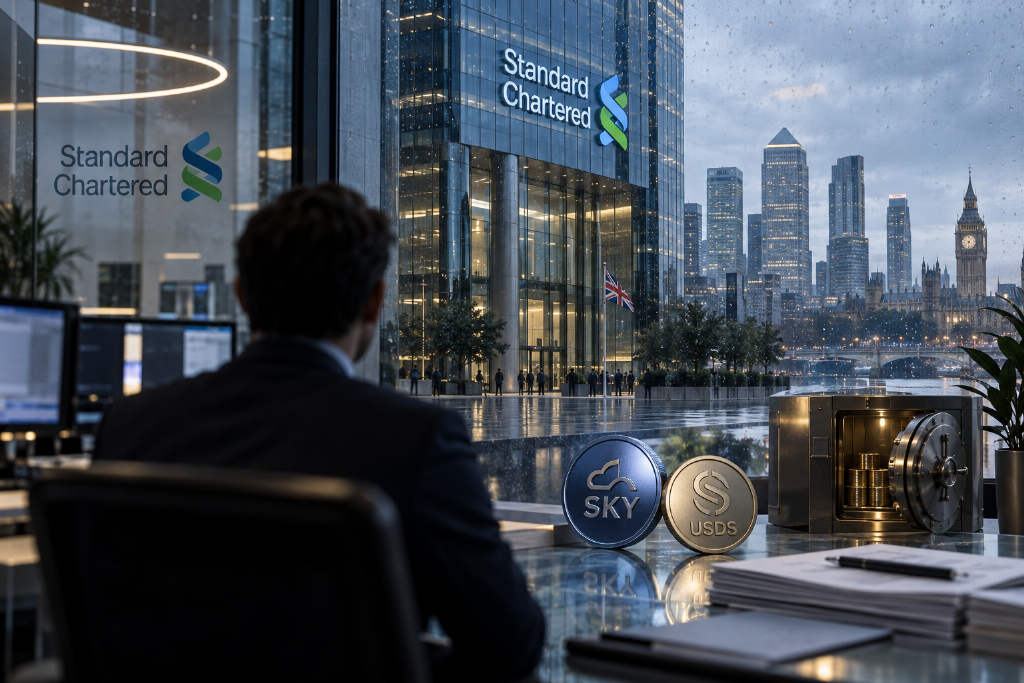
Standard Chartered’s global head of digital assets research, Geoffrey Kendrick, initiated coverage on Sky, formerly MakerDAO, on Sept. 11 and set a $0.325 price target for the SKY token by the end of 2028. That compares with a current price of about $0.065, implying a roughly fivefold increase.
The core argument is not simply that SKY should trade higher. Kendrick’s view is that the value flowing back to SKY holders could expand by about 5x by the end of 2028, driven by the growth of the Sky ecosystem and a larger USDS supply.
Sky as a “federal bank” for DeFi
Kendrick describes Sky as a “federal bank” for decentralized finance. The analogy is meant to explain how the protocol works.
In traditional finance, a central bank issues money, sets a benchmark rate and provides funding to commercial banks at wholesale pricing. Those banks then decide how to deploy that capital and earn a spread. Kendrick argues that Sky maps closely onto that structure on-chain.
USDS and DAI are the “money” issued by Sky. Their combined supply is more than $12 billion. Within that, USDS grew 74% in 2025 to roughly $9.2 billion, while staked USDS, or sUSDS, reached about $5.5 billion, making it the largest yield-bearing stablecoin on-chain.
Spark, Grove and Obex serve as Sky’s “commercial banks,” referred to officially as Agents. Together they currently borrow about $5.9 billion from Sky, against a combined borrowing ceiling of roughly $17.5 billion. They pay Sky a base rate of about 3.8%.
- Spark focuses on crypto lending. It is a fork of Aave V3 and had about $6.8 billion in total value locked as of April 2026. It deploys capital through protocols including Aave and Morpho.
- Grove is focused on real-world assets and manages about $2.6 billion in TVL. That includes $1 billion allocated to AAA-rated CLOs. Its partners include BlackRock, Janus Henderson and Apollo.
- Obex is managed by Framework Ventures. It holds about $2.5 billion in USDS and is designed to bring professional capital allocators into the Sky ecosystem.
Sky also has two additional revenue sources. One comes from USDC reserves held through Coinbase, with the peg stability module, or PSM, enabling conversion between USDS and USDC. The other comes from legacy DAI crypto lending vaults.
The article sums up the model this way: Sky prints the money, the Agents earn the spread, and Sky takes a cut of that spread.
Revenue, distributions and buybacks
For full-year 2025, Sky Protocol recorded about $338 million in gross protocol revenue, up around 10% year over year. Operating expenses fell 63%, and annualized protocol profit stood at about $168 million.
Revenue remained elevated in 2026. Gross revenue was about $123.8 million in the first quarter and about $107.4 million in Q2 2026, with the latter up 10.5% year over year. Sky Frontier Foundation estimates full-year 2026 gross revenue at about $611.5 million, which would represent 81% growth.
That income flows into two main pockets.
One is sUSDS holders. In Q2 2026, about $53.91 million was distributed to sUSDS holders through the Sky Savings Rate, accounting for roughly 80% of protocol spending in the quarter.
The other is SKY holders. Since the Smart Burn Engine launched in February 2025, protocol surplus has been used to buy SKY on the open market and burn it. The system deployed about $102 million in its first year, or roughly $1 million a day on average. Buybacks for full-year 2025 totaled about $96.8 million. SKY stakers currently earn about 4.2%.
Kendrick’s 5x valuation framework is tied directly to the value that reaches SKY holders.
A two-stage path to 5x
Kendrick’s model has two stages.
Stage one: reserve buffer targets are met and distributions rise
Sky currently holds about $90 million in reserve buffer, described as aggregate backstop capital. The protocol retains part of its income to build that cushion further.
At the current pace, Kendrick estimates the buffer could reach $150 million in about eight months. If it also reaches a capital ratio of 1.5% of USDS supply, funds available for SKY staking rewards and buybacks could double.
The article describes that assumption as relatively conservative because it does not rely on new business lines. It relies on time and the natural accumulation of income already being generated.
Stage two: Agent borrowing moves toward the cap
Spark, Grove and Obex have a combined borrowing limit of $17.5 billion, while actual borrowing currently stands at $5.9 billion, or about 34% utilization. If the three Agents were to borrow up to that ceiling, and if the spread remained unchanged, revenue could increase another two to three times.
Put together, the logic is straightforward: distributions could double, while the revenue base could grow by 2x to 3x. That would imply a roughly 4x to 6x increase in value reaching SKY holders. Kendrick uses the midpoint and arrives at about 5x.
A key assumption in that framework is that SKY staking yield stays around 4.2%. Kendrick characterizes SKY as a staking-yield token whose price rises with the growth of the underlying payout stream. If yield remains constant, a higher reward base supports a higher token price.
Three assumptions that carry the model
The article notes that the Standard Chartered framework is internally consistent, but each multiplier depends on an assumption.
Assumption one: Agent borrowing can reach the $17.5 billion ceiling
Moving from $5.9 billion to $17.5 billion requires about a threefold increase. That depends on Spark maintaining share in crypto lending, Grove continuing to source high-quality real-world assets, and Obex attracting enough outside allocators.
That outcome is not guaranteed. The article points to competition in DeFi lending from Aave, Morpho and Compound, along with the possibility of changing rate conditions.
Assumption two: spreads remain stable
The 3.8% base rate is set by Sky governance and can be changed. If competition in stablecoins intensifies, Sky may need to lower rates to keep USDS attractive. The article cites Ethena’s USDe, native yield on USDC and direct reserve-income distribution models at Tether as examples of competitive pressure.
If rates compress, protocol revenue would compress with them.
Assumption three: revenue continues to reach SKY holders
In March 2026, Sky governance paused Smart Burn Engine buybacks in order to preserve surplus. That matters because value returned to SKY holders is governance-driven, not hard-coded as an automatic commitment.
In other words, SKY represents a potential claim on residual income, not a fixed-income promise. If market conditions weaken, governance can choose, and has already chosen, to prioritize protecting protocol assets over holder payouts.
Kendrick also highlighted what he sees as the biggest risk: “If growth in yield-bearing stablecoins is slower than expected, this view faces its greatest risk.”
What to watch on-chain
The article argues that several live metrics will determine whether Sky can match Standard Chartered’s target.
- Growth in USDS supply. It currently stands at about $9.2 billion, while the bank’s implicit assumption points to roughly $20 billion by the end of 2028.
- Utilization of the three Agents’ borrowing lines relative to the $17.5 billion cap.
- Whether the reserve buffer reaches $150 million within about eight months and equals 1.5% of USDS supply.
- Whether monthly Smart Burn Engine buybacks recover to a pace above $1 million per day, especially after the March pause.
- Whether SKY staking yield remains above 4%.
Those figures do not depend on a future report update. On-chain data and quarterly reports from Sky Frontier Foundation already provide a direct way to test the thesis.
The article’s final point is clear: investment judgment should be based on how those indicators actually move, not on any broker price target alone.