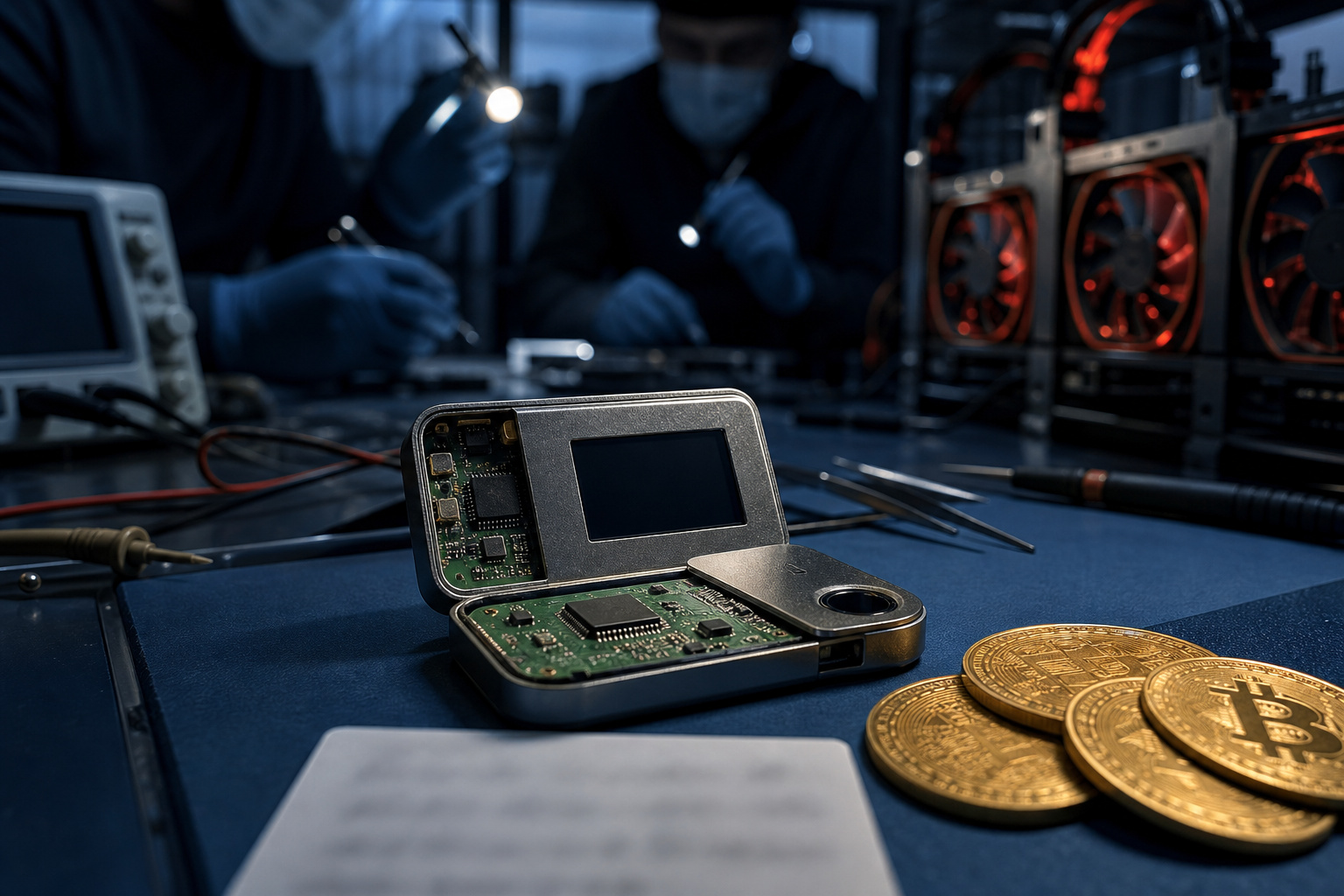
SlowMist said ColdCard, a hardware wallet maker, was hit by a major private key vulnerability that led to losses of about 1,719 BTC. Using Mk3 firmware version 4.1.9 as an example, the security team said it fully reproduced the attack chain and traced the issue to a build configuration error. According to SlowMist, the setting "MICROPY_HW_ENABLE_RNG" was set to 0, which disabled the STM32 hardware true random number generator. That forced the random number path to fall back to the Yasmarang software pseudo-random number generator, which SlowMist described as not cryptographically secure. The team said its state was almost entirely predictable, cutting effective entropy to about 40 bits on Mk2 and Mk3 devices, or about 72 bits on Mk4, Mk5, and Q models. SlowMist said attackers could model keypress consumption patterns, use GPU clusters to brute-force the candidate space, derive private keys, and then match single-signature P2WPKH addresses across the network to steal funds. The firm urged affected users to upgrade to fixed firmware, create a new mnemonic, and move funds only after confirming the new address works properly.
SlowMist said ColdCard recently suffered a major private key vulnerability that resulted in losses of about 1,719 BTC.
Using Mk3 firmware 4.1.9 as an example, the SlowMist security team said it fully reproduced the attack chain. The team traced the flaw to a build configuration error that set "MICROPY_HW_ENABLE_RNG" to 0, disabling the STM32 hardware true random number generator and pushing the device onto the Yasmarang software pseudo-random number generator instead.
SlowMist said Yasmarang is not cryptographically secure and that its internal state is almost fully predictable. That reduced effective entropy to about 40 bits for Mk2 and Mk3 devices, or about 72 bits for Mk4, Mk5, and Q models. Based on that weakness, attackers could model keypress consumption patterns, brute-force the candidate space with GPU clusters, derive private keys, and match single-signature P2WPKH addresses across the network to steal funds.
SlowMist advised affected users to upgrade to the patched firmware immediately, generate a new mnemonic phrase, and transfer all funds only after confirming the new address can be used normally.
This article was originally published by Bit.Fan. For more cryptocurrency news and market insights, visit www.bit.fan. Disclaimer:
The market information, project data, and third-party content displayed on this platform are for industry information sharing only and do not constitute any form of investment advice or return commitment.
Cryptocurrency trading carries high risks. Users should fully assess their risk tolerance and make independent decisions. All profits, losses, and legal responsibilities are borne by the users themselves.