


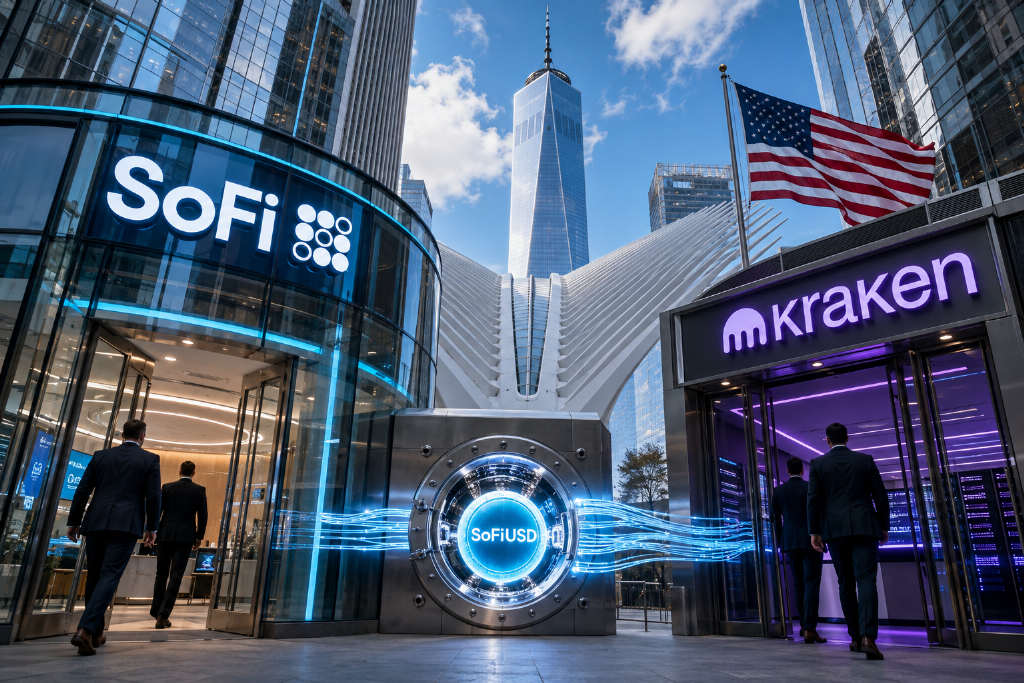
SoFi Technologies and Payward, Kraken’s parent company, said on Sept. 3 that they struck a strategic partnership built around directly linking their infrastructure to each other.
Under the deal, Payward will become part of the SoFi Exchange Network, or SEN, and get 24/7 real-time U.S. dollar settlement. Kraken will list SoFiUSD, a stablecoin issued straight from a U.S. national bank. SoFi will also route part of its crypto asset order flow to Kraken Prime, giving the SoFi app’s 15.8 million users access to smart order routing across multiple trading venues and better execution prices. Kraken’s institutional clients will get access to SoFi’s Big Business Banking services, and the companies said they intend to expand qualified custody capabilities later.
From full-stack ambition to direct connectivity
This deal shows a shift in how banks and crypto exchanges are dealing with each other. Rather than trying to turn into the other side, they’re starting to connect the systems they already built.
For the past three years, both camps had been chasing the same idea: build the whole stack yourself. Crypto exchanges went after banking licenses, and Kraken itself has a special purpose depository institution charter in Wyoming. Banks, meanwhile, tried building trading systems of their own. Same problem, though. Starting the other side’s core business from scratch took more time and more money than expected.
SoFi’s own crypto track record was held up as a clean example. In December 2023, the company halted its crypto trading service under regulatory pressure, and that pause lasted two years. When trading came back in November 2025, SoFi had a decision to make: keep running its own market-making and liquidity stack, or plug into trading infrastructure that was already mature.
This partnership answers that pretty bluntly. Part of the order flow is going to Kraken Prime.
Kraken Prime handles execution while SoFi keeps the user interface
According to the article, Kraken Prime’s smart routing system watches prices and market depth across multiple venues in real time, then sends each order to the destination offering the best execution conditions.
For SoFi users, the in-app front end will stay the same. No visible shake-up. The change sits in the execution layer behind the curtain. Kraken’s blog put it this way: “An exchange account gives you its own order book; a prime broker gives you access to the entire market.”
SoFi keeps the customer relationship and the app experience. Kraken supplies cross-venue liquidity, access to market makers, and institutional-grade execution.
Kraken gets around-the-clock dollar settlement
The exchange side gets something just as big. Kraken’s institutional clients have long had to deal with the mismatch between a crypto market that runs 24/7 and a U.S. banking system that usually runs on business days. The article gives a plain example: if a large U.S. dollar deposit needs to go to an exchange on a Friday night, the transfer might not land until Monday morning, when banks reopen.
SEN is meant to get rid of that snag. The network offers real-time dollar settlement at all hours. Once Payward joins it, Kraken gets a banking rail that lines up much more closely with crypto market hours.
Each company is bringing the piece that is hardest to copy. SoFi is contributing bank accounts, dollar deposits, payment rails, and instant settlement. Kraken is bringing order books, market-maker networks, cross-venue liquidity, and institutional trading capabilities. No one is rebuilding what the other side already spent years assembling.
Why SoFiUSD matters
One of the biggest parts of this partnership is also one of the easiest to overlook: SoFiUSD.
The article says the stablecoin market is dominated by Tether’s USDT and Circle’s USDC, but neither issuer is a bank. Tether is an offshore entity. Circle is a licensed payments company. SoFiUSD is different. It is issued directly by SoFi Bank, N.A., which is regulated by the Office of the Comptroller of the Currency, or OCC, and it is described as the first U.S. national bank to issue a stablecoin on a public permissionless blockchain.
That legal footing changes how the reserve backing is set up. The article says SoFiUSD’s 1:1 dollar reserves are held directly in SoFi’s federal bank account. In SoFi’s original press release, the company said the arrangement carries “zero liquidity risk” and “zero credit risk.” Holders can redeem SoFiUSD for U.S. dollar deposits at any time, and those deposits are covered by FDIC insurance, subject to the terms of the relevant deposit account.
Once Kraken lists it, SoFiUSD becomes the settlement asset tying the two systems together. Institutional clients can use the token to settle trades on Kraken, and they can redeem it back into dollars held in a SoFi bank account. SEN provides instant settlement. SoFiUSD provides on-chain liquidity. Together, they create a closed loop inside the same banking entity.
Part of Kraken’s broader infrastructure network
From Kraken’s side, SoFi is the newest piece in a broader infrastructure alliance.
Kraken’s blog pointed to several names in the announcement: Deutsche Börse for foreign exchange and derivatives infrastructure, Nasdaq as the gateway for xStocks tokenized equities, Franklin Templeton for ETF tokenization, and SoFi as a retail banking distribution channel.
Each partner marks a different vertical way into traditional finance. Deutsche Börse brings FX and derivatives rails. Nasdaq opens the route to tokenized stocks. Franklin Templeton adds fund infrastructure. And SoFi brings a retail banking network that reaches 15.8 million users.
The article argues that Kraken is no longer focused just on being a better exchange. Its path looks more like a connection layer across financial infrastructure, growing into a multi-asset prime brokerage platform where crypto is one asset class moving through the system, not the entire system.
The industry focus is shifting from licenses to network density
The SoFi-Kraken partnership is framed as part of a wider industry shift. The article says the sector is moving away from a race to gather the fullest set of licenses and toward a race to build the densest network of rails.
Traditional banks are still trying to absorb crypto capabilities. The article points to JPMorgan’s Onyx and Goldman Sachs restarting its crypto trading desk. Crypto firms are still trying to gain banking capabilities too, with Paxos applying for a bank charter and BitGo acquiring Go Network to secure a trust charter.
Both tracks are still alive. But both are slow.
SoFi and Kraken suggest a third path: don’t become the other side, just weld the pipes together. The article presents the partnership as a sign of how financial infrastructure may change. If interoperable rails turn out to be faster, cheaper, and easier to line up with regulation than full-stack self-builds, more pairings like this may follow.