
Solana’s SOL posted a strong rebound in August after a prolonged slump, climbing steadily through the month and briefly moving above $110, its highest level since late January this year. On a monthly basis, SOL gained 46.9% in August, ending 10 straight months of negative returns dating back to October 2025. It was also the token’s strongest monthly showing since March 2024.
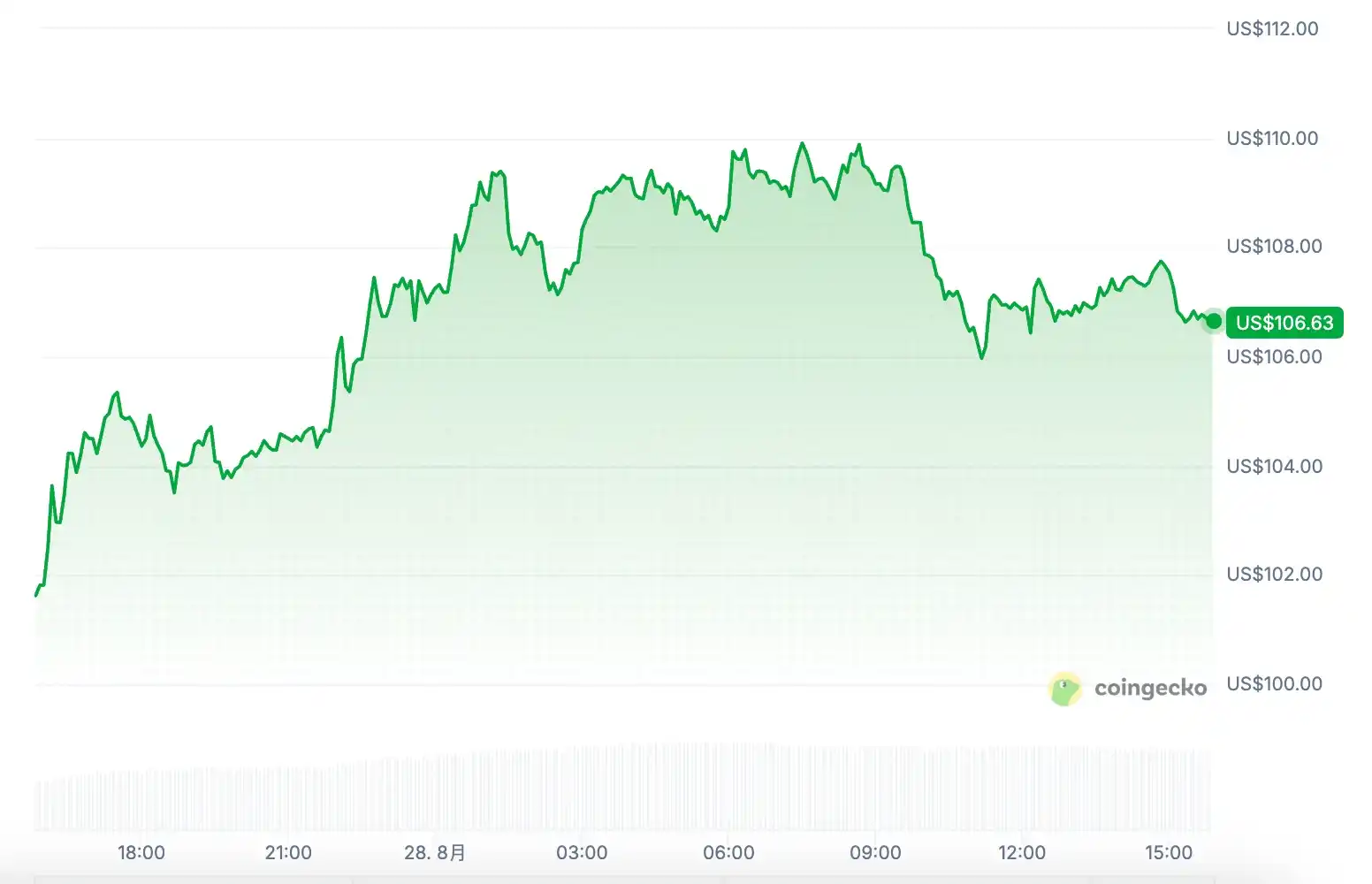
With that rebound, SOL’s loss for the year has narrowed to about 13%. In 2025, the token had fallen as much as 34.1% for the full year.
Institutional demand and ETF flows supported the move
The rally was not driven by sentiment alone. Institutional inflows and continued spot ETF demand were a major source of buying pressure.
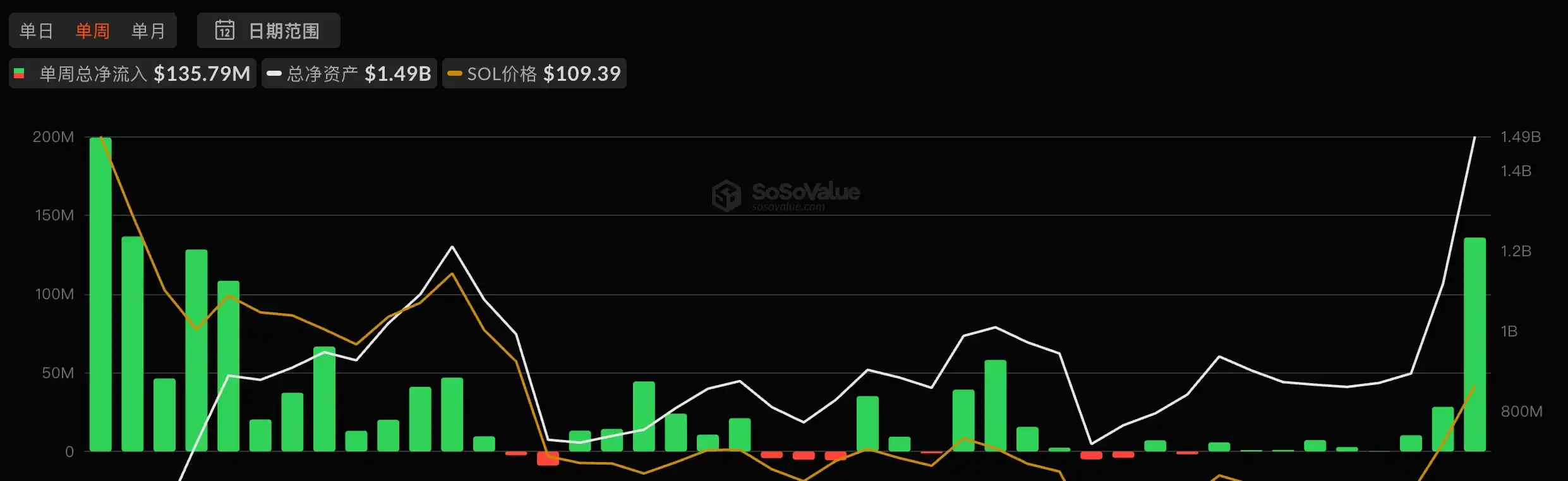
Spot Solana ETFs have recorded inflows for several consecutive days. Data from SoSoValue showed cumulative net inflows of about $1.36 billion over the past week, the largest weekly total since November last year. On a monthly basis, August also marked the second-largest month of inflows since the products were listed.
Treasury-style buyers have been active as well. DeFi Development Corp said it had resumed buying SOL and added about 19,000 tokens at a cost of roughly $1.86 million, bringing its total holdings to around 2.33 million SOL valued at about $180 million. Solmate Infrastructure also disclosed the purchase of 1,000 SOL, taking the total value of its holdings above $100 million.
Access channels for traditional institutions are widening too. Charles Schwab’s crypto platform, under a firm with $12.6 trillion in assets under management, recently said it would open direct SOL trading. That lowers the barrier for traditional institutions seeking exposure to the token.
On-chain activity strengthened across several metrics
Fund flows were only part of the picture. Solana’s on-chain fundamentals also improved through August, with several indicators reaching record levels.
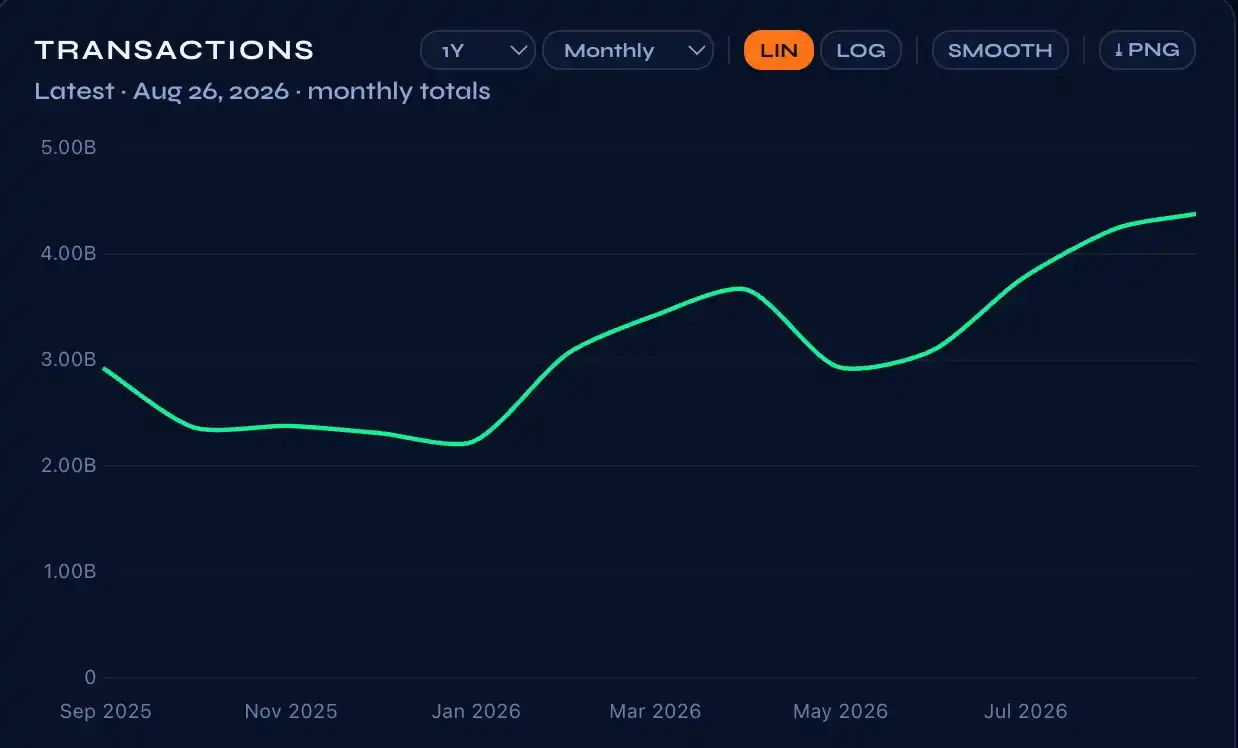
According to State of Solana, the network processed a record 4.48 billion transactions in August. Since late December last year, monthly transaction volume has increased by about 2.25 billion, a gain of 100.9%.
Data from RWA.xyz showed that the total value of real-world assets on Solana has surpassed $4.04 billion, while the number of RWA holders has climbed above 355,000. Both figures are all-time highs for the network.
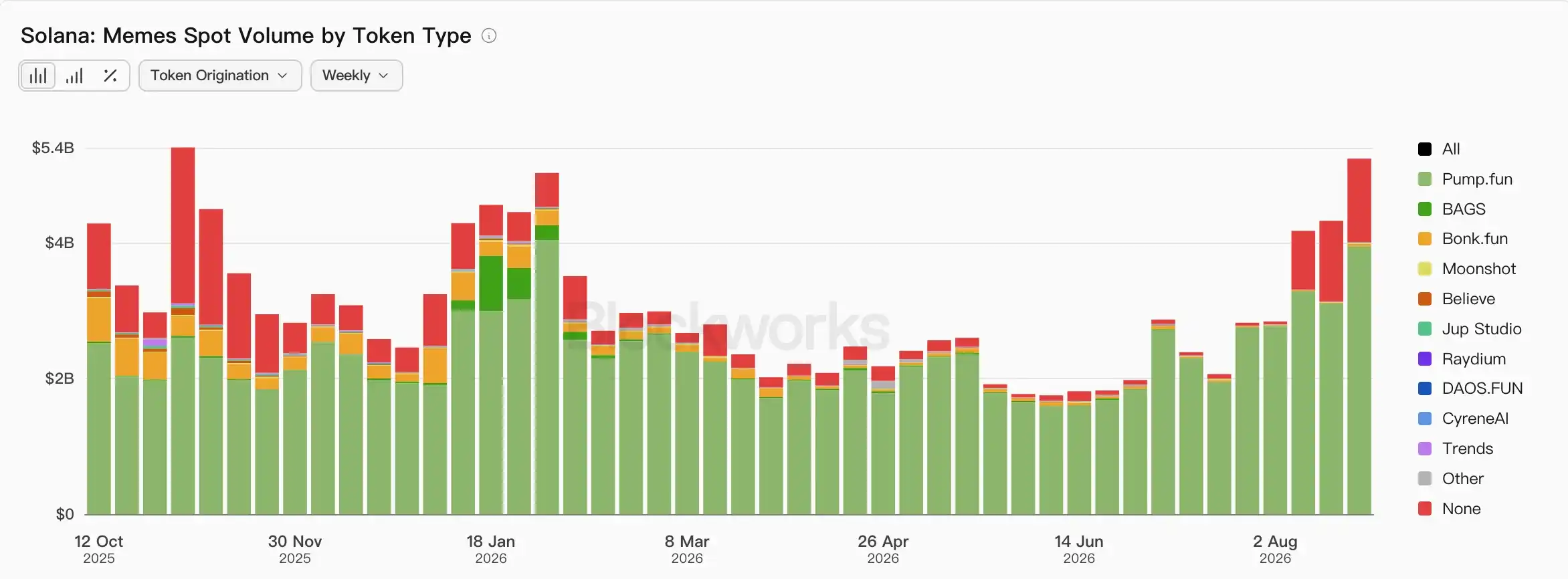
Meme coin trading has also picked up. Blockworks data showed weekly spot trading volume for meme coins on Solana exceeding $5.24 billion, the highest level since late November 2025.
The stablecoin market kept expanding as well. Artemis data showed stablecoin supply on Solana reaching $16.5 billion, up about $4.1 billion from $12.4 billion a year earlier, an increase of roughly 33%.
Mainnet upgrades added to the bullish setup
Technical upgrades have also provided support for improving network performance.
SIMD-0286 was recently activated on mainnet, lifting the block compute unit cap from 60 million to 100 million, a 66% increase in capacity.
Agave 4.2 rolled out a set of phased upgrades on mainnet in August. These included a 90% reduction in rent, a 3.3x increase in maximum transaction size, and a phased reduction in block time from 400 milliseconds to 200 milliseconds.
A more consequential consensus-layer change is Alpenglow, which is planned to go live on mainnet around October this year alongside Agave 4.3. Its target is to compress finality from about 12.8 seconds to roughly 150 milliseconds, while shifting a large amount of voting that previously occupied block space into off-chain aggregation. That would free up more room for real user transactions.
If those upgrades move ahead as planned, Solana could see improvements in confirmation speed, block-space efficiency and overall network throughput.
Tokenomics reform is moving closer to implementation
A more direct factor for SOL’s longer-term valuation may come from changes to its tokenomics model.
As the market becomes less willing to reward token structures defined by high emissions, heavy unlocks and weak value capture, more crypto projects have begun revisiting supply and demand. Over the past few months, Ethena, Polygon, Aptos, Sushiswap, Venice and Near have all been planning or advancing tokenomics changes focused on reducing unlock pressure, using protocol revenue for buybacks or burns, adjusting inflation and emissions, and refining staking incentives.
Solana is now part of that broader shift. Debate around SOL’s model has centered on several issues: issuance is still relatively fast, staking rewards create ongoing sell pressure, transaction fees do not closely track actual compute usage, users often overstate compute unit needs and waste scheduler capacity, and token burn remains low relative to issuance.
To address those concerns, the Solana community has put forward two proposals, SIMD-550 and SIMD-553. One focuses on issuing less, the other on burning more.
SIMD-550 aims to slow supply growth faster
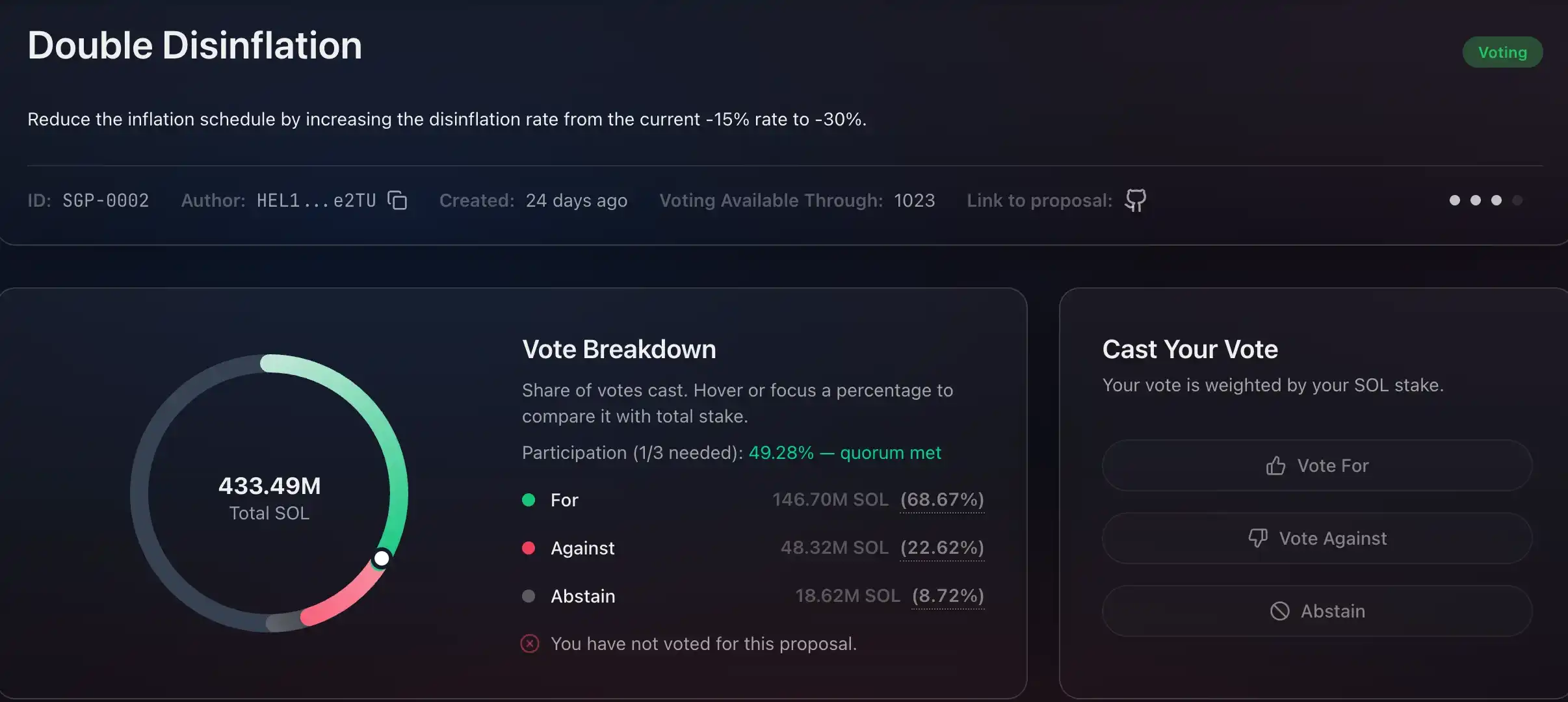
SIMD-550 is designed to tackle the pace of new SOL supply. The proposal would raise the annual inflation decay rate from 15% to 30% and bring forward the point at which SOL reaches its 1.5% starting inflation rate from around 2032 to 2029.
Based on the proposal’s estimates, nominal staking yield over the next three years would gradually fall from about 5% to around 2.25%.
The proposal was put forward by a Helius engineer and is a simplified version of the earlier SIMD-0411 plan. Compared with SIMD-228, an earlier and more complex framework that failed to reach quorum after controversy, SIMD-550 reduces the complexity of community understanding, voting and implementation.
Voting on SIMD-550 is nearing completion. Participation stands at about 49.15%, above the one-third quorum requirement, and 68.58% of votes are in favor.
SIMD-553 targets higher burn through compute-based fees
SIMD-553 addresses low burn levels. The proposal was approved in July and is designed to charge resource fees based on declared compute units, with all related fees burned.
Its goal is to lift daily SOL burn from about 600 to 800 tokens at present to around 7,500 to 9,000 tokens.
The core idea is to better align resource fees with the network capacity that transactions declare and reserve. At present, users often over-declare compute units, meaning the stated resource ceiling is well above actual usage. The scheduler still reserves block space based on the declared amount, which reduces packing efficiency and leaves the current fixed-fee model unable to fully reflect real resource consumption.
Charging by declared compute units and burning the entire fee would raise the cost of overstating limits, reduce that incentive distortion, and increase SOL burn as network activity grows.
Lower issuance and higher burn do not guarantee price gains
From a supply perspective, SIMD-550 is meant to reduce new issuance, while SIMD-553 is meant to increase burn on the supply side. A 21Shares report cited in the source article said the two proposals together could reduce net SOL issuance by about $1.4 billion to $1.5 billion over six years. The changes could also compress staking yield, increase scarcity and shift some capital from staking into on-chain DeFi and application ecosystems.
Even so, tokenomics reform does not automatically translate into value capture, nor does it guarantee a rise in SOL’s price. Over the longer run, the token’s value still depends on whether Solana can keep attracting real users and capital, and whether actual network demand can outpace new supply over time.