
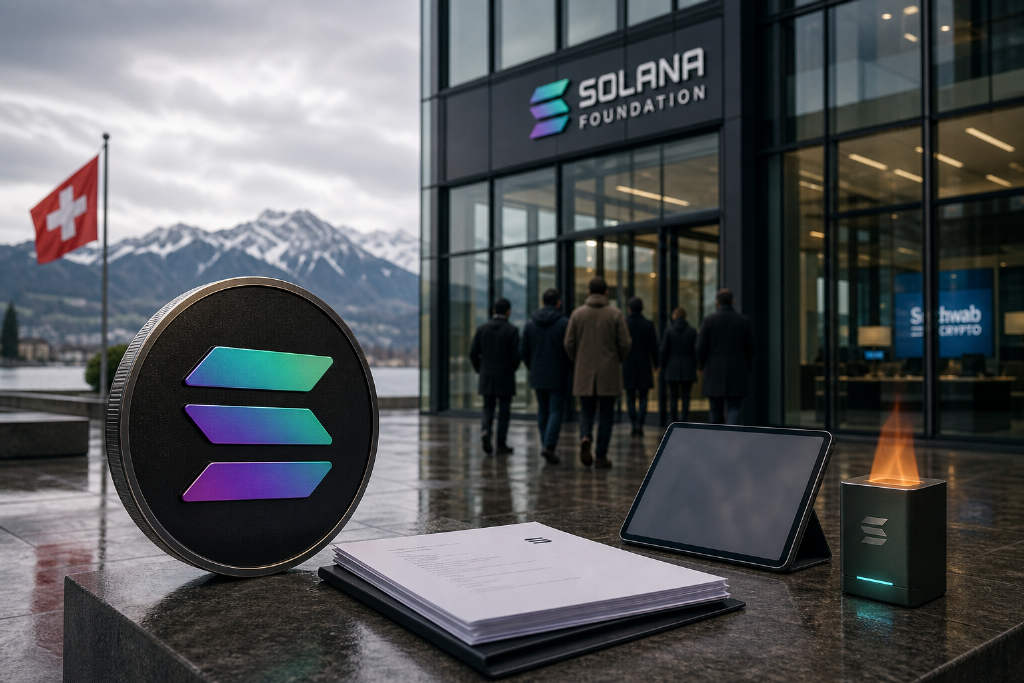
Solana extended its strong August run as the network moved through a historic governance milestone, with Decrypt’s Aug. 28 Morning Minute highlighting both SOL’s price strength and a set of approved on-chain proposals that reshape future issuance.
According to the newsletter, major cryptocurrencies were slightly in the green ahead of Jackson Hole, with SOL leading. BTC was flat at $79,600, ETH rose 0.1% to $2,504, SOL gained 2% to $106, and HYPE added 1% to $83 after briefly touching $85.
Solana posts its strongest month since 2024
SOL climbed back above $105 for the first time since January. The token is up roughly 44% in August, marking its strongest month since 2024, according to the report.
On the same day that price action accelerated, Solana closed what Decrypt described as the first binding on-chain governance vote in the network’s history. The vote determines how much SOL the network will inflate, or disinflate, going forward. All three proposals cleared quorum, and all three passed.
SGP-0002 speeds up disinflation
SGP-0002 doubles the disinflation rate, raising the pace at which new SOL issuance shrinks each year from 15% to 30%. Solana is already moving toward a fixed 1.5% inflation floor. With the change, the network would reach that floor by 2029 rather than 2032, removing roughly 18.9 million SOL from the projected issuance schedule.
The report said the cost falls on stakers because issuance is what pays them. 21Shares estimates staking yield would drop from about 5.25% today to around 2.25% within three years. Smaller validators could be squeezed out entirely.
SGP-0003 adds a resource fee that gets burned
SGP-0003 tackles supply from another angle. It splits transaction fees into a base fee that still goes to validators and a new resource fee tied to how much compute a transaction uses. That second fee would be burned.
Under the figures cited by Decrypt, daily burns would rise from about 650 SOL, worth roughly $48,000, to as much as 9,000 SOL, worth around $668,000.
Institutional holders took different sides
Support for the package was not unanimous. Solana Company, the Nasdaq-listed treasury firm trading as HSDT, backed the constitution and voted against both economic changes, arguing that institutional stakers need predictable yield more than they need a faster cut in issuance.
DeFi Development Corp voted the opposite way on all three proposals and then added to its position, buying 19,000 SOL for $1.86 million at an average price of $98.14. The purchase was DFDV’s first SOL buy since October 2025 and was funded in part by unwinding its ZeroStack position. That brought the treasury to roughly 2.33 million SOL.
DFDV shares rose more than 16% on Thursday and have doubled in a month, though they remain about 90% below their May 2025 high.
Supply tightens as a new distribution channel opens
Decrypt said Solana is heading into September with several changes lining up at once: a supply schedule the network has just voted to tighten, treasury companies buying again for the first time in 10 months, and a broader access channel after Charles Schwab said it plans to add SOL, AVAX, and LINK to Schwab Crypto.
The report said that move would put SOL in front of tens of millions of brokerage accounts. It also noted strong growth at leading Solana applications including Pump.fun and Fomo.
Macro, crypto and market snapshot
The newsletter’s broader market rundown included several other data points and headlines:
- Among top altcoin movers, ENA gained 13%, STX rose 6%, and JUP added 6%.
- Oil was up 1% at $83, while gold was unchanged at $4,650.
- Stock futures were flat ahead of comments from Warsh at Jackson Hole, with the Dow unchanged and the Nasdaq down 0.2%.
- About 81,700 Bitcoin options worth $6.44 billion are set to expire on Deribit on Friday, equal to roughly one-fifth of the exchange’s Bitcoin open interest settling in one session.
- Ledger rejected claims that it had been hacked after OneKey reproduced a transaction-replacement bug in an outdated Ethereum app. Ledger said the flaw was patched on Aug. 13 and was never exploited outside a lab.
- CZ told a conference in Hong Kong that Bitcoin will overtake gold, possibly in the next bull run, with the market value gap now around tenfold.
- Ethena ended monthly VC unlocks and bought back locked tokens from seed investors who had been selling. Token holders are also voting on a fee switch that would route 95% of net revenue to ENA buybacks, sending the token up 23%.
- MoonPay added Kamino to PayBox, allowing users to lend and borrow on Solana by interacting with ChatGPT or Claude, with the AI able to act autonomously within preset limits.
ETF flows
Spot Bitcoin ETFs recorded $242 million in net inflows on Thursday, while spot Ethereum ETFs saw $225 million in inflows, nearly matching the Bitcoin products.
Meme coin moves
Meme coin performance was mixed. DOGE fell 1%, SHIB slipped 1%, PEPE dropped 3%, PENGU was flat, TRUMP climbed 18%, SPX lost 5%, and Fartcoin fell 2%.
On Robinhood chain, gains were again outsized: PONS rose 10%, AI jumped 33%, Pipedog added 20%, DELTA gained 20%, and CHILL surged 16x. Cashcat fell 10% to a $200 million market cap.
Among Solana meme leaders, fone climbed 500% to a $34 million market cap, Zoe rose 50%, GTA6 gained 240%, and Ansem added 20% to reach $340 million.
The report also flagged CYBERLEEK, saying the GTA VI leaker claimed about $146,000 in creator fees and dumped 15.4 million tokens hours before Rockstar’s gameplay reveal. CYBERLEEK then fell 46% to a $7 million market cap from a $25 million peak.
Token, airdrop and protocol tracker
Pump.fun reached 100,000 active users in its Pump.fun app for the first time. Revenue hit a new local high of $3.27 million, which the newsletter described as the project’s second-highest revenue day since January 2025.
Stonkfun said its Launchlab integration is coming soon, a change that will alter deployments, add bonding curves, and improve the user experience.
NFT market update
NFT leaders were mostly flat. CryptoPunks rose 1% to 32.2 ETH, BAYC fell 1% to 7.9 ETH, and Pudgy dropped 2% to 4.3 ETH.
Top movers included Quotrons, up 113%, Templars of the Storm, up 110%, and RH Machines, up 93%.
FWA’s latest drop, Save ETH, debuted at 0.054 ETH, slightly above mint price, while FWA fell to a $16 million valuation.