
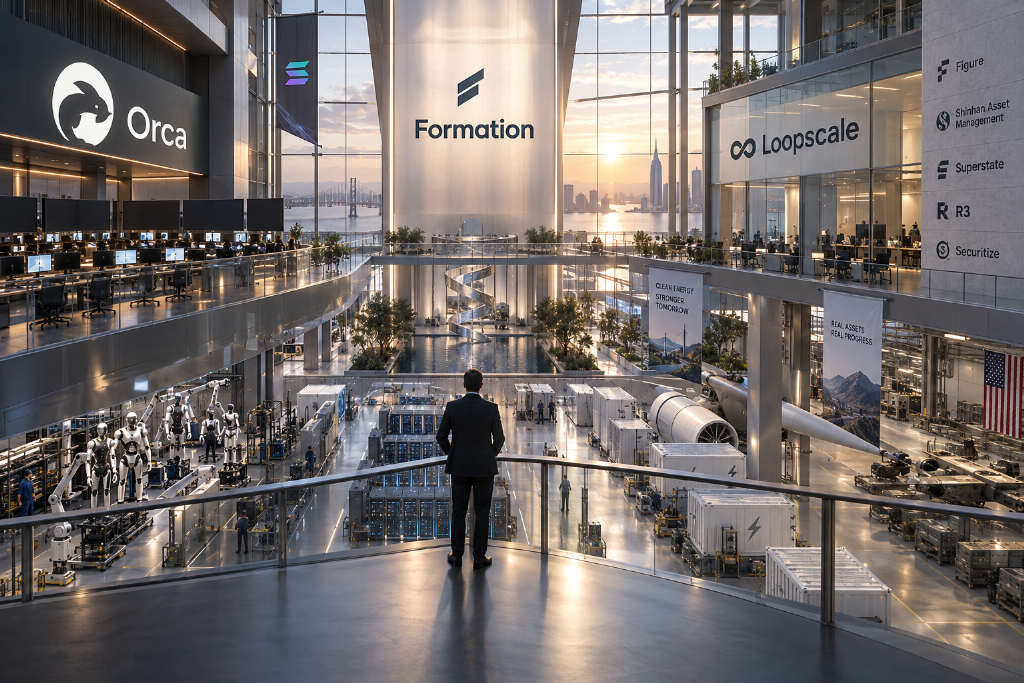
Solana decentralized exchange Orca and lending platform Loopscale are merging to create a new company called Formation, combining Orca’s trading infrastructure with Loopscale’s lending and investment vaults.
The new company will be led by Loopscale co-founder Luke Truitt as CEO. Orca’s Christopher Montagano will serve as chief strategy and legal officer.
Existing protocols stay in place
Formation said the two existing protocols will remain the foundation of the ORCA and xORCA token networks. It did not disclose the financial terms of the merger.
Push beyond crypto-native markets
The company said it wants to take DeFi liquidity outside the crypto sector and into capital-intensive industries including AI, energy, robotics, and defense.
Truitt said frontier sectors are creating new business models and new funding needs, while traditional market infrastructure is not evolving fast enough to keep up.
Formation said traditional financing is too expensive for smaller and mid-sized projects. Its stated goal is to lower those costs and eventually provide access to regulated U.S. capital markets. Over the next year, the company plans to launch tools for asset issuers and roll out new investment strategies.
Five partners named
Formation said it is already working with five institutions:
- Figure, for AI and robotics financing
- Shinhan Asset Management, for Asian asset tokenization
- Superstate, for compliance access
- R3, for enterprise infrastructure
- Securitize, for U.S. securities compliance
Scale and prior fundraising
Orca has processed more than $550 billion in trading volume since launching in 2021. Loopscale, formerly Bridgesplit, reported more than $150 million in deposits and more than $2 billion in loans facilitated.
In 2021, Orca raised $18 million in a round co-led by Polychain Capital, Placeholder, and the now-defunct Three Arrows Capital. Loopscale raised $4.25 million that same year from investors including Solana Labs and Coinbase Ventures. Both projects were early participants in Solana’s DeFi ecosystem.
Korean bond fund tokenization seen as a lead-in
Last August, Orca worked with Shinhan Asset Management, the Solana Foundation, and Etherfuse on a proof of concept for tokenizing a Korean won bond fund. Formation described that transaction as a natural lead-in to the merger.
According to the report, Orca had already been moving from its DEX roots into RWA tokenization. Loopscale’s lending vault structure now adds the financing side.
A broader shift inside Solana
The merger was framed as a sign that parts of the Solana ecosystem are moving from trading and speculation toward infrastructure and institutional services. The report said Solana drew large amounts of memecoin activity and short-term speculative capital over the past two to three years because of its high throughput and low fees. Orca and Loopscale’s tie-up suggests protocol-level teams are preparing for longer-duration and more capital-heavy asset classes.
Formation’s stated ambition is to turn DeFi from an internal crypto tool into a financing option for real-world industries. AI, energy, and defense share the same basic constraints: large capital needs, high compliance thresholds, and slow traditional funding processes.
The report said two points will be worth watching next: what Formation’s issuer tools look like when they launch next year, including whether they support direct listing and secondary liquidity for compliant security tokens, and whether partners such as Figure and R3 move from cooperation plans to live products.