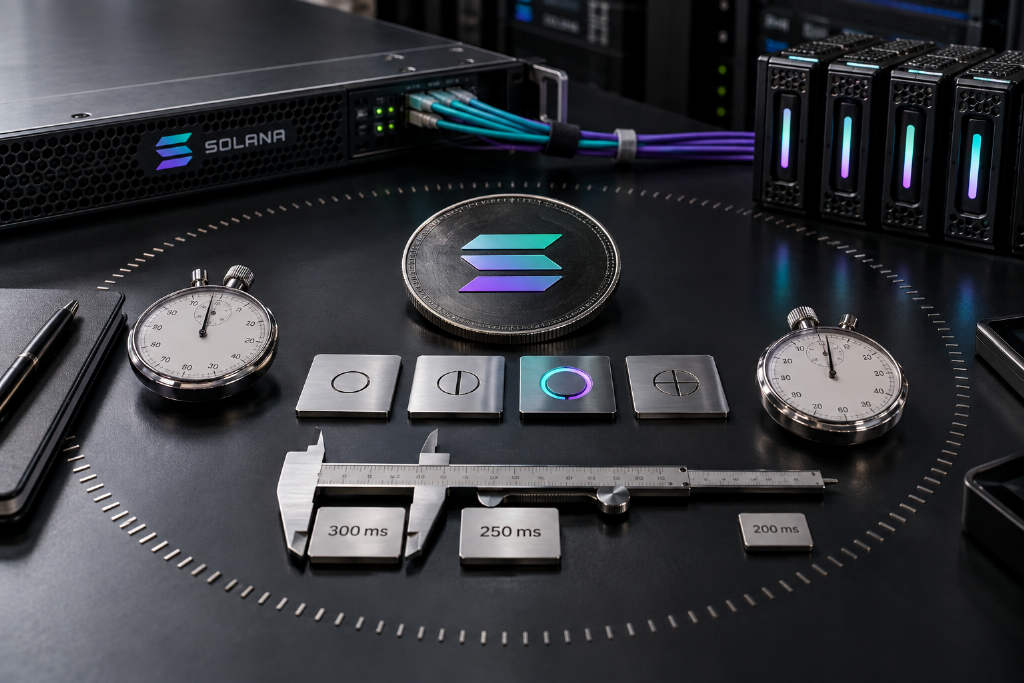
Solana reduced its target block slot time from 300 milliseconds to 250 milliseconds on Friday, according to Decrypt, lifting block production frequency by nearly 17%. The change does not increase the network’s overall transaction throughput because the compute resources and data capacity available in each slot were reduced at the same time. The adjustment marks the third of four planned stages under proposal SIMD-0525. As part of the update, the window in which validators can produce blocks across four consecutive slots was shortened from 1.2 seconds to 1 second. With each epoch fixed at 432,000 slots, the expected epoch duration also fell from about 36 hours to about 30 hours. Solana’s next planned step is to reduce slot time again to 200 milliseconds, though no mainnet deployment date has been set. That phase depends on block skip rates remaining stable.
Solana cut its target block slot time from 300 milliseconds to 250 milliseconds on Friday, according to Decrypt, increasing block production frequency by nearly 17%.
The compute resources and data capacity available in each slot were reduced at the same time, so the network’s overall transaction processing capacity remains unchanged.
Third planned stage under SIMD-0525
The change is the third of four planned stages in the SIMD-0525 proposal. The validator block production window across four consecutive slots was shortened from 1.2 seconds to 1 second.
With epochs fixed at 432,000 slots, the expected epoch length also drops from about 36 hours to about 30 hours.
Next step targets 200 milliseconds
The next stage would reduce slot time again to 200 milliseconds, but no mainnet launch date has been set. That step depends on block skip rates remaining stable.
This article was originally published by Bit.Fan. For more cryptocurrency news and market insights, visit www.bit.fan. Disclaimer:
The market information, project data, and third-party content displayed on this platform are for industry information sharing only and do not constitute any form of investment advice or return commitment.
Cryptocurrency trading carries high risks. Users should fully assess their risk tolerance and make independent decisions. All profits, losses, and legal responsibilities are borne by the users themselves.