
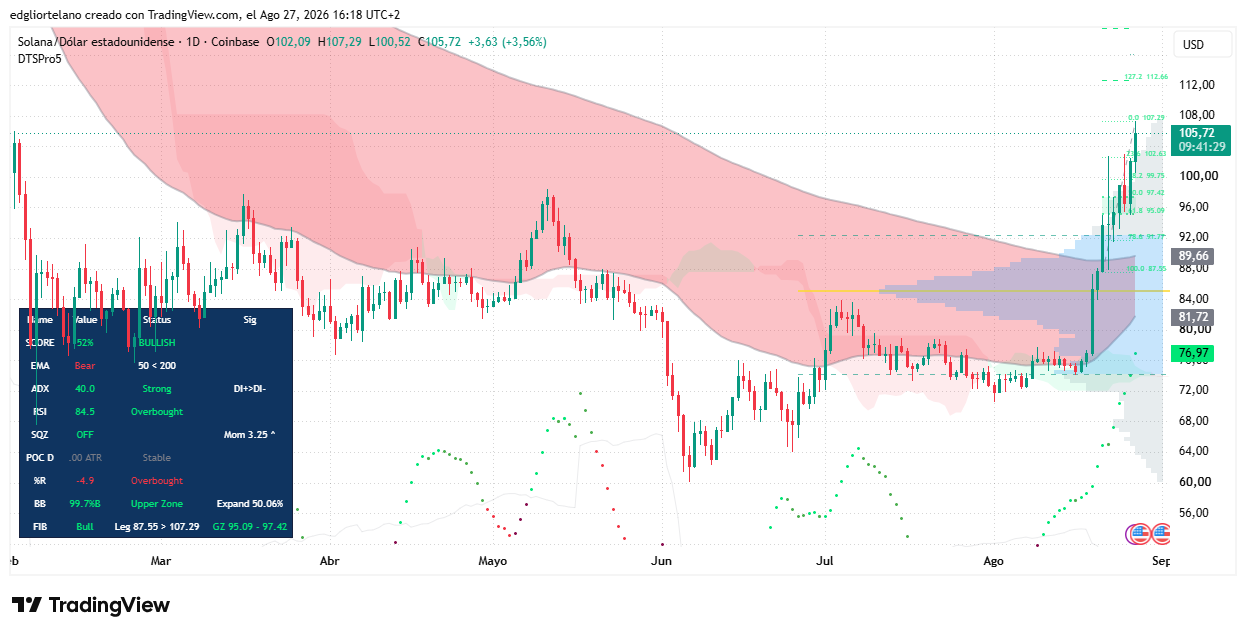
Solana’s token kept climbing ahead of a major governance deadline. SOL rose more than 8% over the past 24 hours, was up roughly 44% since the start of August, and moved back above $105 for the first time since January, according to Decrypt.
The rally coincided with the close of one of the most significant validator votes in Solana’s history. At issue is whether the network should reduce new SOL issuance and sharply increase the amount of SOL permanently removed from circulation.
Decrypt said traders appeared to spend the week pricing in a possible supply squeeze before any outcome became official. Voting is scheduled to wrap up at around 15:30 UTC, when epoch 1023 ends. On Solana, an epoch is roughly a two-to-three-day period of network activity used as an internal clock.
Three proposals are being decided under a new governance system
The vote combines three measures under Solana Governance Proposals, or SGPs. The framework is a new on-chain system that, for the first time, allows validators and the people who delegate SOL to them to cast binding votes weighted by stake.
One proposal would ratify a Solana Constitution that formalizes how voting works from here. The other two have drawn the most attention in the market: SIMD-550 and SIMD-553.
A post from Solana Developers on X said voting is live for SGP 1, SGP 2, and SGP 3 through the end of epoch 1023, at approximately 15:30 UTC on Thursday. The three items are listed as:
- SGP-0001: The Solana Constitution
- SGP-0002: Double Disinflation
- SGP-0003: Resource and Inclusion Fee
The two tokenomics proposals are being voted on independently. Each requires a two-thirds supermajority of participating stake, meaning a failure of one would not automatically block the other.
SIMD-550 would accelerate the decline in token issuance
SIMD-550 was filed by engineers at Solana infrastructure firm Helius. The proposal would double Solana’s disinflation rate, raising the annual pace at which new-token issuance shrinks from 15% to 30%.
Solana’s inflation rate is already designed to decline over time until it reaches a fixed 1.5% floor. If SIMD-550 passes, that floor would be reached in 2029 instead of 2032. Decrypt said the change would mean roughly 18.9 million fewer SOL created over the next six years.
The tradeoff is staking yield. Token issuance is one of the sources of rewards for stakers who lock SOL to help secure the network. According to an analysis from 21Shares cited by Decrypt, staking yield would fall from around 5.25% today to about 2.25% within three years if issuance is cut that aggressively.
The report compared the shift to a Bitcoin halving for staking. It also noted that some smaller validators could become unprofitable under that structure.
SIMD-553 would increase the amount of SOL burned
SIMD-553, submitted by Solana R&D firm Temporal, targets supply from a different angle. The measure would increase token burns, which means sending SOL to an address that cannot be spent from, permanently removing those tokens from circulation.
The proposal would split Solana transaction fees into two parts. A base inclusion fee would still go to the validator, while a new resource fee tied to how much computing power a transaction uses would be destroyed outright.
Decrypt said that single adjustment could raise Solana’s daily burn from about 650 SOL, worth roughly $48,000, to as much as 9,000 SOL, worth around $668,000. Depending on network activity, that would amount to a 12x to 14x increase.
The report added that SIMD-553 cleared code review from Solana’s two client teams, Anza and Firedancer, on July 20. The vote now is about whether to switch it on, not whether it is technically ready.
HSDT backs the constitution proposal but opposes both tokenomics changes
Nasdaq-listed treasury firm Solana Company, which trades as HSDT, said it supports the constitution proposal while voting against both tokenomics changes.
Management said its objection was about timing rather than the end goal. In its view, predictable yield matters more to institutional stakers right now than a faster reduction in issuance.
Results are expected within hours after epoch 1023 ends
The market move continued even as the vote remained unresolved. Decrypt said SOL’s 14-day relative strength index, or RSI, was near 84.5. Readings above 70 are commonly used to indicate that an asset is overbought.
Results from the vote are expected within hours of the close of epoch 1023.