

Solana validators have approved a proposal to speed up the network’s disinflation schedule, cutting future SOL issuance.
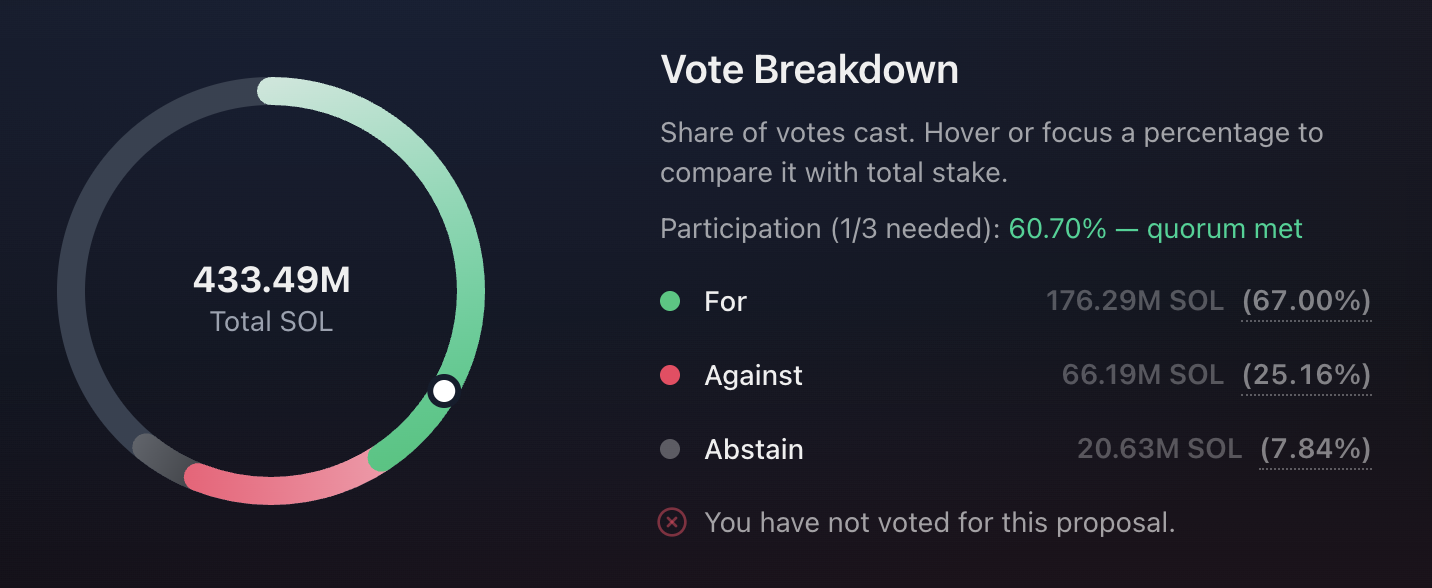
Final voting results show the measure won 67% support, with 25.16% voting against and 7.84% abstaining. Participation reached 60.7% of eligible stake.
The proposal, known as SGP-0002 or Double Disinflation, raises Solana’s annual disinflation rate from 15% to 30%. The network’s long-term inflation target remains unchanged at 1.5%.
New issuance schedule shortens the path to terminal inflation
According to Solana Compass, the revised schedule is expected to bring Solana to its 1.5% terminal inflation rate in about 2.8 years. Under the previous schedule, that timeline was roughly 5.7 years.
The change is estimated to result in 18.9 million fewer SOL being issued over the next six years. That would reduce dilution for SOL holders, while also lowering staking rewards for validators and delegators.
First binding governance round also covered other proposals
The vote took place as part of Solana’s first binding governance process. That process also approved a proposed Solana Constitution and rejected a separate proposal covering resource and inclusion fees.
Final governance data showed that some of the network’s largest participants were split on SGP-0002. Figment, listed as the largest voter in the finalized data with 17.1 million SOL staked, voted entirely against the proposal. Helius and Jupiter overwhelmingly supported it.
Kraken’s position changed during the voting period. The US-based crypto exchange initially voted against SGP-0002 at 12:33 UTC, briefly pushing support below the required threshold. By the end of voting, more than 90% of its roughly 8.9 million SOL voting stake backed the measure.
US-listed Solana products keep attracting capital
The governance decision comes as US-listed Solana investment products continue to pull in investor money despite weaker SOL performance earlier this year.
Bloomberg ETF analyst Eric Balchunas said in a Friday post on X that Bitwise’s Solana ETF recently crossed $1 billion in assets, making it the first Solana ETF to reach that mark.
Balchunas also said US Solana ETFs have attracted roughly $1.7 billion in cumulative net inflows since launch, with little sustained outflow.