
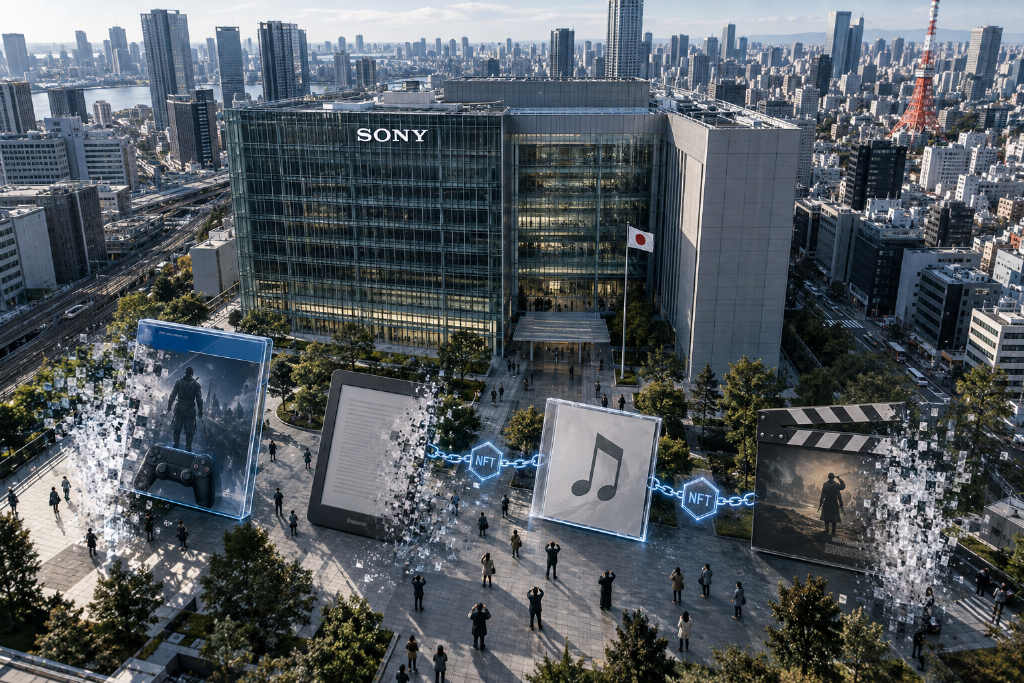
Sony’s position in court that players cannot truly own the digital games they purchased has become the latest flashpoint in a long-running fight over digital ownership.
That battle is still at an early stage, according to Kostas Chalkias, co-founder and chief cryptographer at Mysten Labs. He told Decrypt, 「With media, we're used to renting and streaming, and we're increasingly finding that the things we think we're buying don't actually belong to us.」
The dispute goes well beyond video games
Decrypt said the ownership problem stretches across digital media. In 2009, Amazon Kindle users discovered that their ebook copies of George Orwell’s Nineteen Eighty-Four had been remotely deleted because of a rights issue. Amazon has continued to alter ebook content since then, with works by Roald Dahl, Agatha Christie, and R.L. Stine among those remotely edited by publishers.
Film and television have seen similar cases. Users have found that titles they believed they had bought were actually licensed access that could be revoked. Those titles can also be changed after release. Decrypt pointed to retroactive edits to Stranger Things to patch a plot hole, while other shows have been removed from streaming services over politically sensitive material.
Streaming changed the meaning of ownership in music
Jess Zhang, founder of Canoe, said streaming platforms 「have completely redefined music consumption by swapping ownership for unlimited access,」 removing the user’s ability to build a permanent library.
Industry executive Sammy Andrews said that shift also changed the relationship between artists and audiences. Because royalties are the same whether a stream comes from a dedicated fan or a casual listener, the system 「rewards share of volume, not depth of connection.」
Critics say centralized platforms keep the real control
Some people, including film directors Christopher Nolan and Guillermo del Toro, have argued for physical media as the answer. Others say the core problem in digital ownership is the role of centralized intermediaries.
Primavera De Filippi, director of research at CERSA, told Decrypt, 「When you 'purchase' a digital asset from a digital platform, the platform ultimately retains control of the asset, and your 'ownership' title is nothing but a revocable entry on the platform's database.」
She added that traditional property-law protections against arbitrary seizure do not apply to digital assets. In her words, 「The platform operator can take property away via a simple line of code, without having to justify it on any legal ground, or even modify the content of these digital assets, without the users' consent or knowledge.」
Blockchain is being pitched as the fix
As in other sectors where consumers have pushed back against gatekeepers, blockchain and decentralized technologies are again being presented as an alternative.
Zhang said, 「Blockchain and Web3 gives consumers a clear path to owning a digital copy of a specific good, whether that is a game, a song or a movie.」
Tim Sun, senior researcher at Hashkey, said NFTs were first promoted as a broad solution because they let digital objects 「have a public, verifiable record held directly by the user.」 But he warned that 「excessive hype」 and speculation during the NFT boom damaged how the public sees them.
Early NFT models had storage and privacy problems
De Filippi said the technology stack behind NFTs had clear limits in its earlier form. If an NFT points to a file hosted on a company server, dependence on the platform operator remains. For real digital ownership, she said, both the title and the content of the asset need to live on fully decentralized infrastructure, and many NFTs do not meet that standard.
Another problem is that NFT metadata is public on most blockchains, which means anyone can right-click and save the content. Guy Itzhaki, CEO of privacy blockchain Fhenix, told Decrypt, 「The main issue is that ownership of the NFT does not necessarily give you exclusive control over the asset behind it. If an NFT represents a piece of art, a game item or access to private content, public metadata can expose that content or its attributes to everyone.」
What users need, he said, is both ownership of the NFT and control over who can view the data behind it. Access control would make NFTs look more like physical ownership. Until now, NFT holders have often had to argue that real ownership includes the title, the content, and sometimes the intellectual property rights, while critics pointed out how easy it was to copy a $16,000 monkey picture.
Encrypted NFTs already exist, but integration is weak
Itzhaki said there are already several ways to make NFTs private, including conventional encryption, trusted execution environments, or TEEs, and fully homomorphic encryption, or FHE. During the 2021-22 boom, early encrypted NFT projects using TEEs were sold, including efforts involving filmmakers Kevin Smith and Quentin Tarantino. That line of development faded after the NFT market crashed.
He said encrypted NFTs have been held back by 「integration rather than a lack of technology.」 Existing wallets and marketplaces were built around public NFT metadata, while encrypted NFTs introduce new requirements around permissions, key management, transfers, and confidential computation. They are also tied to specific infrastructure. That was enough to prove technical feasibility, he said, but it made adoption across the broader NFT ecosystem harder.
Mainstream adoption still faces a credibility gap
Itzhaki said privacy technology is gaining traction across blockchain and should see deeper integration with wallets, marketplaces, and developer tools. As those capabilities spread, he said, they should extend to NFTs as well. He also said clear standards for private NFTs would speed the move toward 「NFTs with real utility and value,」 making true ownership of digital assets more practical.
Zhang said, 「At this point, there are no missing technical elements. The missing element is culture and credibility for mainstream adoption.」 She added that NFTs are 「the clear path forward for digital ownership and intellectual property distribution and licensing on the internet,」 and that blockchain is the technical route toward a world where digital ownership is clearly defined and actually possible.