
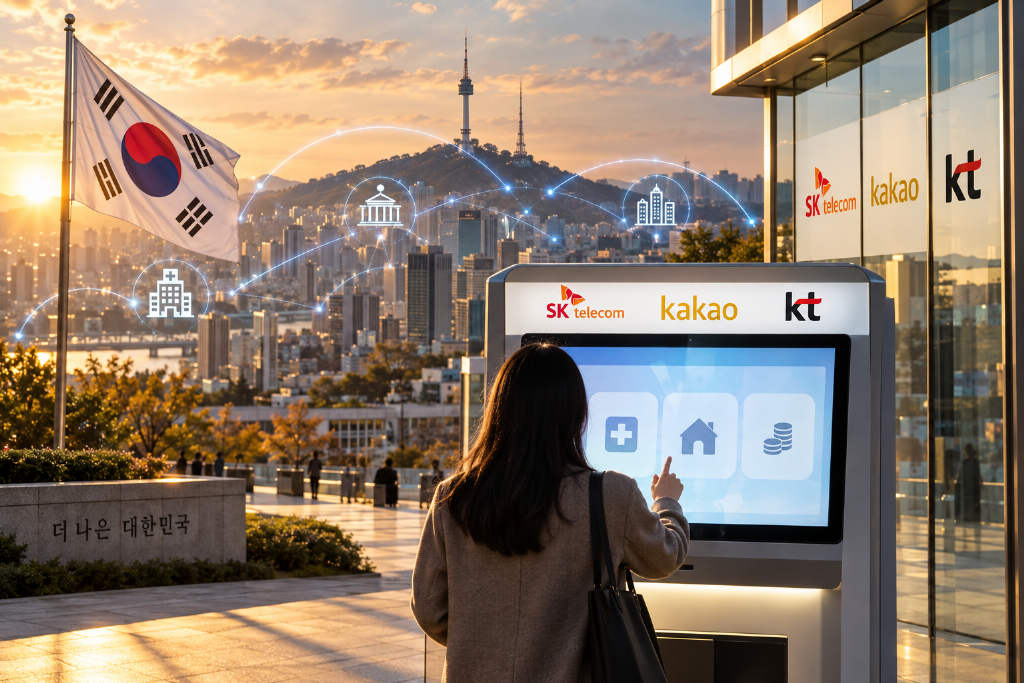
South Korea is rolling generative AI into public services under a plan to provide free, uncapped access to about 51 million citizens.
Under the Ministry of Science and ICT’s “AI for All” program, the government plans to offer generative AI services with no subscription fee and no token cap. The service is set to plug directly into systems for medical appointments, public rental housing applications and tax filing, with operating costs covered by the national budget.
The project has already moved into implementation. On Aug. 28, three consortiums led by SK Telecom, Kakao and KT were selected. On Sept. 4, the government held a kickoff meeting and began pushing toward a nationwide launch before the end of the year.
More than a public benefit program
On the surface, the state is simply footing the bill. The article argues the move goes beyond welfare: AI is not just a tool, but a future means of production, and government-funded access would put that tool in the hands of nearly every citizen.
South Korea has benefited from the hardware side of the AI era, but domestic foundation models have struggled to gain attention at home. Citing Wiseapp·Retail data, the article says ChatGPT had about 23.45 million monthly active users in South Korea in April 2026, Gemini had about 8.45 million and Claude had about 2.41 million. Domestic models were described as drawing little public attention.
That matters because AI competition has strong scale effects. Without users, products improve more slowly and revenue does not support research and development. If products lag, users become even less willing to adopt them, creating a cycle that is hard for local startups to escape.
The “AI for All” framework is designed to break that cycle. The plan requires that at least 50% of the service use Korean models that meet the standard for sovereign foundation models, while at least 30% must rely on models developed by other Korean companies. Foreign models may be used only for necessary functions, and those portions will not receive government support.
That ties public procurement, industrial support and technological sovereignty into one structure. Domestic companies get computing support and deployment scenarios; citizens get free tools; the government aims to keep research, operations and service integration capacity inside the country.
The article says the government is, in effect, using public money to lock 80% of computing capacity to domestic models, helping local companies clear the hardest stage of market launch.
Budget support is taking shape, but total cost is still unclear
According to a Sept. 4 report by MoneyToday, based on a ministry project document obtained by a lawmaker’s office, South Korea’s plan for 2027 to 2030 sets annual spending at 250 billion won.
- 170 billion won is earmarked for GPU rentals.
- 30 billion won is allocated to the three consortiums.
- 50 billion won is set aside to expand the AI agent ecosystem.
Using South Korea’s 2026 population of about 51.61 million, the article says the plan works out to roughly 4,800 won per person per year.
It also says that figure is obviously not enough to fully cover the real cost of heavy generative AI usage, and doubling it would still not be enough. The economics, as presented, depend on mixed usage intensity and on assigning different levels of computing power to different tasks.
SK’s proposal, published on Aug. 19, explicitly said simple questions would be handled by lightweight models and complex tasks by high-performance models. Model routing, along with inference optimizations such as caching, batch processing and quantization, could lower the cost per task.
The service is also expected to preserve some commercial revenue. Financial News reported on Sept. 7 that the government is considering allowing moderate advertising and discussing charges for premium services after the second half of 2027.
Based on the information available, the article describes the fiscal path this way: initial spending to secure startup computing power, then annual support of 250 billion won for service operations, alongside broader investment in AI research and infrastructure.
Even so, the final total is still impossible to pin down. Corporate spending and future capacity expansion tied to actual usage have not been quantified.
Free access does not guarantee immediate productivity gains
The article cites research released by the Bank of Korea in June 2026 showing that AI use reduced working time by an average of 3.8%, or about 1.5 hours per week, corresponding to an estimated 1.0% improvement in potential productivity.
But the study did not find broad evidence that the time saved had already turned into actual output growth. The clearest gains appeared among the self-employed, professionals and heavy AI users.
The article places this in the so-called productivity J-curve often seen in the spread of general-purpose technologies: tools arrive first, while training, process redesign and organizational adjustment come later, and measurable benefits emerge only over time.
In that sense, making AI free for everyone may lower the technical barrier. Turning convenience into real output is a separate challenge. Companies still need to change workflows, and workers need reasons to use saved time in ways that increase production rather than simply extending workloads.
If that shift does not happen, wider AI adoption could raise “AI intensity” per person without easing the pressure of work.
Distribution power, evaluation rules and labor markets may shift
The article says the first parties to gain dependable demand from a taxpayer-funded AI system would be compute suppliers, model developers and platform operators.
For small businesses, a public platform could reduce development and customer acquisition costs. For consumers, it could cut the time and effort needed to complete everyday tasks. But if the chat interface increasingly controls bookings, shopping and service recommendations, the platform also gains new distribution power.
Who gets recommended, who pays commissions and who is allowed to connect to the system would all shape competition.
That is why the article says subsidies should be judged not only by how much money is spent, but by actual usage results. Financial News reported on Sept. 7 that GPU support will be allocated differentially based on user numbers and usage performance, with a first evaluation possibly considered as early as March 2027.
In practical terms, the article says implementation will also need to evaluate task completion rates, error rates and the amount of time genuinely saved.
Labor markets may shift as well. AI assistance can help less experienced workers complete more tasks, but it may also reduce the entry-level work that once gave newcomers room to learn. Older users may find services easier to access, while younger workers still need paths to build skills and earn income.
After tools are widely distributed, training, job redesign and income distribution still have to keep pace.
Turning AI from a subscription product into a social service
The article’s broad judgment is that South Korea has the conditions to make universal AI into a practical public service while also expanding the market for domestic models.
Existing user channels, fiscal backing and integration with local public and daily-life services give the program a foundation for launch. For other countries, the plan also points to a possible route: use public procurement to turn AI from an individual subscription product into a broadly available social service.
Still, broad productivity gains would depend on a much longer process of organizational and institutional change, not on free access alone.
From subsidizing consumption to distributing productive tools
The article ends by focusing on how productive capacity is distributed.
In the project notice, the Ministry of Science and ICT described the long-term direction as “one AI agent for every citizen,” so that people can participate in economic and social activity through their own AI agents and share in the gains created by AI.
The distinction matters. Cash transfers raise present purchasing power. Providing productive tools is an attempt to raise a person’s future ability to generate income. In that framing, fiscal spending no longer supports consumption alone; it starts to support ordinary people’s participation in production.
The article gives an example of a young person trying to run a small business. Marketing, sorting customer requests, analyzing orders and occasionally updating a website all take time and money. Even if that person knows how to use AI tools, token consumption can become expensive. If public AI handles part of that workload, the minimum cost of trying to build a business could fall.
That would lower barriers to entry and expand the productive resources available to individuals. A person’s experience, judgment and customer relationships, paired with cheap and useful tools, could support business activity that might otherwise never get off the ground.
The article also says the shift could affect workers’ bargaining power. If someone depends entirely on software, equipment and organizational systems provided by an employer, the cost of leaving is relatively high. If public AI makes it easier to take on some work independently, learn new skills or switch occupations, that person has more outside options when dealing with an employer.
In that sense, the program moves the distribution debate forward by one stage. Instead of focusing only on how governments redistribute wealth after it is created through taxes and welfare, universal AI seeks to intervene earlier by giving more people tools to participate in creating that wealth in the first place.
The article frames the question in simple terms: will ordinary people join growth only as consumers who buy products, or also as people who can use new tools, provide services and run businesses?
If the government absorbs part of the tool cost, then family background, company size and personal income may become less restrictive in determining who gains productive capacity. The article closes by arguing that once ordinary people have one more productive tool at hand, one more route to earning a living and one more basis for choosing work, they stand a better chance of sharing in the gains created by technological progress.