
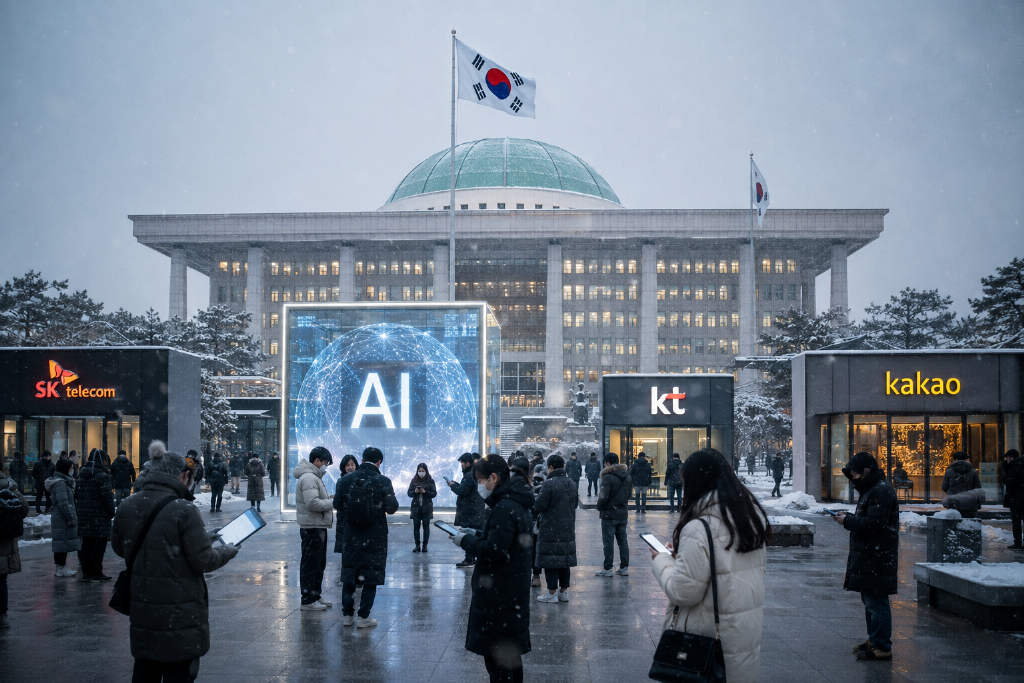
South Korea has formally launched a nationwide AI program built around a simple promise: free, unlimited AI access for everyone.
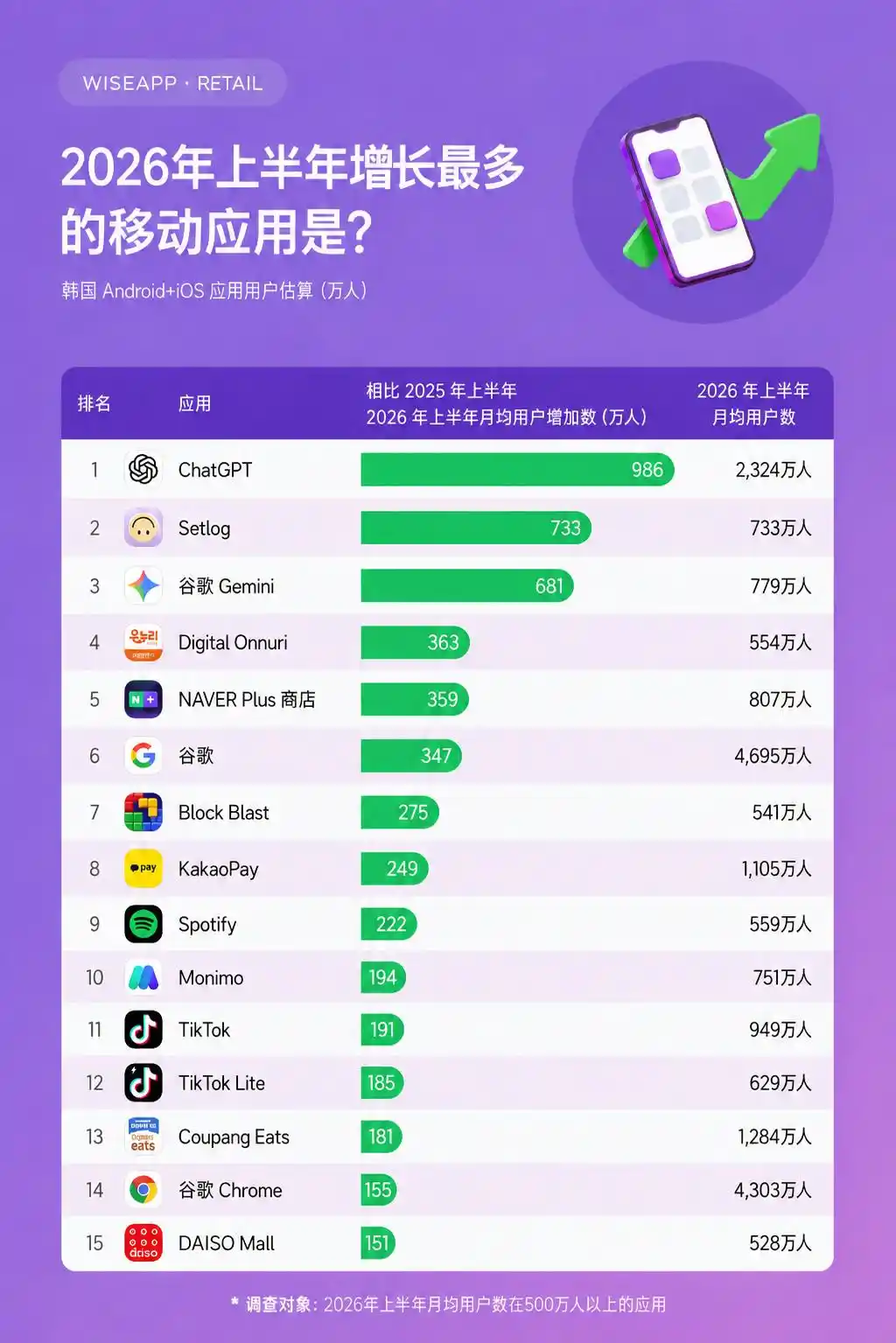
The article says the country has a population of 51 million, and 23.45 million people in South Korea already use ChatGPT. In that framing, a single U.S. product has reached nearly half the country. Seoul’s response is to fund a domestic AI distribution system with public money.
Three consortiums selected for a nationwide rollout by year-end
On Aug. 28, the Ministry of Science and ICT said consortiums led by SK Telecom, KT, and Kakao had been chosen for the “AI for All” project. The goal is to provide free, unlimited AI services to the entire population by the end of the year, with one central condition: 80% of those services must run on South Korea’s own models.
The article describes South Korea as the first G20 economy to treat AI as public infrastructure in this way.
Foreign AI products dominate consumer usage in Korea
The piece frames the problem bluntly: outside the United States and China, most countries sit on the consumer side of the AI market rather than the model-building side. Wiseapp data for April 2026 showed ChatGPT with 23.45 million monthly active users in South Korea, Gemini with 8.45 million, and Claude with 2.41 million. All three are foreign products.
Domestic models such as LG EXAONE, SKT A.X K2, and Upstage Solar exist, but the article says their user scale is several orders smaller.
It argues that local models need real users to improve, while users have little reason to move from ChatGPT to a weaker alternative. As a result, usage data keeps accumulating on foreign companies’ servers. In the article’s telling, the market on its own has not broken that cycle.
Seoul is targeting distribution, not a head-on model race
South Korea’s answer is not to confront leading models directly on raw capability. It is using public finance to shape the distribution layer instead.
The Basic AI Act, which took effect in January 2026, gave the government a legal basis to intervene in the AI industry. The AI Action Plan 2026–2028, finalized in February the same year, introduced the idea of an “AI basic society,” treating access to AI as a basic civic right on par with education.
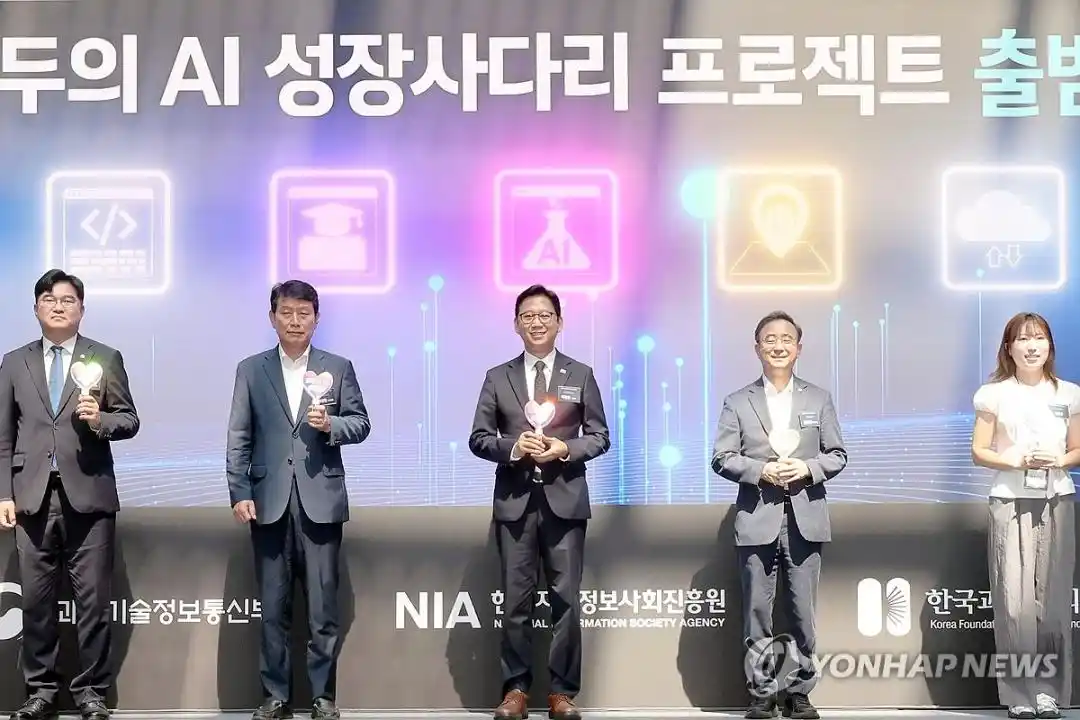
Deputy Prime Minister Bae Kyung-hoon described the initiative as “the calculator and computer of the AI era.” The article links that comparison to the spread of calculators through centralized purchasing by schools and government institutions.
The core rule: 80% must come from Korean models
The article reduces the commercial logic of “AI for All” to one line: the government provides money, compute, and entry points, then pushes 51 million people into a domestic AI ecosystem so local models can grow on real traffic.
This year, the government allocated a combined 512 NVIDIA B200 GPUs to the three consortiums. The article says one B200 roughly equals the inference power of three to four H200 GPUs. From 2027, operating costs will be covered by the national budget, and the free offering will run through at least 2028.
Still, the piece says the real market-shaping force is not just money or hardware. Each consortium must run at least 50% of its services on self-developed sovereign foundation models, while another 30% must run on models from other South Korean companies. That creates an 80% minimum threshold for domestic AI.
Foreign models are allowed only in areas that Korean models cannot yet cover, and the government will not pay for that portion. By the article’s account, the rule pushes each consortium to work with multiple domestic model companies and expands the order pool for South Korea’s AI sector.
Three distribution routes: telecom, messaging, and channel aggregation
The three groups differ mainly in how they reach users.
- SK Telecom: It has 22.5 million mobile subscribers and is focusing on “mobile AI” that can make calls and handle tasks on a user’s behalf. Its stack uses the 68.8 billion-parameter sovereign model A.X K2.
- Kakao: It plans to embed AI into KakaoTalk, allowing users to handle reservations, bill payments, and applications directly inside the chat window.
- KT: It is pursuing a channel-alliance approach, bringing together the Daum portal and a group of vertical apps under a single conversational entry point.
The bet is the same across all three: whoever first turns AI from a chat tool into a public agent that can help ordinary people file taxes, book hospital appointments, or apply for subsidies may offer something ChatGPT does not currently provide.
The first version due this year will be a general-purpose chatbot. The real test, the article says, comes in 2027.
A demand-side industrial policy experiment
The article describes the design as demand-side industrial policy. Over the past decade, many governments have backed domestic technology mostly from the supply side, whether by funding semiconductor production lines or financing AI research and development. South Korea is spending on distribution instead, using public money to create a protected user base where domestic models can gather data and improve in real-world settings.
In the article’s view, the program is larger in scale, tighter in timetable, and more dependent on consumer experience than earlier support efforts.
Naver and Samsung are absent
One of the biggest variables, according to the article, is that Naver is not participating.
Naver is described as Korea’s equivalent of Google and the country’s largest search and lifestyle services platform, with access points across search, maps, shopping, and payments. On paper, it would have been well positioned to build a mass-market AI assistant.
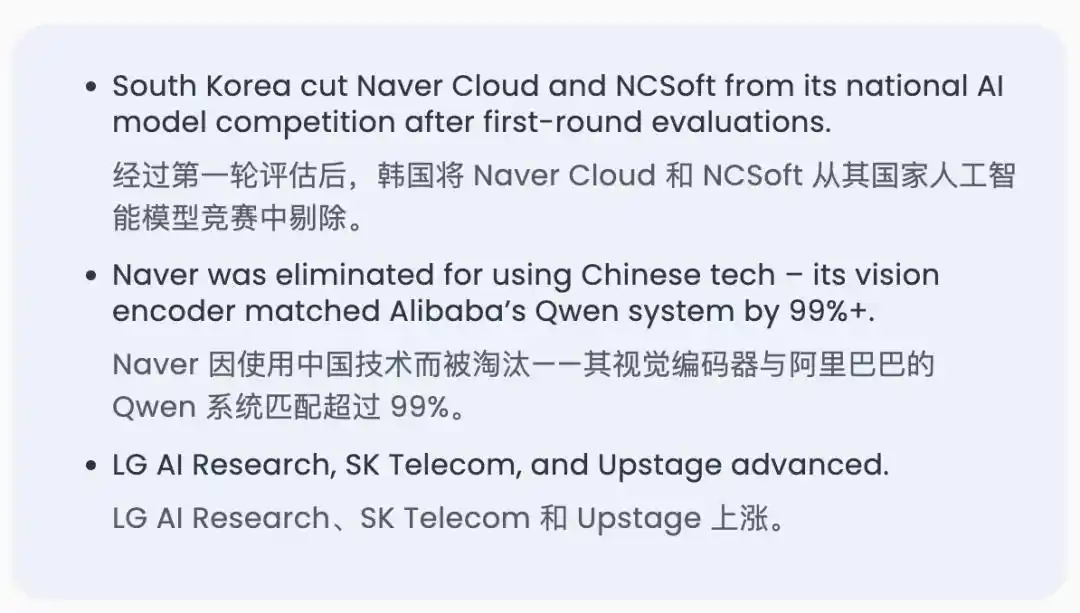
But in January this year, Naver Cloud was removed from a government-led sovereign AI foundation model project. The article says the reason was that the visual encoder in HyperCLOVA X had a cosine similarity of 99.5% with Alibaba’s Qwen, which did not meet the independence requirement. The article interprets that as a shell-based reuse of Qwen.
Samsung is also absent from the project.
That leaves a national initiative being handled by two telecom operators and one messaging app, while the platform with the broadest user scenarios and the country’s largest hardware maker are both outside the group.
Retention may be the first real checkpoint
User retention is another hard problem. ChatGPT already has a free base version, so Korean users are unlikely to stop using it simply because another free alternative appears.
Wiseapp data cited in the article showed ChatGPT was the fastest-growing app in South Korea in the first half of the year, adding 9.86 million users over six months.
The government may be able to push users to the door, but whether they stay will depend on whether domestic agents can do things ChatGPT cannot, especially services tightly connected to local public systems such as tax filing, hospital registration, and subsidy applications. Those are the functions the article says foreign products are least likely to plug into in the near term.
The piece presents that local government-service linkage as the part of the Korean plan most worth watching: using exclusive access to public-service scenarios to build user stickiness for domestic AI.
Compute limits, the free period, and what comes after 2028
The article also points to scale constraints. It says 512 B200 GPUs serving 51 million people still look small compared with the compute behind ChatGPT’s reported 900 million weekly users.
Free access is promised through at least 2028. After that, operators will have to cover their own profit and loss. If users have become accustomed to free access by then, paid conversion may be no easier than it is today.
The market will deliver the first answer after launch
The article says the Korean experiment is trying to answer a question that matters to countries outside the U.S. and China: if local models cannot catch up with the leading players on capability, can control of distribution create a survival window?
Once the service goes live by year-end, the first measurable checkpoint will be retention. If free ChatGPT and free domestic AI are available side by side, the choices made by South Korea’s 51 million residents will test whether this route can become a repeatable model or remains an expensive lesson.