

South Korea’s crypto market: heavy trading, limited tokenization
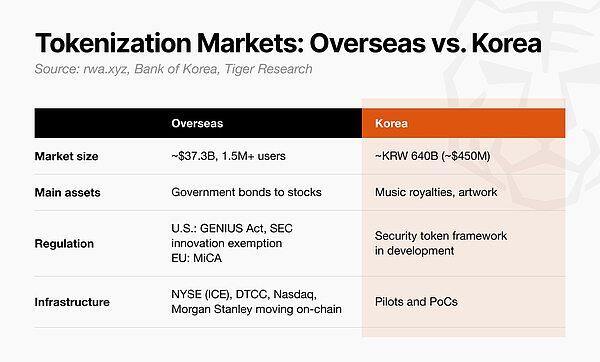
South Korea has tokenized about KRW 640 billion in real-world assets, or roughly $450 million, according to the Bank of Korea. That figure is still less than one-eighth of the average daily trading volume on the country’s centralized exchanges. Investor attention remains concentrated on trading, while the broader ecosystem around real-world use cases is still underdeveloped.
By trading volume, South Korea is already one of the world’s largest crypto markets. A survey released by financial regulators in March 2026 showed that, as of the end of 2025, the country had 11.13 million accounts eligible for trading, equal to more than 20% of the population. Even during a market downturn, average daily trading volume in the second half of 2025 still reached KRW 5.4 trillion, or about $3.8 billion.
Outside trading, tokenization of real-world assets has moved slowly. Total issuance stands at about KRW 640 billion, with most of it concentrated in non-standardized assets such as music royalty rights, which account for 65%, and art, which accounts for 17%. Tokenization of standardized traditional financial assets such as bonds and funds remains relatively rare, according to Bank of Korea data cited from March 2026.
What changed overseas: regulation advanced and institutions moved in
The article contrasts South Korea with a much larger overseas tokenization market. Data published by rwa.xyz in August 2026 put the global value of tokenized assets at about $37.3 billion, with more than 1.5 million users. Asset types moving on-chain now range from cash equivalents such as government bonds to equities.
Regulation has also progressed. The United States passed the GENIUS Act to regulate stablecoins and then continued work on the CLARITY Act. Although the CLARITY Act did not pass a Senate vote, the U.S. Securities and Exchange Commission then introduced an innovation exemption that allows tokenized securities trading platforms to operate for five years without meeting exchange registration requirements. Europe, for its part, established a unified framework through MiCA.
Existing financial infrastructure is also moving on-chain. The New York Stock Exchange, owned by Intercontinental Exchange, is building a platform for round-the-clock trading in tokenized securities. The Depository Trust & Clearing Corporation, which handles clearing and settlement for most U.S. securities trading, has already received SEC approval to operate its own tokenization service. Nasdaq and Morgan Stanley are moving in the same direction.
The article’s point is straightforward: a market that once grew mainly from the bottom up is now being reshaped by direct participation from large financial institutions.
South Korea’s response: pilots first, rules taking shape
Against that backdrop, South Korea has started to move beyond its earlier limits.
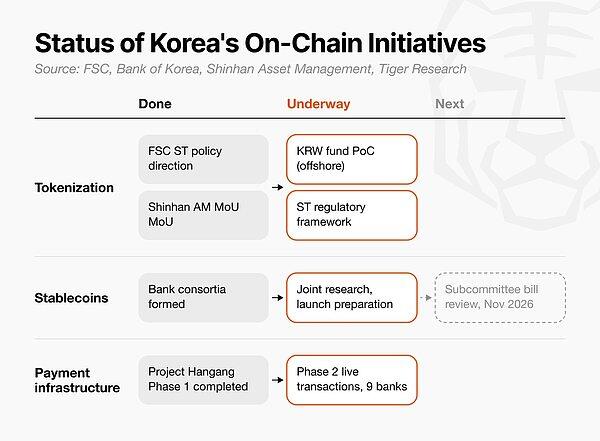
In tokenization, Shinhan Asset Management has been running a proof of concept with overseas partners to test on-chain issuance and distribution of KRW-denominated funds. Many financial institutions are also expanding cooperation through overseas offices. On the policy side, the Financial Services Commission has already set out the direction for security token policy and started building a regulatory framework.
In stablecoins, large financial institutions have formed an alliance to study a KRW stablecoin and accelerate preparations ahead of launch. Related legislation is still under discussion. A relevant subcommittee in the National Assembly plans to review the bill in November 2026, though the timing of passage remains uncertain. Even so, the article says both the market and regulators broadly agree on the need for stablecoins. In that framing, the question is no longer whether stablecoin regulation and market rollout will happen, but when.
On payment infrastructure, the Bank of Korea has completed phase one of Project Hangang. In that phase, the central bank issued wholesale central bank digital currency to participating banks, which then converted customer deposits into deposit tokens and put them into circulation. The number of participating banks has since expanded to nine, and the project has entered a second phase that uses real transactions for testing.
The article argues that South Korea entered the crypto market later than overseas peers but is developing steadily. In an early-stage market, speed alone will not close the gap with more mature jurisdictions. Questions such as who can issue, how ownership should be divided among participants, and what structure tokenized assets should use cannot be settled in haste. On that basis, the current step-by-step pilot approach is presented as the right one, with the next task being to identify new opportunities during that process.
South Korea’s crypto market in 2030
The article sketches out a day in 2030. A customer buys coffee at a convenience store using a KRW stablecoin. A banking app shows salary arriving not as a traditional account transfer but as a token transfer. An employee at a New York asset manager buys KRW-denominated government bonds with nothing more than a wallet.
Those may look like small changes in daily life, but the article treats them as signs of a broader transformation in the financial system. Based on the pace of infrastructure development in major economies, along with South Korea’s own proof-of-concept work and regulatory discussions, it concludes that stablecoins are likely to become part of the Korean financial system within the next few years.
Stablecoins: coexisting with current payment rails
By 2030, the article expects consumers to use KRW stablecoins to buy coffee at nearby convenience stores without even realizing a stablecoin is being used in the background. KRW stablecoins may also take a meaningful share of business-to-business payments.
The case for B2B use is especially strong. OECD data show that trade accounts for about 85% of South Korea’s GDP, roughly 3.5 times the U.S. ratio of 25%.
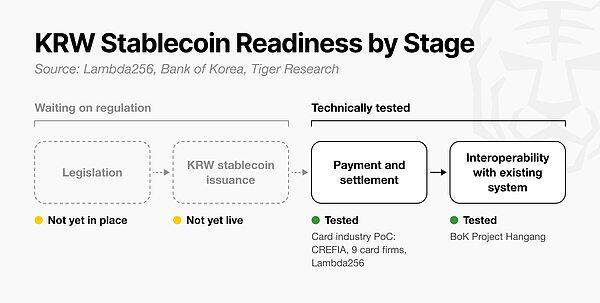
Even before formal regulation is in place, the underlying blockchain technology for KRW stablecoins has already been tested in commercial settings from several angles. In a card-industry proof of concept run jointly by the Korea Credit Finance Association, major card companies and Lambda256, a KRW stablecoin was used as a payment instrument while keeping the existing authorization and settlement system intact. Project Hangang, built around central bank digital currency, also tested interoperability between a distributed ledger payment network and the existing financial system.
Because the technology has already been tested, the article says KRW stablecoins could spread quickly once the regulatory framework is finalized. The main variable is timing.
It divides KRW stablecoin use into two areas:
- Retail: consumers are expected to keep getting the same payment experience they have today, without noticing that a KRW stablecoin is being used underneath. Since KRW stablecoins would coexist with fiat currency and other payment methods, however, the short-term scalability and profitability of the retail model may be limited.
- B2B transactions: intermediaries currently slow down cross-border corporate payments and raise costs. Stablecoins can reduce the cost of large trade transactions and speed up settlement, making this the area with the biggest payoff.
By 2030, the article says, KRW stablecoins are likely to run alongside existing card and settlement infrastructure and become a core part of the payment system rather than replacing it.
Payments: the opportunity is not the button, but settlement operations
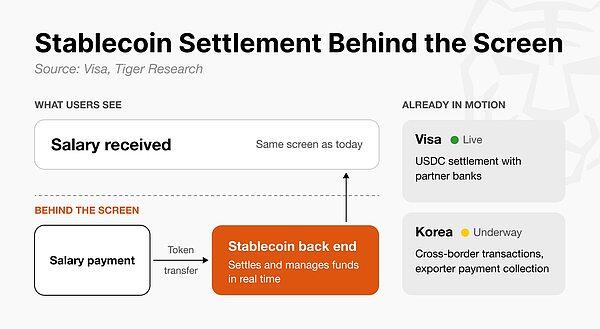
By 2030, salaries may appear in banking apps as token transfers rather than account transfers. If stablecoins are a new form of money, the harder question is how to operate that money. The user interface may look the same as it does today, but the backend would handle settlement and treasury management in real time through stablecoin-based processes.
Technical testing in payments has already advanced. Visa’s USDC settlement pilot has entered the live settlement stage with partner financial institutions. South Korea is working on similar projects, with a focus on cross-border transactions and exporter collections.
The article splits the opportunity into front-end and back-end layers:
- Front end, or payment user experience: the card and payment experience visible to consumers is expected to stay the same, while deposit tokens and stablecoins settle in the background. New tools would run in parallel with existing payment methods.
- Back end, or settlement treasury operations: the key opportunity lies in enterprise software built for treasury teams at payment gateways, card companies and cross-border remittance providers. Those tools would track prefunded balances, meet settlement deadlines and manage risk in real time.
On that basis, the article says the payments market by 2030 is less about building a new payment network and more about providing software and infrastructure that let existing payment companies manage liquidity and settlement risk in real time.
Real-world assets: from issuance to global distribution
The article’s 2030 scenario also includes a New York asset manager buying KRW-denominated government bonds with a wallet. That points to a larger claim: the main opportunity in tokenized real-world assets is not just domestic issuance, but reaching global clients and providing the brokerage and connectivity needed after issuance.
Global financial institutions have already shown that tokenized assets can run commercially. Examples cited include UBS’s tokenized fund uMINT and J.P. Morgan’s JLTXX, both of which handle subscriptions and redemptions in live on-chain environments. In South Korea, discussion around bringing more financial assets on-chain is also becoming more active as regulators build a framework for security tokens.
The article divides the market opportunity into two parts:
- Domestic issuance: issuance remains the first step and still matters. Securities firms and other financial institutions are expected to build infrastructure steadily so they can tokenize and issue underlying assets reliably.
- Global expansion and brokerage services: one opportunity is to connect Korean tokenized assets with overseas investors, or bring overseas real-world asset products into Korea. Another is enterprise connectivity infrastructure that supports real-time subscriptions, redemptions and balance updates between asset managers and custodians after issuance.
Without that infrastructure, the article says, those processes would still rely on manual work and batch processing, and tokenization would lose its efficiency advantage. As the Korean real-world asset market matures, more value is expected to come from circulation of tokenized assets rather than from minting alone.
Where the opportunities may emerge before 2030
As South Korea’s crypto market expands and matures ahead of 2030, the article expects a series of business opportunities tied to the shift on-chain. For now, those opportunities are still closer to pilots than to mature businesses. They have been validated under test conditions, but they are not yet operating at commercial scale.
Timing, in the article’s view, is critical. Institutions that move while the rules are still being written are the ones most likely to gain an advantage once the framework is set.
KRW stablecoins: modular issuance on shared infrastructure
As of September 2026, one core issue in South Korea’s Digital Asset Basic Act remained unresolved: which entities would be eligible to issue KRW stablecoins. Until that is settled, distribution, custody and payment services built around stablecoins cannot fully take shape.
The article argues that for KRW stablecoins to spread, issuers at the center of the business must be able to earn sustainable profits. Stablecoin issuers usually make money from interest on reserve assets, so the model depends on scale. If reserves can only be held as bank deposits, yields fall and growth potential becomes more limited.
To get around that constraint, the article highlights a modular white-label model built on shared technical infrastructure and separated responsibilities. In that setup, the issuer holds and manages reserves and maintains the required regulatory licenses. The infrastructure provider supplies shared on-chain systems for minting, burning, freezing and whitelist management. The infrastructure provider stays neutral at the technical layer, while the issuer keeps control over its own service and assets.
For that division of labor to work, the underlying blockchain must settle at the speed and cost required for consumer accounts. The article specifically mentions support for frequent small transactions, near-instant balance updates and continuously accrued rather than batch-accrued yield.
The mUSD model is used as an example. Bridge, a Stripe subsidiary, acts as the issuer and handles reserve management and legal compliance. Stablecoin infrastructure provider M0 supplies the technical stack. MetaMask then built Money Account on top of that arrangement, allowing users to earn yield automatically on mUSD balances and spend through linked cards without MetaMask itself having to manage reserves or licensing.
As of August 2026, wallet integrations of this kind, including MetaMask’s, had processed more than 1 million gasless transactions. The article treats that as evidence that the infrastructure can handle real consumer transaction volume rather than serving only as a technical demo.
Whether this exact model, with a non-bank issuer working alongside an independent infrastructure provider, can operate in South Korea remains unsettled. The article notes that one proposal in the Digital Asset Basic Act under discussion would require banks to hold a majority stake in KRW stablecoin issuers, meaning 50% plus one share in the issuing entity. Under that structure, an institution equivalent to Bridge would be pushed into a subordinate technical-service role rather than acting as the issuer.
Still, the article says that regardless of the final model, the number of entities able to become issuers is likely to be small. That is where the modular approach matters: a limited number of issuers can share technical infrastructure, while other companies build services that actually use the stablecoin.
Payments: the backend opening
To capture the opportunity in payments, companies need to design their business around a clear division of responsibilities, the article says. The front end would remain with existing payment gateways, card companies and remittance providers, each keeping its own user experience.
The real opening is in the backend: specialized tools for treasury teams that track prefunded balances, meet settlement deadlines and manage risk in real time instead of through daily or weekly batch processes.
That kind of real-time backend places concrete demands on the underlying blockchain. Card networks need to settle within strict time windows. If a blockchain cannot keep up with authorization and settlement volumes, it simply recreates the batch-processing problem in another form.
Stablecoin payments infrastructure company Rain is cited as an example. Rain has built a card issuance product and handles settlement, card partnerships and compliance, leaving fintech clients to manage their own front ends. Stablecoins spent through those cards can continue earning yield and remain usable as collateral until the moment of actual spending, rather than sitting idle in prefunded settlement accounts.
The significance of the Rain model goes beyond cards, the article says, because it addresses the cost of batch settlement. Payment companies that settle only once or twice a day must hold prefunded balances to bridge the gap between accepting a payment and completing settlement. Those balances do not earn yield while idle, and they grow with transaction volume. Real-time settlement can compress that buffer close to zero, freeing capital and shortening the window in which counterparty default or exchange-rate moves can turn into losses.
That cost is especially visible in South Korea because the country’s cross-border payment volume is large relative to the size of its economy. The higher the daily settlement volume, the larger the required buffer. In the article’s view, treasury teams that bear that cost are the natural buyers of solutions that remove it.
Real-world assets: build products, not just tokens
The article argues that the opportunity in South Korea’s real-world asset market is increasingly found after issuance rather than in issuance itself. Tokenization changes the form of an asset, not its nature. Tokenized private equity is still hard to sell quickly, and investors still need a smooth way in and out.
To explain that, the article uses a simple comparison. If most of a person’s wealth is tied up in a building, a large bill may force that person to sell one floor quickly, often at a discount. Someone who also holds cash can pay the bill and keep the whole building. Because the underlying asset problem remains even after tokenization, a real-world asset product needs to work like the second case, with three layers:
- Illiquid assets: the actual investment target, such as equity in unlisted companies, and the reason investors want exposure to the product.
- Liquidity asset layer: a separate pool made up of assets such as tokenized money market funds or stablecoins that can be sold or redeemed almost immediately. When investors want to exit, the product pays from this layer instead of selling the illiquid holdings.
- Distribution and settlement: infrastructure that handles investor entry and exit in real time, in other words subscriptions and redemptions.
Issuance is a one-time event, but post-issuance operations continue. Investors subscribe and redeem. The product needs pricing. Cash has to move between the liquidity layer and investors. Records across asset managers, custodians and different blockchains must stay aligned.
That process is more complex than issuance, and each part depends on the others. Without accurate pricing, redemptions cannot be paid. If records are delayed, pricing cannot be trusted. Settlement speed determines whether the liquidity layer can pay on demand. The three layers only work as a connected whole.
The article points to a live example from Hamco, an asset manager regulated in the Cayman Islands. In September 2026, Hamco launched a tokenized evergreen private equity fund. An evergreen fund has no fixed maturity. Unlike a typical private equity fund, it allows ongoing redemptions instead of locking capital until a single exit point.
- Illiquid assets: pre-IPO equity, private credit and direct investments across pan-Asian technology.
- Liquidity asset layer: tokenized money market funds and credit funds, along with AUSD, a stablecoin issued by Agora.
- Distribution and settlement: Chainlink’s Digital Transfer Agent standard calculates net asset value and supports the fund across multiple blockchains, while regulated distribution channels allow qualified investors to subscribe.
Each layer connects to the next. A channel run by Synthesys brings in investors, while NAV calculated under the Chainlink standard becomes the basis for subscription and redemption pricing. When investors redeem, the liquidity layer provides the cash, so Hamco does not need to sell unlisted equity.
Remove any one piece and the structure breaks, the article says. Without the liquidity layer, redemptions would force sales of unlisted equity. Without accurate pricing and multichain settlement, the liquidity layer could not pay at the speed redemptions require. Without regulated distribution channels, qualified investors could not participate. Managing the links between asset managers, custodians and distributors is where the post-issuance opportunity sits.
South Korea, in the article’s view, can already build the first layer but not the rest. Once the country’s security token framework takes effect in February 2027, Korean securities firms will be able to tokenize illiquid assets. In the first phase, they could also pair those assets, through institution-only private placements, with a liquidity layer made up of tokenized money market funds or bonds. That would resemble Hamco’s combination of illiquid assets and liquidity assets.
What South Korea still cannot provide is the stablecoin component in that liquidity layer, because a KRW stablecoin issuance framework has not yet been established. It also lacks channels that reach investors outside Korea. The article says those two gaps can be addressed immediately by building on structures like Hamco’s rather than waiting for all domestic conditions to mature. Similar infrastructure is already running on public blockchains: Etherfuse’s tokenized Korean government bonds, Centrifuge’s institutional credit funds and Valos’s credit vaults all rely on comparable stablecoin liquidity and cross-chain settlement.
Once Korean assets plug into those structures, the article says, they can tap partners that already have stablecoin liquidity and global distribution. At the same time, domestic components such as tokenized assets and licensed issuers can be built and tested in parallel. When South Korea’s own stablecoin and distribution rules are eventually finalized, institutions would not be starting from zero. They would already have a live operating architecture that can connect to domestic components.
Architecture choices: what institutions need underneath
To build real businesses around these opportunities, the article says, institutions first need to choose the right architecture. Financial services are tied closely to everyday payments and trading, so the underlying system must process high-frequency transactions in real time without creating bottlenecks.
For financial use cases, that means infrastructure that can handle high-frequency activity in real time. Public, permissionless blockchains can support the same smart contracts and tools used on Ethereum and, through techniques such as parallel execution, can bring settlement speed and cost down to levels institutions can use.
But speed alone is not enough. Even with high-performance infrastructure, the article says institutions still face two constraints:
- Liquidity fragmentation across public mainnets: spreading liquidity across multiple blockchains locks up capital and raises both operating and opportunity costs during real-time settlement and rebalancing.
- Isolation of private chains: private chains may satisfy internal regulatory needs and avoid fragmentation, but if they operate as standalone ledgers they become disconnected from public networks and global cross-border liquidity.
By contrast, public permissionless chains can combine high performance with open access, allowing institutions to connect without prior approval. The article presents that as the direction institution-grade infrastructure needs to consider.
Hub chains for high-frequency finance
To address those limits, the article introduces the idea of a hub chain. A hub chain is a central network where on-chain fund flows from payment networks, centralized exchanges and other mainnets come together. If institutions handle settlement, cross-chain transfers, liquidity reallocation and treasury management on a hub chain, they no longer need to scatter deposits across multiple blockchains. That removes the root cause of poor capital efficiency.
The article compares the structure to international air travel, where routes between major cities connect through a central hub airport. Instead of leaving funds idle on separate blockchains, a hub chain can move capital quickly to where it is needed. That makes it better suited to support real on-chain business rather than technical testing alone.
It also notes that six requirements form the protocol-level technical foundation, though those six are not listed in the provided text. Beyond them, institutions conducting due diligence still need to assess operating factors such as regulatory compliance, custody support, liquidity depth and network uptime.
The stablecoin, payments and real-world asset opportunities discussed in the article all depend on this kind of hub-chain setup. Stablecoin issuers need a blockchain that can settle high-frequency, low-value transactions at low cost. Payment companies need one that does not reintroduce batch settlement. Real-world asset structures need settlement speed fast enough for the liquidity layer to fund redemptions on demand. For all three areas, the article says, the main question is no longer whether to use blockchain, but whether the underlying blockchain can meet those requirements.
A playbook for Korean financial institutions
The article cites a study covering 6,848 banks across 29 countries in Europe and the Americas. Scott, Van Reenen and Zachariadis found in 2017 that after adopting the interbank communications network SWIFT, banks improved profitability by about 40% over the following decade. The effect was smaller in the early years and grew as more banks joined. For smaller banks, the impact was about six times larger than for large banks. The authors argued that smaller banks gained access to counterparties they previously could not reach.
Compared with the largest financial groups, local Korean banks and mid-sized securities firms have fewer overseas branches and correspondent banking relationships. Shared on-chain infrastructure could offer them a similar kind of market access, the article says. It then lays out two paths, each governed by different rules.
Path one: domestic strategy and internal infrastructure
Under current guidance, South Korea’s domestic tokenized securities regime excludes public blockchains. Ledger guidance released by the Korea Securities Depository in September 2026 limits ledger participants to the depository and account management institutions, and it prohibits the use of crypto assets to pay transaction fees. From February 2027, Korean tokenized securities will be allowed to operate only on private ledgers run by licensed intermediaries.
Even though financial companies are still barred from directly holding crypto assets under guidance dating back to 2017, the article says preparing early for the domestic market remains important. It points to examples elsewhere in Asia where institutions began preparing before full rollout:
- Hong Kong: the Hong Kong Monetary Authority has run a stablecoin issuer sandbox since 2024, including Standard Chartered, and in April 2026 issued the first two licenses to HSBC and Anchorpoint.
- Japan: after proof-of-concept work in 2025, MUFG, Mizuho and SMBC formed a joint committee in June 2026 to standardize stablecoin issuance infrastructure.
- South Korea: phase two of Project Hangang is currently testing deposit tokens across nine participating commercial banks.
The article lists several concrete domestic steps:
- Obtain account management institution status by applying under the revised Electronic Securities Act, allowing direct participation in private ledgers rather than going through intermediaries. The application should be filed in parallel with offshore pilots so both are ready before the regime starts in February 2027.
- Launch pilot products in 2027 by deploying institution-only private money market funds or private bonds on compliant domestic ledgers, using the same team and operating model already tested offshore.
- Form a stablecoin alliance early, before the Digital Asset Basic Act is formally passed, by coordinating with reserve custody, issuance and compliance partners. The Financial Services Commission roadmap calls for interoperability between tokenized securities ledgers and stablecoin ledgers in later phases. Institutions already operating products on public chains would then have the operating knowledge required for that stage.
Path two: offshore strategy and immediate global distribution
The offshore route, the article says, offers a lawful way to reach international capital right away. In August 2026, the Financial Services Commission said clearly that if an offshore entity tokenizes an offshore fund holding Korean underlying assets, sells it privately to non-Korean residents and restricts resale to Korean residents, the Electronic Securities Act does not apply to that structure.
Two macro factors are presented as support for demand:
- Offshore KRW network: the Bank of Korea plans to open KRW settlement to foreign banks in January 2027, expanding the offshore liquidity window.
- World Government Bond Index inflows: after South Korea’s inclusion in the FTSE World Government Bond Index, foreign passive inflows are expected to total KRW 70 trillion to KRW 90 trillion.
Leading institutions have already started using this structure. Shinhan Asset Management is designing an offshore KRW money market fund token, while Mirae Asset’s Hong Kong subsidiary launched a tokenized share class of a Global X exchange-traded fund in August 2026.
The article lists several practical steps:
- Select target assets, focusing on KRW money market funds or government bond funds that fit the Financial Services Commission exemption and meet offshore institutional demand.
- Set up an offshore vehicle in a financial center such as Hong Kong or Singapore, or work with a local legal entity there.
- Partner with regulated distributors that can perform investor qualification checks and block secondary-market flows to Korean residents.
- Integrate settlement and liquidity infrastructure by using existing public hub-chain systems, such as sub-second settlement layers and multichain interoperability protocols, so subscriptions and redemptions can be handled in real time.