
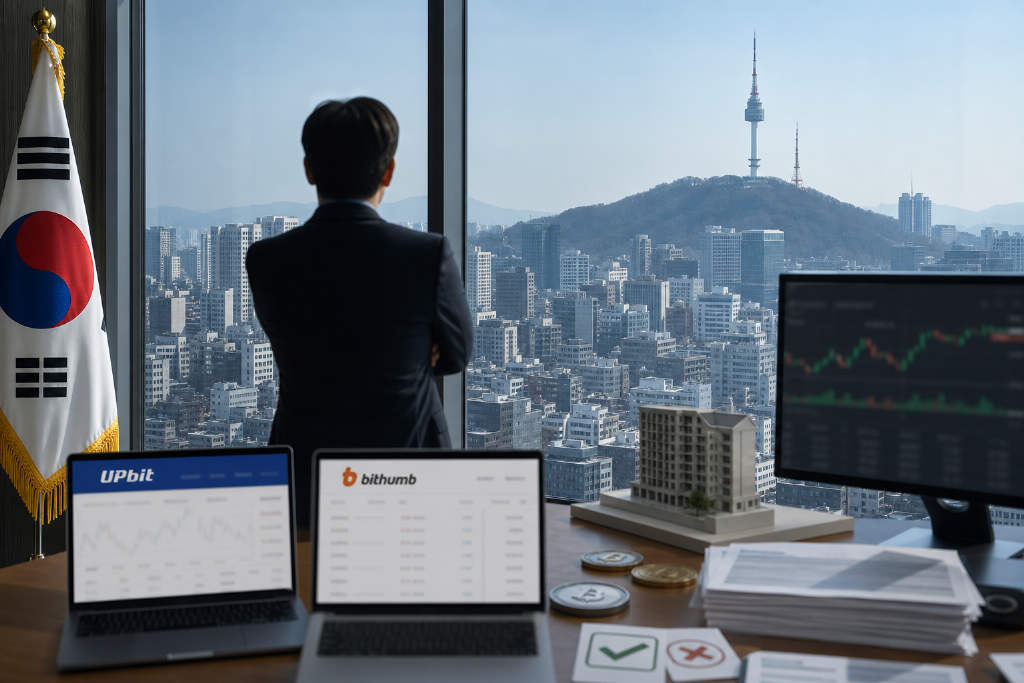
A Four Pillars commentary says South Korea’s crypto market may be past its peak years, but it still matters for global protocols because retail liquidity in the country can return quickly.
According to the article, trading volumes at exchanges such as Upbit and Bithumb dropped sharply during the latest prolonged bear market. Even so, volumes can rebound 2.5x to 3x in a short period once market sentiment improves. The piece presents that as evidence that Korean retail liquidity comes back fast.
The article draws a distinction between trading activity and industry development. It says South Korea’s crypto ecosystem has become less attractive than it was in the past. During the 2021 bull market, Korea had a visible place in the global crypto sector, backed by a solid investor base and active communities across public blockchains, DeFi, blockchain gaming, NFTs, infrastructure and wallets. After the 2022 collapse of Terra, that changed.
Global on-chain growth has split into two poles
While Korea’s domestic blockchain industry has slowed, the global market has moved in a different direction. The commentary says Bitcoin’s 2025 peak was nearly double its 2021 high, but the native on-chain products that surged in 2021 and 2022 did not keep pace.
It argues that the total market has grown, but the gains have been unevenly distributed. Using year-over-year comparisons, the article says DeFi total value locked fell sharply, while spot trading volume on decentralized and centralized exchanges, liquid staking token deposits, NFT turnover and the number of crypto funding deals also moved lower. In the author’s view, the native on-chain products that defined the last bull cycle have performed worse than Bitcoin, which the piece treats as the market’s baseline reference point.
At the same time, a small number of sectors have continued to expand. The article groups them into two categories: speculative demand, represented by perpetual futures and prediction markets, and crypto linked to the real economy, represented by stablecoins and RWAs. In that framing, blockchain industry growth has taken on a barbell shape, with speculation on one end and real-economy integration on the other.
Korea lacks a workable legal path in the four fastest-growing sectors
The commentary says perpetual futures, prediction markets, stablecoins and RWAs are the four strongest growth areas in the current global blockchain cycle. It then argues that none of those sectors has a proper legal route to operate domestically in South Korea.
Perpetual futures
The article says South Korea has no law that explicitly bans perpetual futures. Still, the Financial Services Commission is described as highly conservative toward crypto-asset-related credit provision, and under the current legal framework there is no formal basis for running crypto derivatives businesses in the domestic market.
Prediction markets
Prediction markets are generally treated as illegal gambling in South Korea, according to the piece. It also says the Korea Communications Standards Commission recently blocked domestic access to Polymarket.
Stablecoins
The proposed Digital Asset Basic Act, which is expected to cover stablecoin regulation, has been delayed repeatedly, the article says. For now, there is still no legal basis for companies to issue and circulate stablecoins.
RWA
On RWAs, the article says South Korea has an STO framework, but it is closely tied to “fractionalized investment products” and does not match what global markets usually mean by RWAs. It adds that Korea does not yet have a dedicated RWA regulatory framework. Regulators recently said tokens issued overseas and backed by Korean securities, if sold only to overseas investors, would be less likely to be seen as violating the Electronic Securities Act. Even so, the restrictions on Korean institutional investors entering RWA products remain clear, the article says.
Innovation is moving overseas while Korea waits
The commentary gives several examples from outside Korea. It describes perpetual futures as a trading innovation that emerged from the crypto market itself. Singapore Exchange has already launched Bitcoin and Ether perpetual futures, and the U.S. Commodity Futures Trading Commission has approved KalshiEX’s Bitcoin perpetual futures, according to the article.
Prediction markets are presented as another form of innovation, one that can turn almost any event into a tradable interface. The article says they have also started to show potential as hedging venues and even as a basis for next-generation insurance products.
Stablecoins and RWAs are placed in a different category. The author argues that both have moved beyond crypto market sentiment and found product-market fit on their own, becoming part of the core infrastructure for the next generation of finance.
Against that backdrop, the piece says these innovations have barely happened in Korea. That leaves what it calls a paradox: the gap between South Korea and the global market is now bigger than it was in 2021.
Activity remains, but the framework is missing
The article does not say the market is standing still. It notes that financial institutions are preparing stablecoin businesses even though the regulatory framework remains unclear. In RWAs, some participants have chosen to issue products overseas first.
The author argues that South Korea still has one major advantage. If the regulatory environment is put in place, the country could build out the industry faster than most others. The commentary ends with a call for clearer rules on perpetual futures, prediction markets, stablecoins, RWAs and related sectors.