
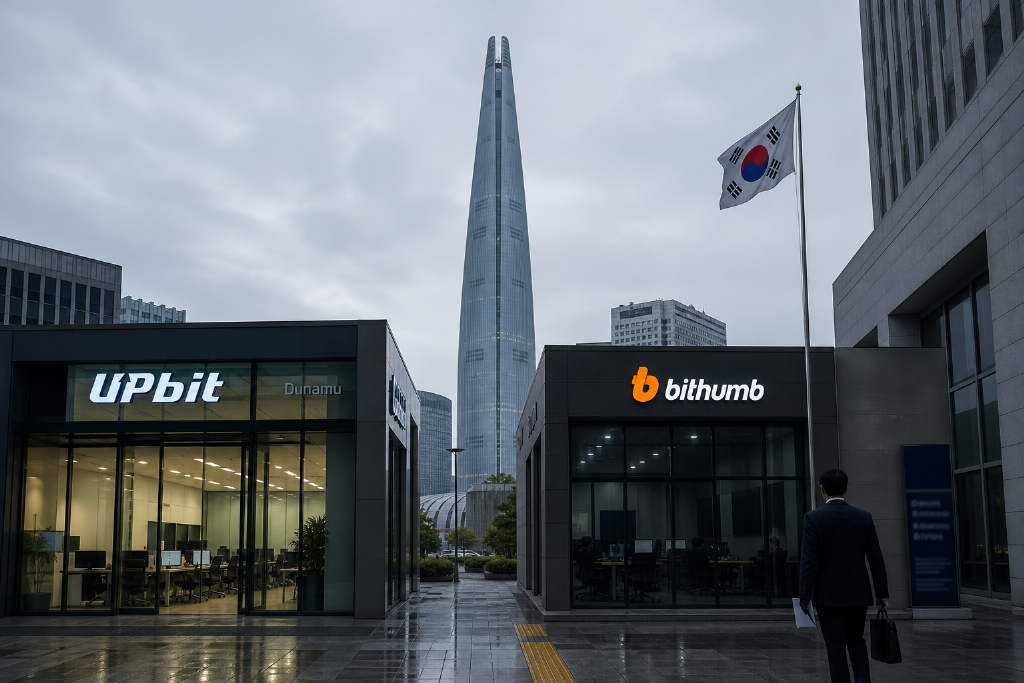
South Korea’s two largest crypto exchange operators reported near-mirror declines in revenue for the first half of 2026, but their bottom lines split sharply.
On Aug. 14, Dunamu, the parent company of Upbit, filed its first-half 2026 report through the electronic disclosure system of South Korea’s Financial Supervisory Service, or FSS. Bithumb’s half-year report surfaced the same day. Put side by side, the filings showed the same retreat in trading-driven revenue and two very different profit outcomes.
Revenue at both firms fell by about half
Dunamu reported consolidated operating revenue of 408.1 billion won for the first half, down 49.1% from a year earlier. Operating profit came in at 111.5 billion won, down 79.7%, and net profit fell 74.1% to 108.4 billion won.
Bithumb posted operating revenue of 168.8 billion won, down 48.7% year over year. Operating profit dropped 83.4% to 14.9 billion won. The company recorded a net loss of 108.7 billion won, compared with a net profit of 55 billion won in the same period last year.
The revenue declines were almost identical, both hovering around 49%. Profitability was not. Dunamu remained in the black even after a steep earnings drop, while Bithumb swung to a loss that exceeded Dunamu’s net profit for the period.
Trading slowdown hit fee income across the market
The immediate driver was a broad fall in domestic crypto trading activity.
Combined second-quarter volume across South Korea’s five licensed KRW exchanges — Upbit, Bithumb, Coinone, Korbit and Gopax — fell 49.5% year over year to about $146.4 billion. With market turnover cut roughly in half, fee income moved in the same direction.
Dunamu’s filing showed that platform revenue from Upbit accounted for about 395.5 billion won in the first half, or 97% of total revenue. At Bithumb, the share was even more concentrated, with nearly 100% of revenue coming from trading fees.
That concentration left both companies highly exposed to volume cycles. When trading activity weakened, there was little elsewhere in the income statement to offset the drop.
Why Dunamu stayed profitable and Bithumb did not
The report tied the profit gap to differences in cost control and expense structure.
Dunamu was described as having managed costs more effectively, allowing it to preserve profitability despite a much smaller revenue base.
Bithumb’s loss included digital asset impairment and administrative spending tied to regulatory penalties. Its operating margin was below 9%.
The details were especially stark in Bithumb’s quarterly progression. In the first quarter, operating profit was just 2.8 billion won and net loss reached 86.9 billion won, with a large share of that tied to digital asset impairment and compliance remediation costs. The second quarter showed some recovery at the operating level, but the company still ended the first half with a net loss.
Dunamu’s own margin compression was also severe. At its 2021 peak, the company kept 88 won in operating profit for every 100 won of revenue. By the second quarter of 2026, that figure had fallen to 14 won. In other words, operating margin dropped from 88% to 14% over five years under the same core business model.
Retail money rotated toward AI and semiconductor stocks
The article linked the drop in crypto trading to a broader shift in where Korean retail investors were putting money.
In the first half of 2026, retail capital in South Korea moved noticeably from crypto into AI and semiconductor names. Samsung Electronics and SK Hynix became favored trades on expectations for AI memory chip demand, while retail turnover in the country’s tech-heavy equity segment rose over the same period.
In that framing, the two markets compete for the same pool of discretionary money rather than complement each other. A retail investor’s spare capital goes either into tokens or into stocks, then rotates back when sentiment changes.
There was also a tax overhang. South Korea is set to begin imposing a 22% capital gains tax on crypto assets in January 2027. The article said that expectation may already be weighing on trading appetite. If roughly one-fifth of gains is set to be taxed away, trading frequency and leverage use would naturally contract.
Both companies are still pursuing IPO plans
Even with revenue down sharply, Dunamu and Bithumb are both moving ahead with listing plans.
For Dunamu, the article said that in May 2026, Samsung Group affiliates, Hana Bank and Hanwha Investment & Securities bought close to one-fifth of the company for about 1.5 trillion won, or roughly $1.07 billion.
At the same time, Dunamu has been pushing a share-swap partnership with Naver Financial as part of preparations for a future initial public offering on the Korea Exchange, or KRX. Naver was described as South Korea’s largest internet company, and the deal was presented as a key step in Dunamu’s attempt to shift from a crypto trading platform toward a broader fintech company.
Bithumb, for its part, has laid out a three-stage IPO roadmap with a target listing in 2028. The current phase is focused on internal-control remediation and compliance preparation under KIFRS, the Korean International Financial Reporting Standards.
Still, with a first-half net loss of 108.7 billion won and an operating margin below 9%, Bithumb faces clear pressure on any public-market valuation discussion.
A fee-heavy business model is back under scrutiny
The half-year results also reopened a deeper question about what kind of business a crypto exchange really is.
When 97% to nearly 100% of revenue comes from transaction fees, and those fees rise and fall almost in lockstep with market turnover, the financial profile starts to look less like stable infrastructure and more like a highly cyclical brokerage business.
The article drew a parallel with Coinbase, saying its valuation logic in the U.S. market has faced the same test. During the 2024 crypto bull market, Coinbase increased the share of subscription and services revenue, and the market at one point viewed that as progress toward a platform-infrastructure model. But when volumes fell back, fee revenue still remained the biggest variable in quarterly profit direction.
Dunamu’s answer, as presented in the article, is its work with Naver. If it can combine Naver’s user traffic and payment scenarios with Upbit’s trading infrastructure, the share of total revenue coming from trading fees could decline, giving the company a profile closer to a technology firm than a brokerage.
Bithumb’s answer is less defined. The article mentioned its Southeast Asia expansion, including cooperation with SSID to develop a compliant platform in Vietnam, as one possible direction, though scale effects in overseas markets have yet to show up.
For both Dunamu and Bithumb, the central question now is not only when trading volume returns. It is whether they can convince public-market investors that the next time volume is cut in half, profit will not evaporate again.