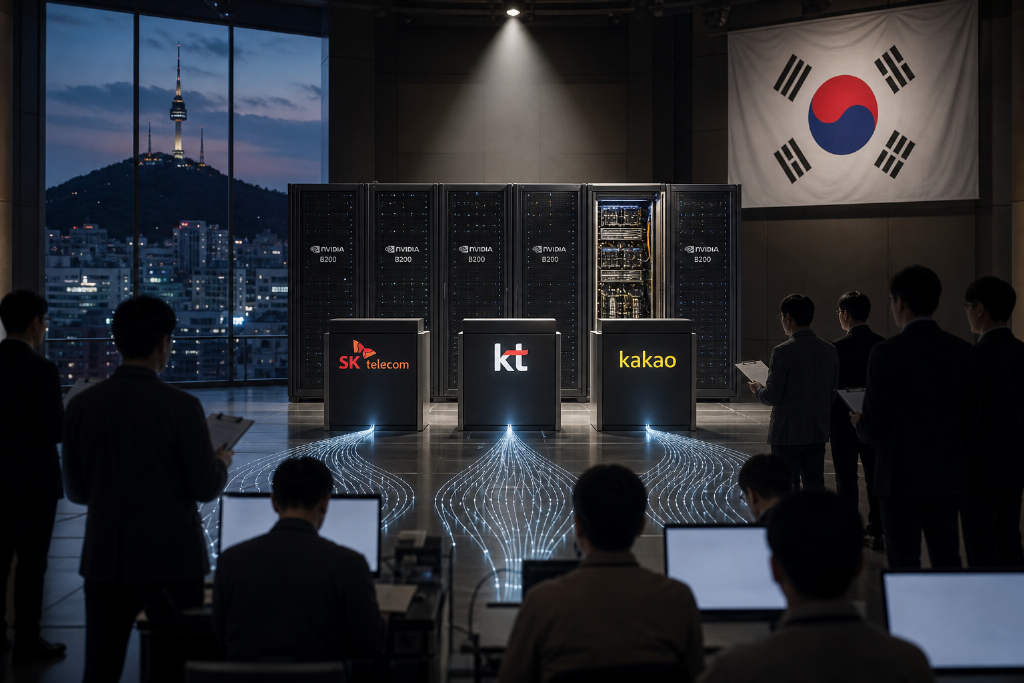
South Korea to test free nationwide AI service in September, backed by 512 Nvidia B200 GPUs

South Korea to test free nationwide AI service in September, backed by 512 Nvidia B200 GPUs

N
News Editor
2026-08-31 05:50:19
South Korea is preparing to begin testing a free nationwide AI service in September, with a full launch scheduled by year-end. Three consortiums led by SK Telecom, KT, and Kakao were selected for the program. According to the plan, South Korean residents will be able to use the service at no charge, with no token cap. The government will initially provide the three groups with a combined 512 Nvidia B200 GPUs this year. Based on an estimate of four queries per user per day and 500 tokens per response, that capacity could theoretically support about 18.4 million daily active users. Seoul also set model allocation rules: at least half of the AI services must be powered by South Korean domestic foundation models, while at least 30% must go to models from other Korean companies. One notable inclusion is Motif 3. The model was previously excluded from South Korea’s domestic foundation model “national team” review on Aug. 18, despite scoring 47 points on the Artificial Analysis Intelligence Index, the highest among participating Korean models. Ten days later, it was added to the model pools of both SK Telecom and KT under the nationwide AI project. The selection process appears to have prioritized distribution reach and user acquisition over benchmark scores, with those factors worth 50 points, compared with 30 points combined for model quality, stability, and safety.

South Korea is preparing to start testing a free nationwide AI service in September, with a formal launch set for the end of the year. Three consortiums led by SK Telecom, KT, and Kakao were selected.

Under the plan, South Korean residents will be able to use the service for free, with no token limit. The government will first allocate a combined 512 Nvidia B200 GPUs to the three groups this year. Based on an estimate of four prompts per user per day and 500 tokens per response, that capacity could theoretically handle about 18.4 million daily active users.

Domestic model quotas are built into the plan

The government also requires that at least half of the AI services be provided by South Korean domestic foundation models. Another at least 30% must be allocated to models from other Korean companies.

Motif 3 enters two model pools after missing the “national team” cut

Motif 3, which had previously been eliminated in South Korea’s “national team” selection, was included this time in the model pools of both SK Telecom and KT.

Motif 3 scored 47 points on the Artificial Analysis Intelligence Index, the highest score among the Korean models in the competition, but it was excluded in the Aug. 18 review for the country’s domestic foundation model “national team.” Ten days later, in the nationwide AI project, both SK Telecom and KT placed it in their model pools. That means missing the national team did not prevent the model from still reaching users across the country.

Selection put more weight on reach and user acquisition

South Korea currently has about 23 million generative AI users, but most of them are still using overseas products such as ChatGPT, Gemini, and Claude.

In this round of evaluation, benchmark performance was not the top priority. Service reach and user acquisition accounted for 50 points, while model quality, stability, and safety together accounted for only 30 points. The final winners were SK Telecom, KT, and Kakao, all of which control access points through telecom networks, portals, or super apps. Model companies were positioned more as suppliers behind the scenes.

This article was originally published by Bit.Fan. For more cryptocurrency news and market insights, visit www.bit.fan.
1800

Disclaimer:

The market information, project data, and third-party content displayed on this platform are for industry information sharing only and do not constitute any form of investment advice or return commitment.

Cryptocurrency trading carries high risks. Users should fully assess their risk tolerance and make independent decisions. All profits, losses, and legal responsibilities are borne by the users themselves.