
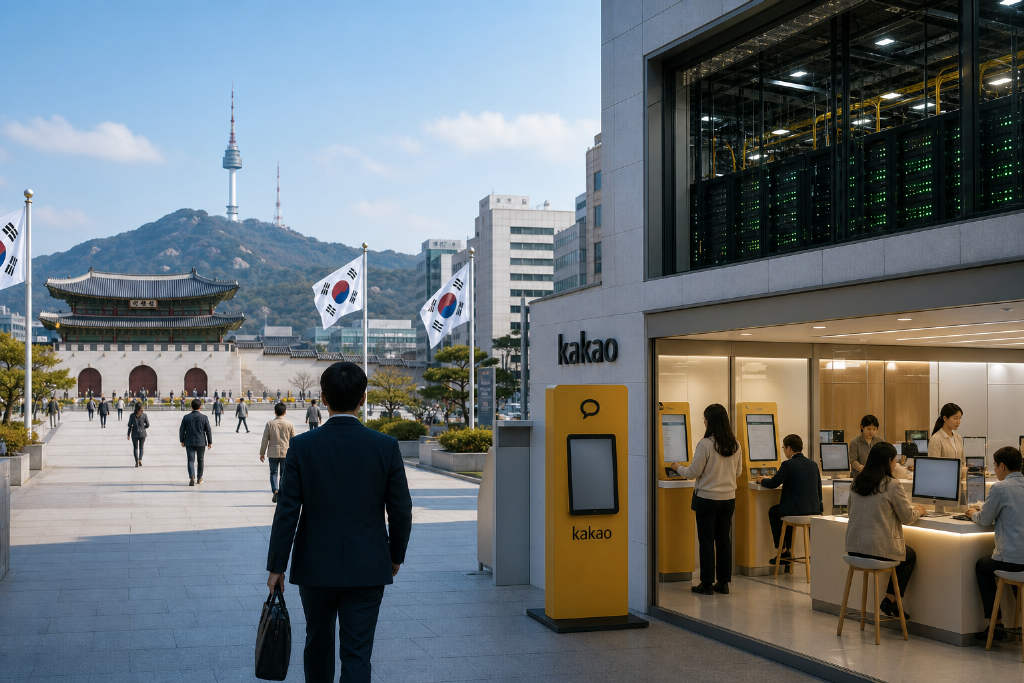
South Korea intends to give every citizen free access to generative AI, a move the Wall Street Journal described as the first attempt by a national government to treat model access as something close to a public service.
AI tools will be tied into government services
The tools are set to be integrated into government systems. The Wall Street Journal said possible uses include booking doctor appointments, getting help finding an apartment, and asking for tax advice. Small businesses would be able to work through their taxes and check whether they qualify for state support programs, while parents would receive suggested educational materials for their children.
Three consortia selected, with no token caps
Seoul named three technology consortia on Friday to deliver the services. The groups include South Korea’s two largest telecom operators and the company behind Kakao, whose messaging platform functions as a broad everyday app in the country. Each consortium will launch a dedicated app and also add AI features to products people already use. Usage will be uncapped, with no token limits.
Up to 512 Nvidia B200 chips allocated, beta in September
The government will divide as many as 512 of Nvidia’s high-end B200 chips among the three groups and will contribute to operating costs. The Ministry of Science and ICT has not disclosed the total cost of the program. Beta testing is due to start in September, followed by a full rollout later this year.
Reducing reliance on U.S. and Chinese models
One aim of the program is to steer South Korean citizens away from depending on systems built in the United States or China. The report noted that other governments are pursuing similar goals from a different direction.
The European Commission launched InvestAI in February 2025 to mobilize $232 billion (€200 billion) across the bloc, including $23 billion (€20 billion) for large compute sites intended to reduce European dependence on non-EU providers. India approved its IndiaAI Mission in March 2024 with about $1.25 billion, then made tens of thousands of subsidized GPUs available to startups and researchers while funding 20 domestic model projects. The report drew a distinction between those efforts and Seoul’s plan: Europe and India are building capacity, while South Korea is preparing to hand finished AI products directly to citizens.
Most Korean users still rely on foreign free tiers
About two-thirds of South Koreans have tried AI, and roughly 23 million people use generative tools regularly. Most of them are still using free tiers from foreign providers. Figures cited in ministry tender documents show that ChatGPT had 23.45 million users in South Korea in April, compared with 8.45 million for Gemini and 2.41 million for Claude. Only about 1.8 million people in the country pay for any AI service.
Rules require 80% of queries to go through Korean models
The operating rules are written to shift that balance. Service providers must route at least half of all queries through their own certified Korean foundation model, and another 30% through models built by other Korean firms. That sets a domestic minimum of 80%. Foreign models are allowed only where the Ministry of Science and ICT considers them necessary, and that usage will not be subsidized. The government has not set a target for adoption.
AI spending for 2026 set at about $7.2 billion
President Lee Jae Myung’s administration has earmarked about $7.2 billion, or 10 trillion won, for AI spending in 2026. The amount is three times what it committed the previous year.