
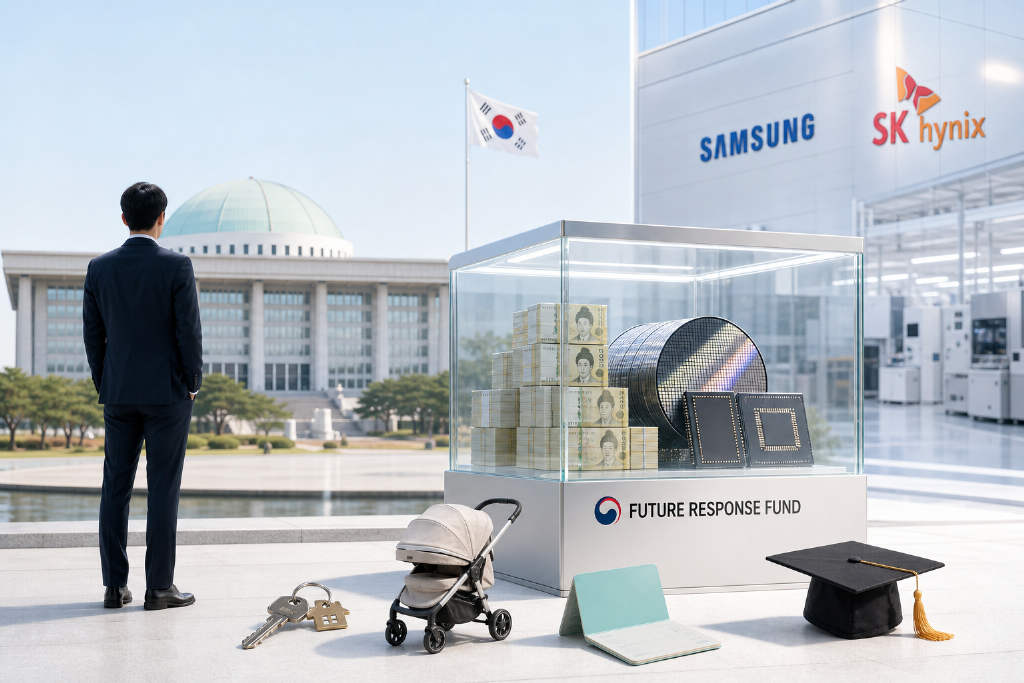
South Korea’s Ministry of Economy and Finance said it will set up a "Future Response Fund," with local media estimating the vehicle could reach 100 trillion won, or roughly $72 billion. The fund is intended to support youth employment, home purchases and childbirth, while also investing in future industries including AI.
The plan comes as tax revenue has been lifted by profits tied to the AI chip boom. In simple terms, the report frames the policy as an effort to redirect part of the money generated by AI-led corporate earnings toward young people facing job pressure and South Korea’s low birthrate problem.
Fund would be financed by excess tax revenue
In a statement, the Ministry of Economy and Finance said the Future Response Fund would be financed mainly by tax income that exceeds a benchmark tied to the average growth rate of domestic tax revenue over the past 10 years.
That means when annual tax revenue grows faster than the 10-year average, the surplus would be saved in the fund. When revenue growth slows or turns negative, the money could then be used as a buffer.
Two main spending lines: people and industry
The ministry drew two broad lines for how the money would be used.
- For individuals, the fund would support a young person’s first job, first home and first savings, extending to marriage and childbirth.
- For industry, the money would go to AI, talent development and regional balanced growth.
President Lee Jae-myung laid out three fiscal principles at a national fiscal strategy meeting in July: creating the Future Response Fund, advancing three "super projects," and delivering inclusive growth. The fund is focused on four areas: future industries, youth, regional development and education.
The three super projects are semiconductors, AI data centers and physical AI. The report says these projects are seen as a core direction for fiscal spending under Lee’s administration, while the fund is meant in part to preserve flexibility for long-term investment if the economic cycle turns.
Budget and tax revenue are both expected to hit records
South Korea’s 2027 budget is expected to exceed 800 trillion won, while national tax revenue is forecast at no less than 500 trillion won. Both would be record highs. The report attributes that rise to AI-driven semiconductor earnings and the resulting increase in corporate tax payments.
No final official size yet, but local estimates point to 100 trillion won
Officials have not given a final figure for the fund. South Korean media estimated a starting scale of around 100 trillion won, or $72 billion, based on the government’s revenue outlook for next year and other expected funding channels.
Even so, the size looks less striking when compared with profits and shareholder return plans in the country’s chip sector.
Samsung and SK Hynix posted 150 trillion won in combined operating profit
According to Bloomberg, Samsung Electronics and SK Hynix posted a combined 150 trillion won in operating profit in the second quarter of 2026, equivalent to about $104 billion. The report said that profit was driven almost entirely by AI demand for high-end memory.
SK Hynix alone posted 60.54 trillion won in quarterly operating profit, or about $41.2 billion, setting a company record.
SK Hynix announced a buyback, while Samsung is said to be preparing a massive payout plan
On Aug. 19, SK Hynix announced a treasury share buyback worth 40 trillion won, or about $28.7 billion, to run from Aug. 20 through Nov. 19. It also raised its fixed dividend to 1,500 won per share from 1,200 won per share.
Bloomberg also reported that Samsung Electronics is preparing a shareholder return program worth 110 trillion won, or about $79 billion. If announced, it could become the largest such program ever by a listed South Korean company.
Placed side by side, the figures highlight a contrast noted in the report: the South Korean government’s proposed fund built from surplus tax revenue would still be smaller than Samsung’s reported standalone shareholder return plan.