
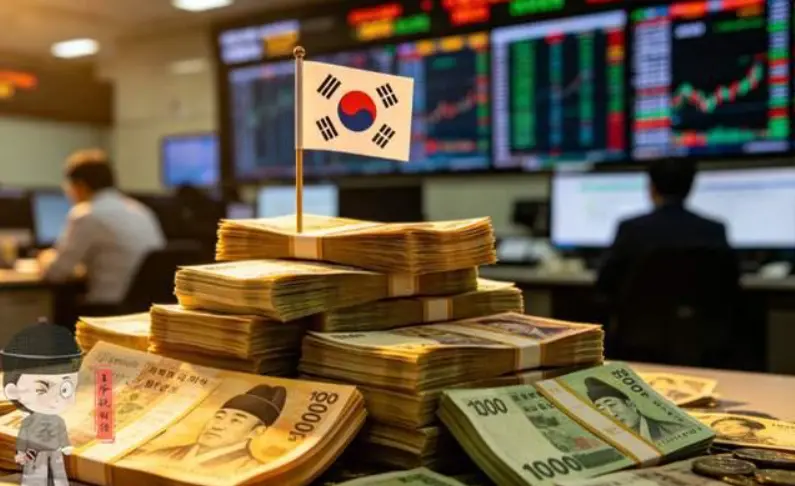
South Korea’s equity selloff, described in the article as a key flashpoint in the global AI trade, may be moving into its later stages as the market works through a broad deleveraging cycle rather than a fundamental break in the AI theme.
The piece, written by Ge Jila with data support from Gugu Big Data, says the KOSPI has posted a maximum drawdown of 32% since its June 19 high of 9,385.6. It argues that the decline in Korean equities became an important trigger for the wider pullback in global technology shares.
In the article’s reading, the first leg of the decline came from shifts in earnings expectations and a temporary rotation of capital. What turned that move into a sharper selloff was the market’s concentrated leverage structure.
It says Korean market fundamentals have not undergone a fundamental change. Instead, the forced unwinding tied to leverage appears to be nearing its end.
Leveraged ETF unwind is estimated at about 75%
The article identifies leveraged exchange-traded funds as the core catalyst behind the turbulence.
During the earlier rally, leveraged ETF assets reportedly climbed to nearly $50 billion. According to the piece, that represented a share of South Korea’s equity market capitalization roughly four times the comparable level in the US, magnifying internal volatility across the market.
That structure changed the way prices moved. Rather than fundamentals alone setting direction, positioning began to dominate. The article says this level of volatility kept long-only capital that is sensitive to sharp swings from stepping in, while also making risk management harder for asset managers and brokerages.
As the global AI hardware segment weakened in June and July, the daily rebalancing mechanism built into leveraged ETFs intensified the move. Those products add exposure when prices rise and cut exposure when prices fall. The article says that once major stocks started to retreat, the market was exposed to a negative loop of falling prices, margin calls, forced liquidations, and still lower prices.
It notes that in late June, several leveraged ETFs fell more than 25% in a single day, helping trigger circuit breakers. The VKOSPI volatility gauge at one point rose to five times the level of the US VIX, while market liquidity came close to drying up on a temporary basis.
Institutional estimates cited in the article put leveraged ETF assets at about $26 billion now, down from roughly $50 billion at the peak. That is a contraction of about $24 billion. Using a “reasonable” residual size of about $18 billion as a benchmark, the article concludes that about 75% of the unwind has already taken place, leaving roughly 25% of the adjustment still outstanding.
The regulatory backdrop is also changing. The article says that from Aug. 5, all new single-stock leveraged ETF launches will be suspended and the minimum cash threshold for trading will rise from 10 million won to 30 million won. From Aug. 19, only cash will be accepted as initial margin. From November, the minimum trading unit for single-stock leveraged ETFs will rise from one lot to 20 lots.
Its conclusion is that these steps are closing off fresh channels for highly leveraged inflows and should continue shrinking the leveraged ETF segment, reducing the structural mechanism that had been amplifying volatility.
Hedge fund deleveraging has passed 50%
The article names hedge fund positioning as the second major amplifier in the drawdown.
Since April, global equity and macro hedge funds had materially increased exposure to South Korea, using total return swaps provided by brokerages to scale up stock exposure. On the way up, that structure added elasticity to the market. On the way down, it intensified deleveraging pressure.
As the index pulled back and memory-chip stocks temporarily lagged the broader market, the squeeze in swap capacity has eased, according to the piece. Institutional calculations cited there show the long-short positioning ratio has fallen from a peak of about 5.5x to below 4x.
The article then compares current conditions with more extreme levels, when the long-short ratio was around 7x and the corresponding net long position was about 6x. Against that backdrop, the current net long level of around 3x suggests leverage has dropped by more than 50%.
It also says that as lower share prices reduced MSCI index weightings, the forced selling pressure from passive index money has largely been released. That, in turn, has eased the risk of liquidity stress on the institutional side.
The article’s judgment is that the most violent phase of hedge-fund-driven forced deleveraging has already passed.
Retail margin is not seen as the main systemic risk
By contrast, retail financing is presented as a much smaller source of systemic danger than leveraged ETFs or hedge funds.
The article says retail margin balances in South Korea have fallen from more than $25 billion to about $21 billion. That amounts to roughly 0.5% of the country’s total equity market capitalization. It compares that with about 1.9% in the US and about 2.8% in China’s A-share market.
There is also a structural difference. Retail financing is described as more concentrated in the KOSDAQ market, where small- and mid-cap stocks have a larger presence, limiting the direct hit to the KOSPI’s core heavyweights.
Just as important, standard margin accounts do not have the same mechanical rebalancing feature as leveraged ETFs. In a falling market, investors are not forced into the same kind of rapid, passive position cutting, making a chain reaction less likely.
The article adds that Korean households still hold cash, overseas assets, and gains accumulated from earlier stock investments, which provide a buffer. On that basis, it argues that retail financing is unlikely to become the central driver of systemic stress and does not provide a realistic foundation for a large-scale cascade of forced liquidations.
The market is shifting from liquidity-driven selling to fundamental pricing
Bringing those strands together, the article summarizes the current state of deleveraging in South Korea as follows: leveraged ETF unwinds are about 75% complete, hedge fund deleveraging has exceeded 50%, risks tied to retail margin remain manageable, and the passive selling pressure linked to foreign capital has largely been absorbed.
Compared with the early stage of the selloff, the most dangerous part of the high-leverage structure — the part most likely to produce chain selling — has already been cleared out to a large extent. The article says the market is moving away from a liquidity-driven decline and toward pricing led by fundamentals.
Under that framework, as long as fundamentals do not reverse in a sustained way, the correction is presented as a concentrated cleanup of a crowded trade rather than the end of the AI rally.
Author’s closing view on the AI trade
In its closing section, the article turns from market structure to a broader view on the AI theme. The author writes that “the AI trend is irreversible” and that “silicon is irreversible.”
He argues that most technological revolutions follow a similar path: a compelling narrative forms, capital rushes in, crowding and leverage bring violent volatility, and then the washout rebuilds positioning. In that framing, a price decline looks like a setback on the surface but functions as a structural reset underneath.
The piece says South Korea became the center of the storm not because it was the weakest market, but because it sits in one of the most critical points in the AI supply chain: memory chips. Capital tends to crowd into the clearest part of a theme first, and that concentration becomes especially unstable once leverage is layered on top.
The author then argues that the central question is not short-term price action but whether the underlying track still exists. If the answer is yes, he writes, volatility is a cost of participation rather than the risk itself.
He also says the larger AI trend has not changed during this correction. Demand for computing power is still growing, large models continue to iterate, and data centers, optical communications, and advanced packaging are all still expanding. Based on that, the article describes AI not as a theme that can be easily disproved but as a productivity revolution already in progress.
The closing paragraphs broaden that idea into a generational argument. The author writes that many people are not short of effort but short of an entry point into the era’s returns. In his view, the opportunity today is no longer mainly about opening factories or trading goods. It is about standing on top of a technological wave and using capital markets to participate in industrial upgrading.
He says chips, large models, compute networks, and optical modules are difficult, high-threshold fields that most ordinary people cannot join directly. Capital markets, however, provide a route to take part. What matters most, the article says, is not whether an investor can identify every winning name with precision, but whether they are positioned in the right direction.
The article ends by arguing that if AI is ultimately wrong, this generation may miss one of its most important opportunities. If it is right, each correction offers a fresh chance to get involved. Markets will not stop for hesitation, the author writes, and the era will not slow down because of uncertainty. The only decision left is whether to get on board.